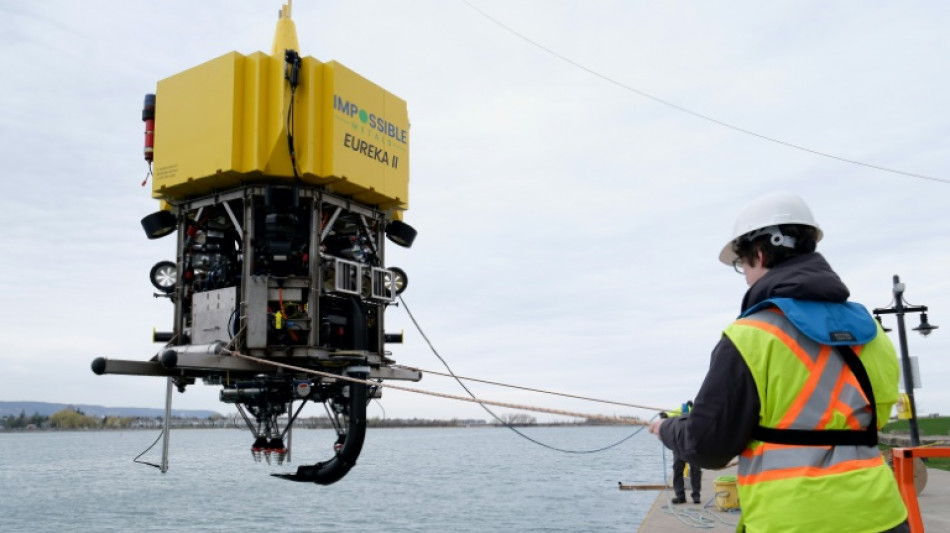
In Canada lake, robot learns to mine without disrupting marine life / Photo: John Wong - AFP

 TROJAN: Special protection for a more perilous political era

 Tanzid makes history as Bangladesh dominate first Australia Test

 Indonesia to close more than 750 state-owned enterprises

 US backs Japan over Putin trip to disputed islands

 'I want to be Eala': Philippine sensation sparks tennis boom at home

 US says lower oil prices, not Iran's nuclear program, are now top priority in war

 Most Asian stocks track Wall St record as US data ease rate fears

 China's viral 'spicy strips' take a bite of global snack market

 Shelton does the double in Canada

 'Shock' gloves for US immigration agents fuel potential abuse fears

 New Zealand Football withdraws support for Infantino, urges review

 Hopes fade in Colombia as window to find quake survivors shuts

 Trump announces tariffs of up to 100% on imported drones

 Spieth among five sharing Memphis lead as PGA playoffs open

 Boats rescue tourists as forest fire flames threaten Greek beaches

 Good vibes powering Djokovic return to Cincinnati

 Britain's Hunt wins 200m for European sprint double

 Draper dumped as Norrie saves face for Britain in Cincinnati

 England opener Gay out for duck in Pakistan warm-up

 Europe swelters under fresh wave of extreme heat

 French Olympic gold medallist Florent Manaudou announces retirement
 Tourists rescued by boat as forest fire threatens Greek beaches
 Indicted Raul Castro reappears after months out of public view

 Italian teen Curtis breaks women's 50m backstroke world record for second time

 Taulagi steps out of 'comfort zone' with code switch to French Top 14 new boys

Three robotic arms extended under the water in a Canadian lake, delicately selecting pebbles from the bed, before storing them back inside the machine.
The exercise was part of a series of tests the robot was undergoing before planned deployment in the ocean, where its operators hope the machine can transform the search for the world's most sought-after metals.
The robot was made by Impossible Metals, a company founded in California in 2020, which says it is trying to develop technology that allows the seabed to be harvested with limited ecological disruption.
Conventional underwater harvesting involves scooping up huge amounts of material in search of potato-sized things called poly-metallic nodules.
These nodules contain nickel, copper, cobalt, or other metals needed for electric vehicle batteries, among other key products.
Impossible Metals' co-founder Jason Gillham told AFP his company's robot looks for the nodules "in a selective way."
The prototype, being tested in the province of Ontario, remains stationary in the water, hovering over the lake bottom.
In a lab, company staff monitor the yellow robot on screens, using what looks like a video game console to direct its movements.
Using lights, cameras and artificial intelligence, the robot tries to identify the sought-after nodules while leaving aquatic life -- such as octopuses' eggs, coral, or sponges -- undisturbed.
- 'A bit like bulldozers' -
In a first for the nascent sector, Impossible Metals has requested a permit from US President Donald Trump to use its robot in American waters around Samoa, in the Pacific.
The company is hoping that its promise of limited ecological disruption will give it added appeal.
Competitors, like The Metals Company, use giant machines that roll along the seabed and suck up the nodules, a highly controversial technique.
Douglas McCauley, a marine biologist at the University of California, Santa Barbara, told AFP this method scoops up ocean floor using collectors or excavators, "a bit like bulldozers," he explained.
Everything is then brought up to ships, where the nodules are separated from waste, which is tossed back into the ocean.
This creates large plumes of sediment and toxins with a multitude of potential impacts, he said.
A less invasive approach, like that advocated by Impossible Metals, would reduce the risk of environmental damage, McCauley explained.
But he noted lighter-touch harvesting is not without risk.
The nodules themselves also harbor living organisms, and removing them even with a selective technique, involves destroying the habitat, he said.
Impossible Metals admits its technology cannot detect microscopic life, but the company claims to have a policy of leaving 60 percent of the nodules untouched.
McCauley is unconvinced, explaining "ecosystems in the deep ocean are especially fragile and sensitive."
"Life down there moves very slowly, so they reproduce very slowly, they grow very slowly."
Duncan Currie of the Deep Sea Conservation Coalition said it was impossible to assess the impact of any deep sea harvesting.
"We don't know enough yet either in terms of the biodiversity and the ecosystem down there," he told AFP.
According to the international scientific initiative Ocean Census, only 250,000 species are known, out of the two million that are estimated to populate the oceans.
- High demand -
Mining is "always going to have some impact," said Impossible Metals chief executive and co-founder Oliver Gunasekara, who has spent most of his career in the semiconductor field.
But, he added, "we need a lot more critical minerals, as we want to electrify everything."
Illustrating the global rush toward underwater mining, Impossible Metals has raised US$15 million from investors to build and test a first series of its Eureka 3 robot in 2026.
The commercial version will be the size of a shipping container and will expand from three to 16 arms, and its battery will grow from 14 to nearly 200 kilowatt-hours.
The robot will be fully autonomous and self-propel, without cables or tethers to the surface, and be equipped with sensors.
While awaiting the US green light, the company hopes to finalize its technology within two to three years, conduct ocean tests, build a fleet, and operate through partnerships elsewhere in the world.
J.V.Jacinto--PC