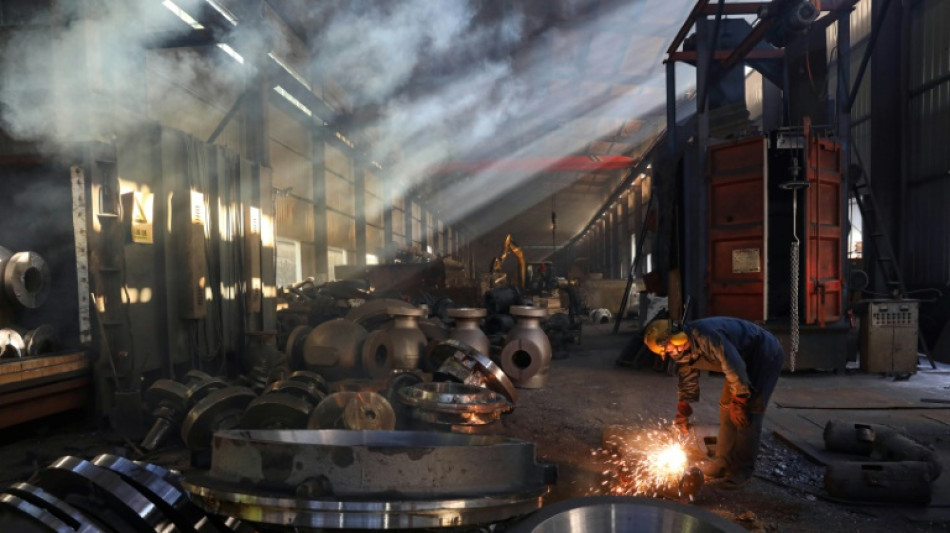
Chinese consumer prices continue to fall as US trade talks loom / Photo: STR - AFP

 Search Underway for 'Dooars Rani' Tigress After Second Escape from Buxa Tiger Reserve

 IIM Indore Announces IPMAT 2027 Exam Date for April 24

 The Dilemma of Recording Live Music: Preserving Memories vs. Being Present

 ANC’s Renewal Rhetoric Fades as Voters Reject Party in 2026 Local Elections

 Foreign Investors Return to Indian Markets After 10-Month Selloff

 Honda CR-V and Toyota RAV4 Lead Canada’s Most Stolen Vehicles List for 2025

 China Extends Tariff Suspension on US Imports to Stabilize Trade Ties
Chinese consumer prices fell for the fourth straight month in May, data showed Monday, as the world's second biggest economy struggles with sluggish spending and global trade turmoil.
Beijing has failed to boost sluggish domestic consumption since the end of the pandemic, threatening official growth targets and complicating its ability to shield its economy from US President Donald Trump's tariff blitz.
Representatives from the two countries are expected to meet on Monday in London for more high-stakes trade talks being closely watched for signs of a lasting deal on reducing levies.
China's consumer price index -- a key measure of inflation -- dropped 0.1 percent year on year in May, according to statistics published Monday by the National Bureau of Statistics (NBS).
The reading was unchanged from April but slightly better than the 0.2 percent fall forecast in a Bloomberg survey of economists.
While deflation suggests the cost of goods is falling, it poses a threat to the broader economy as consumers tend to postpone purchases under such conditions, hoping for further reductions.
A lack of demand can then force companies to cut production, freeze hiring or lay off workers, while potentially also having to discount existing stocks -- dampening profitability even as costs remain the same.
"China continues to face persistent deflationary pressure," Zhiwei Zhang, president and chief economist at Pinpoint Asset Management, wrote in a note, adding that Beijing "needs to rely on domestic demand to fight the deflation".
Zhang said exports continued to perform well and support the economy, while warning that they will "probably slow as the frontloading fades out" -- a reference to overseas buyers increasing shipments ahead of potentially higher tariffs.
Trade figures for last month due later on Monday will also shed light on how the country's exporters are faring.
Deepening a slump that has now lasted more than two years, factory gate prices also dropped in May, the NBS said Monday.
The producer price index declined 3.3 percent, accelerating from a 2.7 percent drop in April, and faster than the 3.2 percent estimated in the Bloomberg survey.
The China-US talks in London will mark the second round of formal negotiations between the world's two largest economies since Trump launched his global trade blitz in April.
The first round of talks was held in mid-May in Geneva and saw them pause sky-high tariffs but fail to reach a sweeping trade deal.
The latest negotiations are expected to include Chinese Vice Premier He Lifeng, US Treasury Secretary Scott Bessent and Commerce Secretary Howard Lutnick.
They were announced after a phone call last week between Trump and Chinese President Xi Jinping, which the US president described as "very good".
F.Cardoso--PC

