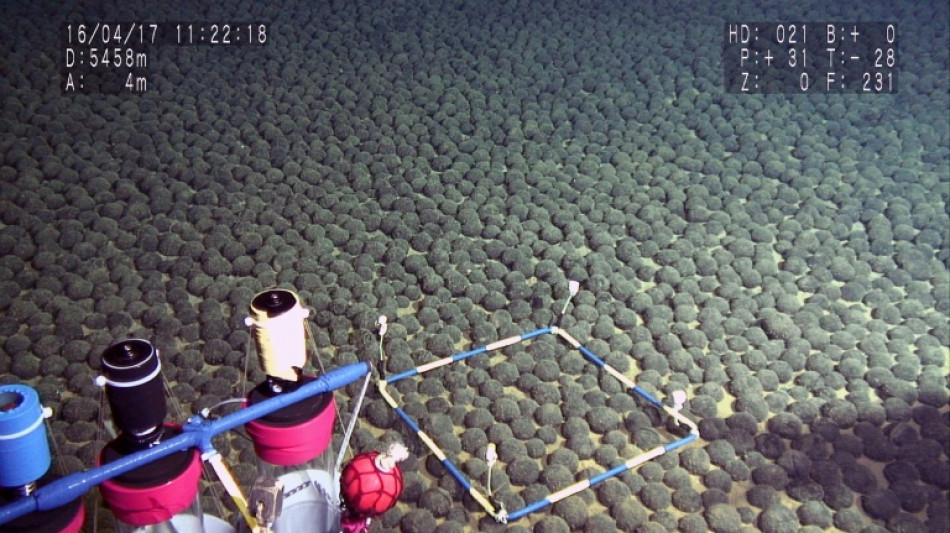
China carefully assembling a deep-sea mining strategy / Photo: HO - JAMSTEC/AFP

 'I want to be Eala': Philippine sensation sparks tennis boom at home
 US says lower oil prices, not Iran's nuclear program, are now top priority in war

 Most Asian stocks track Wall St record as US data ease rate fears

 China's viral 'spicy strips' take a bite of global snack market

 Shelton does the double in Canada

 'Shock' gloves for US immigration agents fuel potential abuse fears

 New Zealand Football withdraws support for Infantino, urges review

 Hopes fade in Colombia as window to find quake survivors shuts
 Trump announces tariffs of up to 100% on imported drones

 Spieth among five sharing Memphis lead as PGA playoffs open

 Boats rescue tourists as forest fire flames threaten Greek beaches

 Good vibes powering Djokovic return to Cincinnati

 Britain's Hunt wins 200m for European sprint double

 Draper dumped as Norrie saves face for Britain in Cincinnati

 England opener Gay out for duck in Pakistan warm-up

 Europe swelters under fresh wave of extreme heat

 French Olympic gold medallist Florent Manaudou announces retirement
 Tourists rescued by boat as forest fire threatens Greek beaches
 Indicted Raul Castro reappears after months out of public view

 Italian teen Curtis breaks women's 50m backstroke world record for second time

 Taulagi steps out of 'comfort zone' with code switch to French Top 14 new boys

 Leicester's Thai owners put troubled club up for sale: reports

 Stocks steady as US inflation worries ease, oil slips

 Porsche to end production of flagship electric car: report

 Twitch sparks gamers' wrath with Amazon AI sharing deal

In a world hungry for crucial resources, China may not be poised to start deep-sea mining but it is planting seeds for such operations in a meticulously planned economic and geopolitical strategy.
The world's oceans, both international waters and those under national jurisdiction, are rich in minerals and metals, like cobalt, nickel and copper.
These are important for building electric car batteries, for instance, and other technologies as countries try to transition away from fossil fuels.
China "is an energy-thirsty country. It will look for resources everywhere," including the deep sea, said Julia Xue of Shanghai Jiao Tong University.
But she said China is not particularly anxious over the issue, although recent developments -- one company is itching to be the first to start mining the sea bed -- may put more pressure on Beijing.
A Canadian firm, The Metals Company, has filed an application with the United States to begin undersea mining in international waters.
Using its American subsidiary, it acted after President Donald Trump, bypassing international negotiations, signed an executive order in April to speed up the permit-issuing process for such mining in US and international waters.
Trump cited an obscure 1980 US law that says American citizens can explore for and recover deep sea minerals in areas beyond the country's jurisdiction.
Environmental groups are outraged by Trump's order, arguing that a wild hunt for the potato-sized, metal-containing nodules could harm fragile undersea ecosystems.
The Canadian company initially said it would submit its request to the International Seabed Authority (ISA), a body which has jurisdiction over the ocean floor in international waters.
The Metals Company says it ignored this authority because of its slow pace in talks on adopting a mining code that establishes rules for exploiting seabed resources. The United States is not an ISA member.
A long-time observer of those talks who spoke on condition of anonymity said China is not particularly worried about who starts mining first.
"For them it's more about dominance, staying competitive in the game, and giving the impression that you can't mess with us," the observer said.
With that goal in mind "they're definitely developing the technology and putting the strategic agreements in place," Alex Gilbert, a researcher at the Payne Institute for Public Policy at Colorado School of Mines, told AFP.
For instance, China has reached an agreement with the Cook Islands to explore for minerals in that Pacific country's waters.
Another tiny Pacific nation, Kiribati, also says it is exploring a deep-sea mining partnership with China.
This approach is "more geopolitical than economic," said Emmanuel Hache of the French Institute for International and Strategic Affairs, noting Beijing is using undersea mining as a lure to cement greater diplomatic support as it exerts power.
China holds five contracts handed out by the ISA to look for resources in the Pacific and Indian Ocean sea beds and these contracts cover all types of undersea mineral resources. China's is the largest number of the 22 contracts the organization has granted.
- Years behind -
"From a research perspective, we have been continuously getting closer. And from a technical perspective, we have been continuously improving," said Chen Xuguang, a researcher at Ocean University of China.
In 2024 a Chinese prototype deep-sea mining vehicle called Pioneer II, developed by Shanghai Jiao Tong University, set a national record by operating at a depth of more than 4,000 meters (13,100 feet).
State-owned Beijing Pioneer Hi-Tech Development Corporation told AFP that later this year it plans a seabed nodule collection test.
Still, China is not as advanced technologically as The Metals Company, experts say.
"I would characterize China as being two to four years behind them in terms of their technology," said Gilbert in Colorado.
Hache, the French expert, put the gap at five years.
But China has an advantage over firms like the Canadian one in recovering and processing nodules: its companies are supported by the state and China has infrastructure for processing metals.
The observer of the international seabed talks said China does not need seabed mining for metal supply, "but maybe geopolitically, in the context of maintaining their control over the commodities market."
China wants to keep its options open, this person said.
And while it supports an international mining code, China does not need one now and "they're not going to put pressure until they've decided strategically that they're ready," said Gilbert.
V.F.Barreira--PC