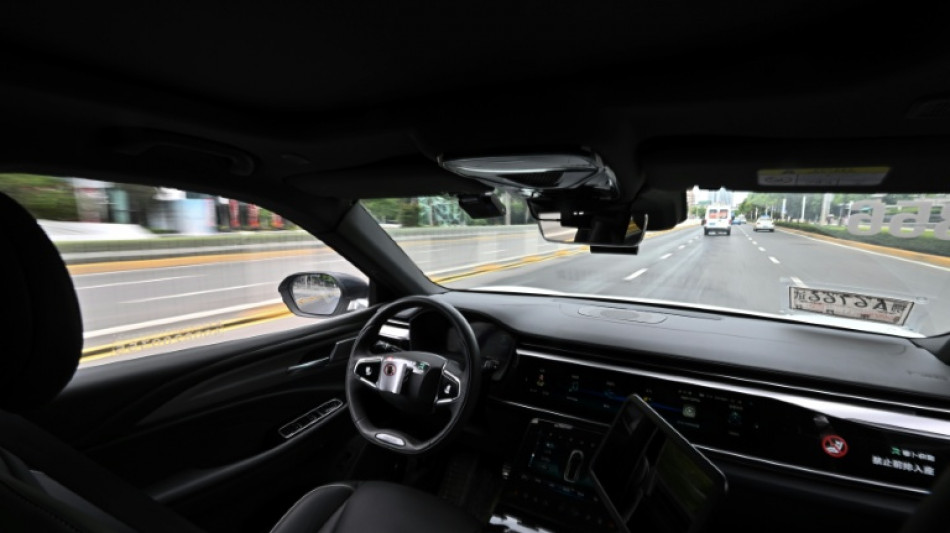
Uber to launch driverless taxis in London next year / Photo: Pedro PARDO - AFP/File

 Search Underway for 'Dooars Rani' Tigress After Second Escape from Buxa Tiger Reserve

 IIM Indore Announces IPMAT 2027 Exam Date for April 24

 The Dilemma of Recording Live Music: Preserving Memories vs. Being Present

 ANC’s Renewal Rhetoric Fades as Voters Reject Party in 2026 Local Elections

 Foreign Investors Return to Indian Markets After 10-Month Selloff

 Honda CR-V and Toyota RAV4 Lead Canada’s Most Stolen Vehicles List for 2025

 China Extends Tariff Suspension on US Imports to Stabilize Trade Ties
Ride-hailing firm Uber will launch self-driving taxis in London next year when England trials new driverless services, the firm and the UK government said on Tuesday.
Under the Uber pilot scheme, services will initially have a human in the driver's seat who can take control of the vehicle in an emergency, but the trials will eventually transition to being fully driverless.
The government announcement will see companies including Uber allowed to trial commercial driverless services without a human presence for the first time in the UK.
They will include taxis and "bus-like" services.
Uber CEO Andrew Macdonald described London's roads as "one of the world's busiest and most complex urban environments".
"Our vision is to make autonomy a safe and reliable option for riders everywhere, and this trial in London brings that future closer to reality," he said.
Members of the public will be able to book the transport via an app from spring 2026, ahead of a potential wider rollout when new legislation -- the Automated Vehicles Act -- becomes law from the second half of 2027, the Department for Transport added.
The technology could create 38,000 jobs, add £42 billion ($57 billion) to the UK economy by 2025, and make roads safer, it said.
"The future of transport is arriving. Self-driving cars could bring jobs, investment, and the opportunity for the UK to be among the world-leaders in new technology," Transport Secretary Heidi Alexander said.
"We can't afford to take a back seat on AI.... That's why we're bringing timelines forward today," added Technology Secretary Peter Kyle.
The wider rollout will also allow the sale and use of self-driving, private cars.
Driverless vehicle trials have been underway in the UK since January 2015, with British companies Wayve and Oxa "spearheading significant breakthroughs in the technology", the ministry said.
"These early pilots will help build public trust and unlock new jobs, services, and markets," said Wayve CEO Alex Kendall.
According to the government the forthcoming legislation will require self-driving vehicles to "achieve a level of safety at least as high as competent and careful human drivers".
"By having faster reaction times than humans, and by being trained on large numbers of driving scenarios, including learning from real-world incidents, self-driving vehicles can help reduce deaths and injuries," it said.
Driverless taxis with limited capacity are already on the roads in the United States and China, most notably in the central Chinese city of Wuhan where a fleet of over 500 can be hailed by app in designated areas.
A.Magalhes--PC

