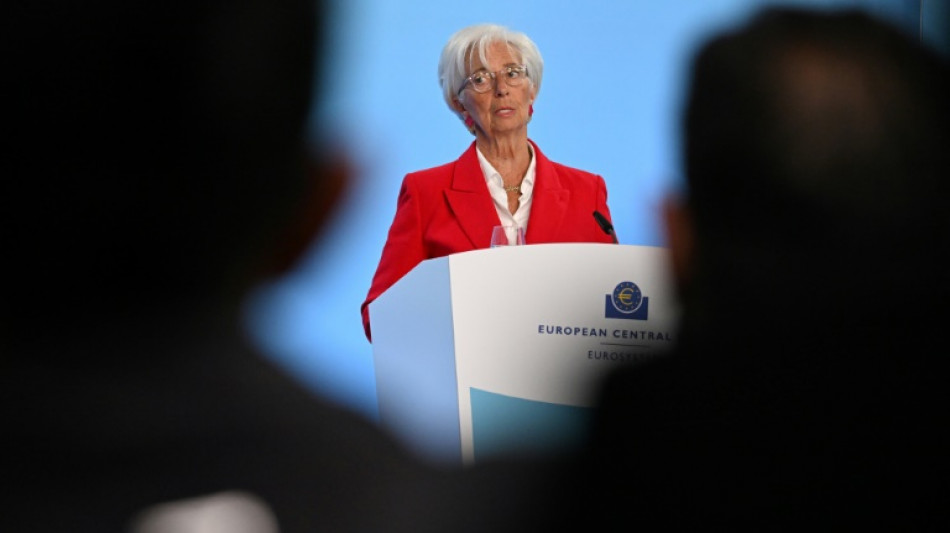
ECB's Lagarde slams 'coercive trade policies' in Beijing visit / Photo: Kirill KUDRYAVTSEV - AFP/File

 Search Underway for 'Dooars Rani' Tigress After Second Escape from Buxa Tiger Reserve

 IIM Indore Announces IPMAT 2027 Exam Date for April 24

 The Dilemma of Recording Live Music: Preserving Memories vs. Being Present

 ANC’s Renewal Rhetoric Fades as Voters Reject Party in 2026 Local Elections

 Foreign Investors Return to Indian Markets After 10-Month Selloff

 Honda CR-V and Toyota RAV4 Lead Canada’s Most Stolen Vehicles List for 2025

 China Extends Tariff Suspension on US Imports to Stabilize Trade Ties
European Central Bank chief Christine Lagarde warned Wednesday that "coercive trade policies" risked harming supply chains and the global economy, and called for a de-escalation of a tariff standoff that has wiped billions off markets.
Lagarde, one of the world's most influential central bankers, is visiting Beijing this week for talks with local counterparts on the Chinese economy and expanding cooperation.
Her visit came as high-level China-US talks in London ended with an agreement to lower tensions after US President Donald Trump launched his tariff blitz in April.
In a speech at the People's Bank of China -- the country's central bank -- she urged all parties to find solutions "even in the face of geopolitical differences".
Lagarde urged countries to protect the "multilateral framework" of international trade, which she said "so greatly benefited our economies".
"Coercive trade policies are far more likely to provoke retaliation and lead to outcomes that are mutually damaging," she added.
"All countries should examine how their structural and fiscal policies can be adjusted to reduce their own role in fuelling trade tensions," she said, calling for an end to "mutually damaging escalation of tensions".
She warned that protectionism risked "eroding the foundations of global prosperity".
Beijing and Brussels' trade policies have been slammed by Trump, who last month threatened to escalate tariffs on the European Union if it did not negotiate a swift deal.
China, meanwhile, has sought to improve shaky relations with the bloc as a counterpoint to Trump.
China and the European Union will host a summit next month marking 50 years since they established diplomatic ties.
The two sides will discuss setting minimum prices for Chinese electric vehicles in Europe and opening a "green channel" for rare earth exports to the 27-nation bloc, according to official statements.
E.Borba--PC

