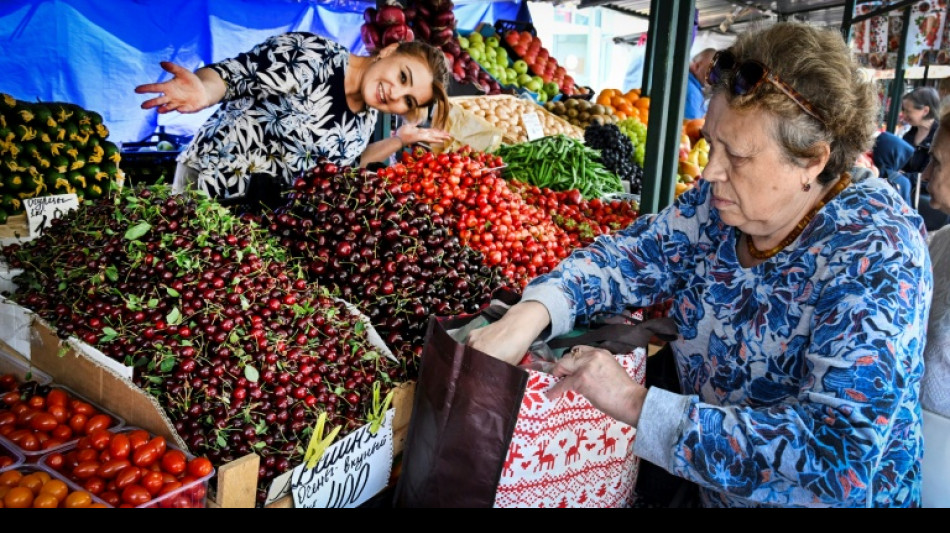
Russians struggle with 'crazy' prices / Photo: Alexander NEMENOV - AFP

 Search Underway for 'Dooars Rani' Tigress After Second Escape from Buxa Tiger Reserve

 IIM Indore Announces IPMAT 2027 Exam Date for April 24

 The Dilemma of Recording Live Music: Preserving Memories vs. Being Present

 ANC’s Renewal Rhetoric Fades as Voters Reject Party in 2026 Local Elections

 Foreign Investors Return to Indian Markets After 10-Month Selloff

 Honda CR-V and Toyota RAV4 Lead Canada’s Most Stolen Vehicles List for 2025

 China Extends Tariff Suspension on US Imports to Stabilize Trade Ties
Russian pensioner Roman Paltievich stared at the prices for apricots, tomatoes and watermelons stacked high on stalls at a Moscow market -- foods that he now struggles to fit into his budget.
"The prices are crazy," lamented the 84-year-old, who said he can no longer afford cherries -- or even potatoes, a staple that is now three times more expensive than a year ago.
Russia's three-year-long military offensive on Ukraine has caused inflation to surge at home, a thorn in the side for the Kremlin, which strives to shield Russians from the fallout of its campaign.
Western sanctions have disrupted supply chains and dozens of consumer brands have left the country, while inflation is now running above 10 percent.
Meanwhile, deep labour shortages caused by massive recruitment by the army and arms manufacturers, have seen both salaries and prices jump higher.
Russia's Central Bank last week cut interest rates from a two-decade high, saying inflation -- including food prices -- was starting to come under control.
But for many hard-pressed Russians, it does not feel that way.
Paltievich's wife, Tatyana, stood next to him clutching a small punnet of strawberries -- a precious treat for her grandchildren that set her back 400 rubles ($5).
"We survived 1991, so now we're not afraid of anything," she said defiantly, in reference to the collapse of the Soviet Union and the economic chaos that followed.
- Filling up the fridge -
Many of those navigating the aisles at Moscow's Preobrazhensky market were also worried about high prices.
"I came here to buy chicken for my granddaughter. It's more expensive in the supermarkets, so I don't buy there anymore," Nikolai Kucherov, a 62-year-old freelance artist told AFP.
"I had to forget about travelling. For the past three or four years, I've only been thinking about filling up the fridge," he said.
The Kremlin has hailed Russia's economic performance since it ordered its troops into Ukraine in February 2022.
A huge surge in spending on the military has helped Moscow defy predictions that sanctions would collapse the Russian economy.
Engineer Konstantin Zelenkov, 38, is one of those who have benefited from rising wages amid the government spending boom.
"Some things are becoming more expensive but salaries are rising too, so it's staying roughly the same," he told AFP.
Central bank chief Elvira Nabiullina has also pointed to rising wages and on Friday said inflation was starting to moderate, though it remains well above the institution's four percent target.
"The high interest rate has led to a significant slowdown in inflation," she told reporters.
Overall "the rate of increase in food prices has slowed", she added.
But even Russian President Vladimir Putin was forced recently to address fears over a potato shortage that sent prices for the staple soaring.
For many across Russia, price rises feel never-ending.
"Starting even with bread, everything is getting more and more expensive," Irina Yakovleva, 68, said.
"We just have to limit ourselves," she added.
X.Brito--PC

