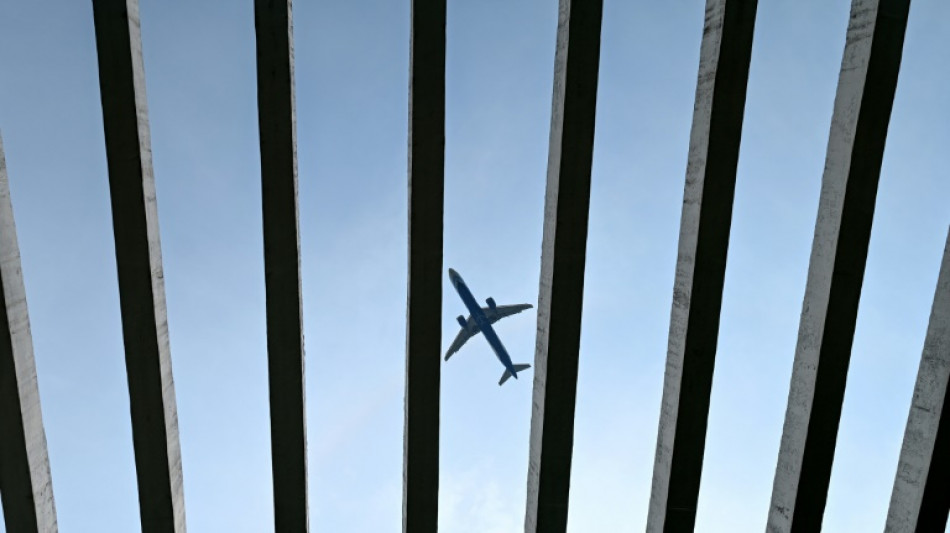
India and its vast booming aviation sector / Photo: R.Satish BABU - AFP

 Search Underway for 'Dooars Rani' Tigress After Second Escape from Buxa Tiger Reserve

 IIM Indore Announces IPMAT 2027 Exam Date for April 24

 The Dilemma of Recording Live Music: Preserving Memories vs. Being Present

 ANC’s Renewal Rhetoric Fades as Voters Reject Party in 2026 Local Elections

 Foreign Investors Return to Indian Markets After 10-Month Selloff

 Honda CR-V and Toyota RAV4 Lead Canada’s Most Stolen Vehicles List for 2025

 China Extends Tariff Suspension on US Imports to Stabilize Trade Ties
Air India's London-bound flight 171 that crashed on Thursday with 242 people on board was a Boeing 787-8 Dreamliner, part of India's bold push to radically expand its air industry sector.
The growth of its economy has made India and its 1.4 billion people the world's fourth-largest air market -- domestic and international -- with IATA projecting it will become the third biggest within the decade.
Indian Prime Minister Narendra Modi, who called the crash "heartbreaking beyond words", has made the development of the air sector a priority since coming to power in 2014.
Modi, who has said he wants to "bring air travel to the common people", began a plan in 2016 to boost air links between small towns and megacities in the world's most populous nation.
"A common man who travels in slippers should also be seen in the aircraft -- this is my dream," Modi was quoted as saying by the aviation ministry at the time.
Air India, the country's former national carrier, was taken over by the Tata Group in 2022.
The sprawling salt-to-software conglomerate has since sought to turn around the airline by ordering new aircraft and upgrading its existing fleet.
The airline currently operates a fleet of over 190 planes, according to latest available data on its website, including 58 Boeing aircraft.
Over the last two years it has placed orders for 570 new aircraft.
In September 2024, Air India kicked off a $400 million refit programme to revamp 67 legacy aircraft in its fleet.
The airline's global network spans 31 countries across five continents, connecting India with destinations in North America, Europe and Asia Pacific.
The airline says it operates about 5,000 flights a week "to and from 49 destinations within India and 43 destinations outside of India".
Domestic air passengers have more than doubled in the past decade, according to government figures, as Indian airlines quickly ramp up their fleets.
This has partly helped the number of airports more than double in the past decade -- from 74 in 2014 to 157 in 2024, according to ministry figures.
The government is pouring in millions of dollars and is promising to increase the number of airports to between 350 and 400 by 2047, the centenary of India's independence.
At the same time, the government has opened programmes to train some 30,000 pilots and at least as many mechanics over the next 20 years.
H.Portela--PC

