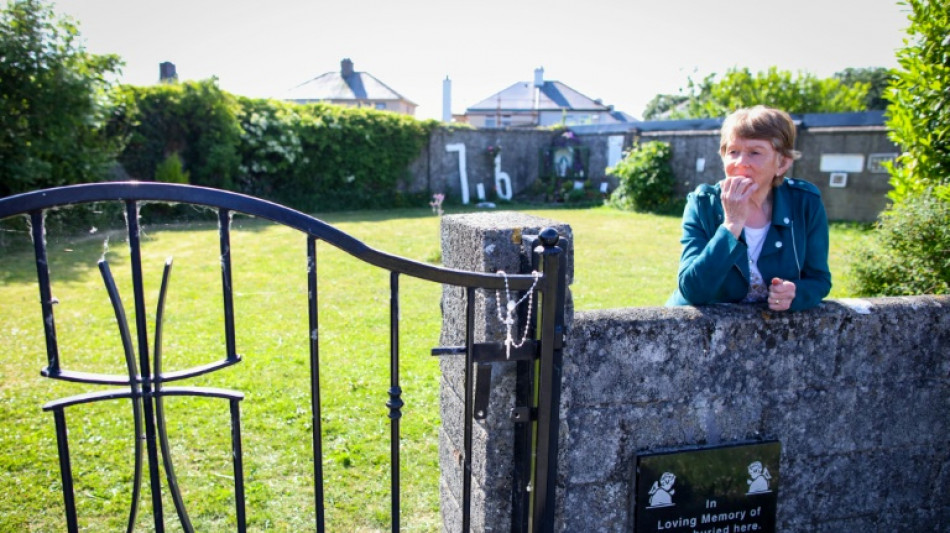
Ireland prepares to excavate 'mass grave' at mother and baby home / Photo: Paul Faith - AFP

 Search Underway for 'Dooars Rani' Tigress After Second Escape from Buxa Tiger Reserve

 IIM Indore Announces IPMAT 2027 Exam Date for April 24

 The Dilemma of Recording Live Music: Preserving Memories vs. Being Present

 ANC’s Renewal Rhetoric Fades as Voters Reject Party in 2026 Local Elections

 Foreign Investors Return to Indian Markets After 10-Month Selloff

 Honda CR-V and Toyota RAV4 Lead Canada’s Most Stolen Vehicles List for 2025

 China Extends Tariff Suspension on US Imports to Stabilize Trade Ties
Over a decade since a historian discovered an unmarked mass burial site for children at a former mother and baby home in western Ireland, workers finally began on Monday to prepare for extensive excavations.
A crew sealed off the site in Tuam, 135 miles (220 kilometres) west of Dublin, in preparation for beginning to dig for any remains next month.
In 2014, local historian Catherine Corless produced evidence that 796 children, from newborns to a nine-year-old, died at Tuam's mother and baby home.
Her research pointed to the children's likely final resting place -- a disused septic tank discovered in 1975.
Significant quantities of baby remains were discovered in an apparently makeshift crypt at the site during test excavations between 2016 and 2017.
The home was run by Catholic nuns between 1925 and 1961, and the site was left largely untouched after the institution was knocked down in 1972.
It was Corless's discovery of the unmarked mass burial site that led to an Irish Commission of Investigation into the so-called mother and baby home.
n findings published in 2021, the commission said there had been "disquieting" levels of infant mortality at the institutions.
"It's been a fierce battle. When I started this nobody wanted to listen. At last we are righting the wrongs," Corless, 71, told AFP last month in Tuam.
"I was just begging 'Take the babies out of this sewage system and give them the decent Christian burial that they were denied'," she said.
- Babies taken from mothers -
Women who became pregnant out of wedlock were siloed in the so-called mother and baby homes by Irish society, the state and the Catholic church, which has historically held an iron grip on Irish social attitudes.
After giving birth at the homes, mothers were then separated from their newborn children, who were often given up for adoption.
The state-backed enquiries sparked by the discoveries in Tuam found that 56,000 unmarried women and 57,000 children passed through 18 such homes over the space of 76 years.
The commission's report concluded that 9,000 children had died in the homes across Ireland.
Often church and state worked in tandem to run the institutions, which still operated in Ireland as recently as 1998.
A team was finally appointed in 2023 to lead the Tuam site excavation.
It is tasked with recovering, memorialising and re-burying any remains recovered at the site.
Sample DNA will be taken from people who have reasonable grounds to believe the remains are those of a close relative.
P.Sousa--PC

