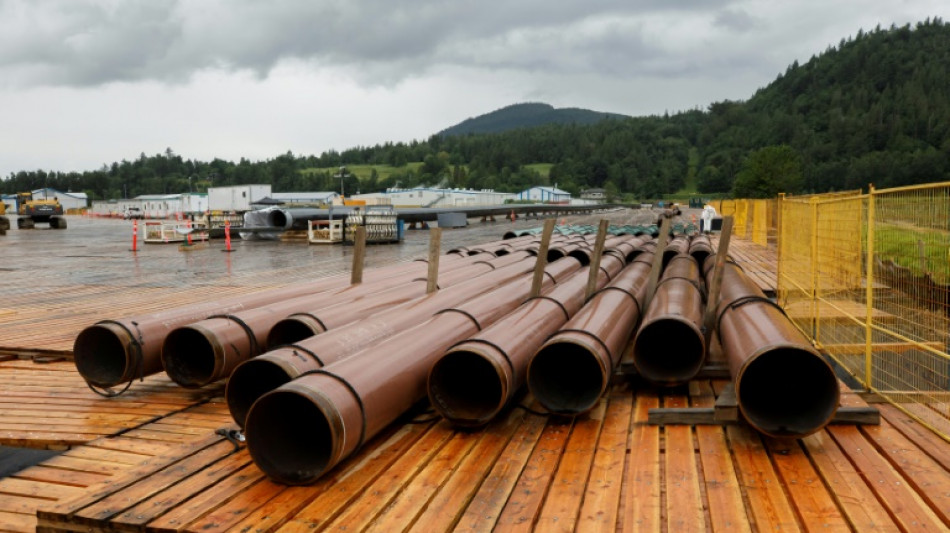
Troubled Canada pipeline no longer profitable: budget watchdog / Photo: Cole Burston - AFP/File

 KUFOS Signs MoU With Old Dominion University to Expand Academic Ties

 Karen Wazen Launches First Standalone Boutiques in Cairo

 Municipal Elections: How Service Failure Becomes a Public Health Crisis in South Africa

 Rene Eyre Revisits Autobiographical Performance 'Say A Little Prayer' in London

 UAE's HCT Holds Record Graduation and Announces Major Training Expansion

 NASA Awards $10B Lunar Contract Framework to SpaceX, Blue Origin

 Katy Perry Tells Fans Ex-Husband Russell Brand 'Should Be in Jail' During UK Concert
The controversial Trans Mountain pipeline expansion project, now under construction in western Canada after being nationalized, is no longer profitable as costs have spiralled, Parliament's budget watchdog said Wednesday.
In a report, the office of the Parliamentary Budget Officer said a review of the project's finances found "that the government's 2018 decision to acquire, expand, operate, and eventually divest of the Trans Mountain assets will result in a net loss for the federal government."
Ottawa purchased the pipeline for Can$4.4 billion (US$3.4 billion) from Kinder Morgan four years ago to salvage the troubled expansion project.
But its current value, the PBO estimated, is only Can$3.9 billion, after construction costs soared to $21.4 billion and its completion was pushed one year to late 2023.
The negative valuation is based on the pipeline's future cash flows over 40 years, minus construction costs.
The project is to replace an aging conduit built in 1953 to deliver 890,000 barrels of oil a day from landlocked Alberta to the Pacific coast for shipping to new markets in Asia and elsewhere.
Prior to the government taking over the project, it had been stalled by legal challenges and protests by Indigenous groups and environmental activists.
M.Gameiro--PC

