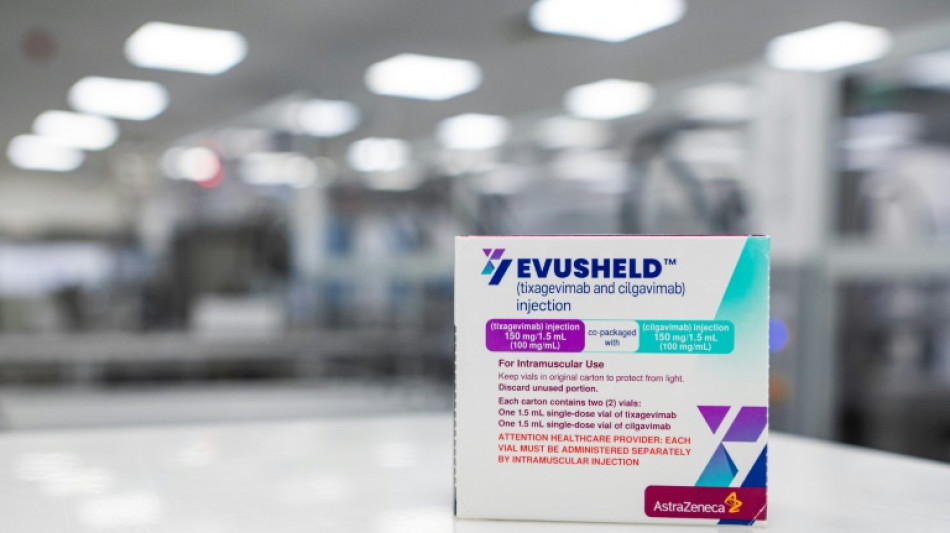
New antibody therapies fight cancer, drum up investment / Photo: Jonathan NACKSTRAND - AFP/File

 Zambia's opposition leader charged with treason

 Marc Marquez wins Aragon MotoGP Grand Prix

 Robinson rocks Pakistan again as England eye series win at Lord's

 Nepal rescuers advance towards trapped tunnel workers

 Grisly search for missing as Nepal morgues overflow, burials begin

 Barcelona's Yamal getting back to 'top level': Flick

 Dutch federation calls for football summit without Infantino

 Ron’s Honky Tonk Residency Revives UK Country Music in Bermondsey

 Chelsea sign Argentina 'stopper Martinez from Villa

 Norway's churches hold services to late King Harald

 Walmart Agrees to $50 Million Settlement Over Opioid Prescription Allegations

 Soundcore Liberty 5 Pro Review: Call Quality Redefines Value in Wireless Earbuds

 Lexus ES Review: Electric ES 350e Falls Short in Luxury Saloon Segment

 Vietnamese coffee farmers ride China's durian wave

 Venezuela says retains 'sovereignty' in US oil deal

 NASA's Roman telescope set to launch on cosmic mapping mission

 Data center backlash scrambles US midterm politics

 Emotional Federer inducted into tennis Hall of Fame

 Hovland takes solo lead as McIlroy surges at Tour Championship

 Djokovic 'prepared' for US Open bid for history

 Atletico down Sevilla to go top of La Liga

 US deports right-wing provocateur Milo Yiannopoulos

 Niger junta says it is back in control after soldiers' mutiny

 Erasmus calls Rennie barbs over Springbok scrumming 'nonsense'

 Lawrence's fifty leaves Pakistan facing record chase to level England series

Antibody therapies are offering promising treatment breakthroughs for cancer and other illnesses, generating greater investor interest more than 20 years after they were first commercialised.
Antibodies are proteins that recognise foreign substances, known as antigens, attaching themselves to them to alert the rest of the human immune system.
In 1975, scientists Georges Koehler and Cesar Milstein discovered how to produce them in a laboratory, which later earned them a Nobel Prize for medicine. Dozens of synthetic antibodies have since been developed.
New antibody treatments to be used with chemotherapy have arrived on the scene in recent years.
Most recently, a clinical trial of an antibody developed by pharmaceutical groups Daiichi Sankyo and AstraZeneca caught the attention of leading cancer specialists gathered at the American Society of Clinical Oncology's annual congress in Chicago this month.
The treatment, Enhertu, was already authorised for breast cancer patients who had large amounts of a protein called HER2.
The antibody also performed well in patients with smaller quantities of the protein -- increasing the number of people who could benefit.
The antibody latches onto the surface of a cancer cell whose receptors no longer work and the cell then "digests" the receptors to recycle them, activating the chemotherapy, explained cancer specialist William Jacot.
"We hadn't seen such progress, in terms of survival, with a chemotherapy treatment for dozens of years," said Jacot, a professor at the Montpellier Cancer Institute in southern France.
Although antibody therapy technology has a complex production process, it is less difficult to implement than new treatments using cellular therapy.
Antibodies can be used in different ways to fight cancer. They can target and destroy the proteins necessary to produce cancer cells or act to regulate the immune response.
French biotech firm Inatherys is in the first stage of clinical trials of an antibody treatment for leukaemia, its boss Pierre Launay said.
He said the company's antibody will be designed act as a "guided missile" and target a receptor that lets iron enter cancer cells, which need the substance.
The antibody will then release a poison within the cell to destroy it.
Some antibody treatments are being used preventively while others are treatments. For example, AstraZeneca's Evusheld antibody treatment is used preventively to ward off Covid-19, while Xevudy by British company GSK is used as a treatment.
Treatments are also being developed for inflammatory diseases, which are also a major killer.
- Booming market -
The promising announcements have triggered interest beyond the scientific community and a flood of investment. French biotech firm ImCheck Therapeutics recently raised almost 100 million euros ($106 million) for an antibody treatment in development.
Pharmaceutical giants are also prepared to spend big to ensure they do not miss out. French company Sanofi bought Belgian biotech firm Ablynx and its mini antibodies, nanobodies, for almost four billion euros in 2018.
Dupixent, Sanofi's flagship immunotherapy antibody medication, earned more than five billion euros for the pharma giant last year, and Keytruda, an oncological treatment by US firm MSD, generated more than $17 billion in 2021.
According to predictions by research firm Market Data Forecast, the market could grow to reach $249 billion in three years' time.
T.Vitorino--PC