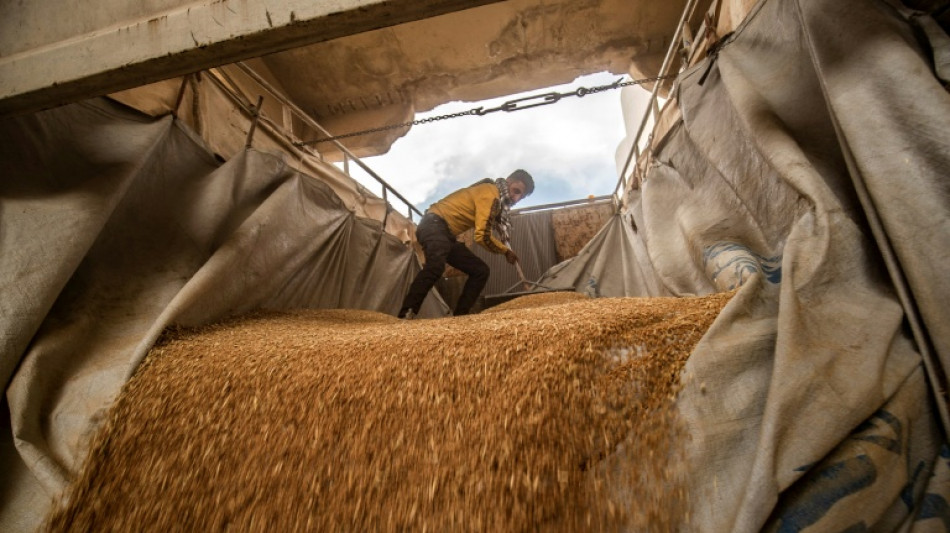
Syria's wheat war: drought fuels food crisis for 16 million / Photo: Delil SOULEIMAN - AFP

 Britain's Hunt wins 200m for European sprint double

 Draper dumped as Norrie saves face for Britain in Cincinnati

 England opener Gay out for duck in Pakistan warm-up

 Europe swelters under fresh wave of extreme heat

 French Olympic gold medallist Florent Manaudou announces retirement
 Tourists rescued by boat as forest fire threatens Greek beaches
 Indicted Raul Castro reappears after months out of public view
 Italian teen Curtis breaks women's 50m backstroke world record for second time

 Taulagi steps out of 'comfort zone' with code switch to French Top 14 new boys

 Leicester's Thai owners put troubled club up for sale: reports

 Stocks steady as US inflation worries ease, oil slips

 Porsche to end production of flagship electric car: report

 Twitch sparks gamers' wrath with Amazon AI sharing deal

 Blaze forces families to abandon Turkish tour boat

 'If you can, move!' say Rome's viral dancing seniors

 Zambia voters weigh Hichilema's economic record

 SBCFX to Showcase Trading Innovation, Regional Growth Strategy, and Future Vision at iFX EXPO Asia 2026

 Hodgkinson sets up Werro showdown after Euro 800m drama

 'How many will die?': the mysterious ailment killing Kenyan elephants

 Arteta coy over Lewis-Skelly's Arsenal future after 'emotional' celebration

 Romania shuts down nuclear plant as Danube drops

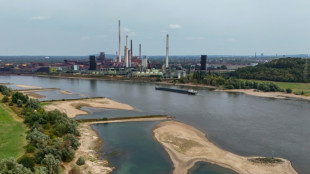 German steel giant Thyssenkrupp weighs options as Rhine drops

 US ambassador denounces settler siege as Israel dispatches troops

 Hasan takes 6-55 as Bangladesh claim opening day of Australia Test

 Taiwan says AI agents used in cyberattacks targeting island

Rival Syrian and Kurdish producers are scrambling for shrinking wheat harvests as the worst drought in decades follows a devastating war, pushing more than 16 million people toward food insecurity.
"The country has not seen such bad climate conditions in 60 years," said Haya Abu Assaf, assistant to the United Nations Food and Agriculture Organization (FAO) representative in Syria.
Syria's water levels have seen "a very significant drop compared to previous years, which is very worrying", Abu Assaf told AFP, as a relatively short winter rainy season and decreased rainfall take their toll.
"A gap of between 2.5 to 2.7 million tonnes in the wheat crop is expected, meaning that the wheat quantity will not be sufficient to meet local needs," Abu Assaf said, putting "around 16.3 million people at risk of food insecurity in Syria this year".
Before the civil war erupted in 2011, Syria was self-sufficient in wheat, producing an average of 4.1 million tonnes annually.
Nearly 14 years of conflict have since crippled production and devastated the economy.
The FAO estimates that harsh weather has impacted nearly 2.5 million hectares of wheat-growing land.
"Around 75 percent of the cultivated areas" have been affected, as well as "natural pastures for livestock production", said Abu Assaf.
- Imports, competition -
To bridge the wheat gap, imports would be essential in a country where around 90 percent of the population lives in poverty.
Before his ouster in an Islamist-led offensive in December, Syria's longtime ruler Bashar al-Assad used to rely on ally Russia for wheat.
In April, new authorities reported the first wheat shipment since his removal arrived in Latakia port, with more Russian shipments following.
Iraq also donated more than 220,000 tonnes of wheat to Syria.
During the war, Damascus competed with the semi-autonomous Kurdish administration in the northeast to buy wheat from farmers across fertile lands.
Last year, Assad's government priced wheat at $350 per tonne, and the Kurds at $310.
After Assad's ouster, Damascus and the Kurds agreed in March to integrate Kurdish-led institutions into the new Syrian state, with negotiations ongoing on implementation.
Damascus set wheat prices this month at between $290 and $320 per tonne, depending on the quality, plus a $130 bonus.
The Kurdish-led administration offered $420 per tonne including a $70 bonus.
- 'Poverty and hunger' -
Damascus' agriculture ministry expects a harvest of 300,000 to 350,000 tonnes in government-controlled areas this year.
Hassan Othman, director of the Syrian Grain Establishment, acknowledged Syria was not self-sufficient, in comments on state television.
But he said authorities were working "to ensure food security by importing wheat from abroad and milling it in our mills".
In northeast Syria's Amuda, farmer Jamshid Hassu, 65, inspected the tiny wheat grains from his fields, which cover around 200 hectares (around 500 acres).
Despite heavy irrigation efforts to offset scarce rainfall, he said, production has halved.
The FAO's Abu Assaf said indicators showed that "about 95 percent of rain-fed wheat has been damaged and affected", while irrigated wheat yields were down 30 to 40 percent.
Hassu, who has been farming for four decades, said he had to pump water from depths of more than 160 metres (525 feet) to sustain his crops as groundwater levels plunge.
Agriculture remains a vital income source in rural Syria, but without urgent support, farmers face ruin.
"Without support, we will not be able to continue," Hassu warned.
"People will suffer from poverty and hunger."
V.Fontes--PC