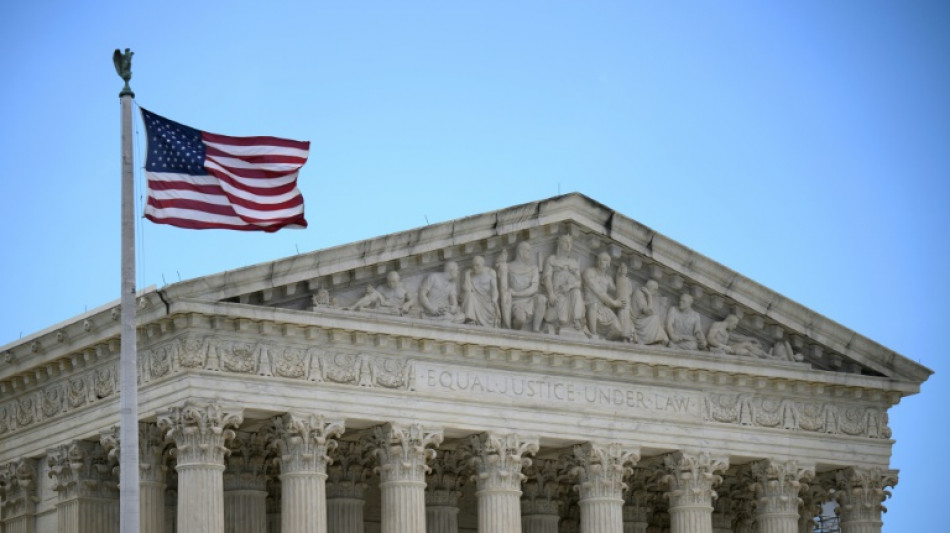
US Supreme Court upholds Texas age-check for porn sites / Photo: Drew ANGERER - AFP

 Britain's Hunt wins 200m for European sprint double

 Draper dumped as Norrie saves face for Britain in Cincinnati

 England opener Gay out for duck in Pakistan warm-up

 Europe swelters under fresh wave of extreme heat

 French Olympic gold medallist Florent Manaudou announces retirement

 Tourists rescued by boat as forest fire threatens Greek beaches

 Indicted Raul Castro reappears after months out of public view

 Italian teen Curtis breaks women's 50m backstroke world record for second time

 Taulagi steps out of 'comfort zone' with code switch to French Top 14 new boys

 Leicester's Thai owners put troubled club up for sale: reports

 Stocks steady as US inflation worries ease, oil slips

 Porsche to end production of flagship electric car: report

 Twitch sparks gamers' wrath with Amazon AI sharing deal

 Blaze forces families to abandon Turkish tour boat

 'If you can, move!' say Rome's viral dancing seniors

 Zambia voters weigh Hichilema's economic record

 SBCFX to Showcase Trading Innovation, Regional Growth Strategy, and Future Vision at iFX EXPO Asia 2026

 Hodgkinson sets up Werro showdown after Euro 800m drama

 'How many will die?': the mysterious ailment killing Kenyan elephants

 Arteta coy over Lewis-Skelly's Arsenal future after 'emotional' celebration

 Romania shuts down nuclear plant as Danube drops

 German steel giant Thyssenkrupp weighs options as Rhine drops

 US ambassador denounces settler siege as Israel dispatches troops

 Hasan takes 6-55 as Bangladesh claim opening day of Australia Test

 Taiwan says AI agents used in cyberattacks targeting island

The US Supreme Court on Friday upheld a Texas law requiring pornographic websites to verify visitors' ages, rejecting arguments that this violates free speech and boosting efforts to protect children from online sexual content.
The court's decision will impact a raft of similar laws nationwide and could set the direction for internet speech regulation as concerns about the impact of digital life on society grow.
Texas is one of about 20 US states to institute checks that porn viewers are over 18, which critics argue violate First Amendment free speech rights.
Other countries such as France, Britain and Germany also enforce age-related access restrictions to adult websites, while companies like Meta are lobbying Washington lawmakers for age-based verification to be carried out by smartphone giants Apple and Google on their app stores.
The Texas law was passed in 2023 by the state's Republican-majority legislature but was initially blocked after a challenge by an adult entertainment industry trade association.
A federal district court sided with the trade group, the Free Speech Coalition, saying the law restricted adults' access to constitutionally protected content.
But a conservative-dominated appeals court upheld the age verification requirement, prompting the pornography trade group to take its case to the Supreme Court, where conservatives have a 6-3 supermajority.
Under the law, companies that fail to properly verify users' ages face fines up to $10,000 per day and up to $250,000 if a child is exposed to pornographic content as a result.
To protect privacy, the websites aren't allowed to retain any identifying information obtained from users when verifying ages, and doing so could cost companies $10,000 daily in fines.
During arguments in January before the Supreme Court, a lawyer representing the Free Speech Coalition said the law was "overly burdensome" and that its goal could be accomplished using content filtering programs.
But Justice Amy Coney Barrett, the mother of seven children, took issue with the efficacy of content filtering, saying that from personal experience as a parent, such programs were difficult to maintain across the many types of devices used by kids.
Barrett also asked the lawyer to explain why requesting age verification online is any different than doing so at a movie theater that displays pornographic movies.
The lawyer for the Free Speech Coalition -- which includes the popular website Pornhub that has blocked all access in some states with age verification laws -- said online verification was different as it leaves a "permanent record" that could be a target for hackers.
During the court's hearing of the case in January, Chief Justice John Roberts and Justice Clarence Thomas, both Republican appointees, seemed to suggest that advances in technology might justify reviewing online free speech cases.
In 1997, the Supreme Court struck down, in an overwhelming 7-2 decision, a federal online age-verification law in what became a landmark free speech case that set a major precedent for the internet age.
M.Gameiro--PC