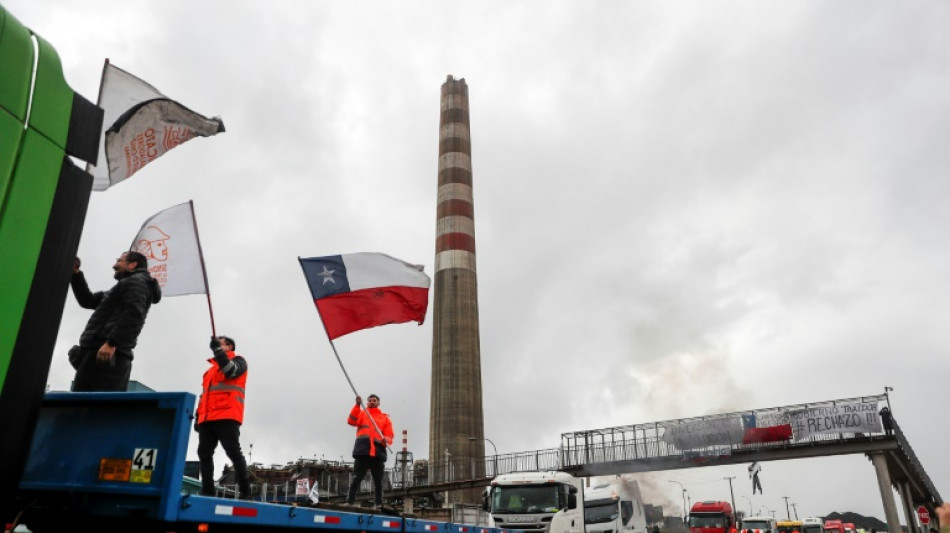
Chile workers end strike at world's largest copper producer / Photo: Javier Torres - AFP

 KUFOS Signs MoU With Old Dominion University to Expand Academic Ties

 Karen Wazen Launches First Standalone Boutiques in Cairo

 Municipal Elections: How Service Failure Becomes a Public Health Crisis in South Africa

 Rene Eyre Revisits Autobiographical Performance 'Say A Little Prayer' in London

 UAE's HCT Holds Record Graduation and Announces Major Training Expansion

 NASA Awards $10B Lunar Contract Framework to SpaceX, Blue Origin

 Katy Perry Tells Fans Ex-Husband Russell Brand 'Should Be in Jail' During UK Concert
Workers at Chile's state mining company Codelco, the world's largest copper producer, called off an open-ended strike Thursday after reaching agreement with the government.
The strike by some 40,000 mine workers to protest the closure of a foundry in one of Chile's most polluted regions, was ended after one day, the FTC labor federation announced.
The FTC had agreed with the company to work jointly towards closing the Ventanas foundry, over a period of time, in an area dubbed "Chile's Chernobyl."
Codelco announced it would close the Ventanas foundry after an incident on June 9 when 115 people, mostly school children, suffered sulfur dioxide poisoning released by heavy industry in the area around Quintero and Puchuncavi, home to some 50,000 people.
It was the second such incident in just three days.
Greenpeace described the area around the Ventanas plant as "Chile's Chernobyl" following a serious incident in 2018 when around 600 people received medical treatment for symptoms such as vomiting blood, headaches, dizziness and paralysis of the extremities.
Unions, however, described the announced closure as "arbitrary" and demanded the government spend money instead on bringing the plant up to environmental standards.
Pollution accumulated in the area of Quintero and Puchuncavi after the government decided in 1958 to convert it into an industrial center that now hosts four coal-fired power stations and oil and copper refineries.
J.V.Jacinto--PC

