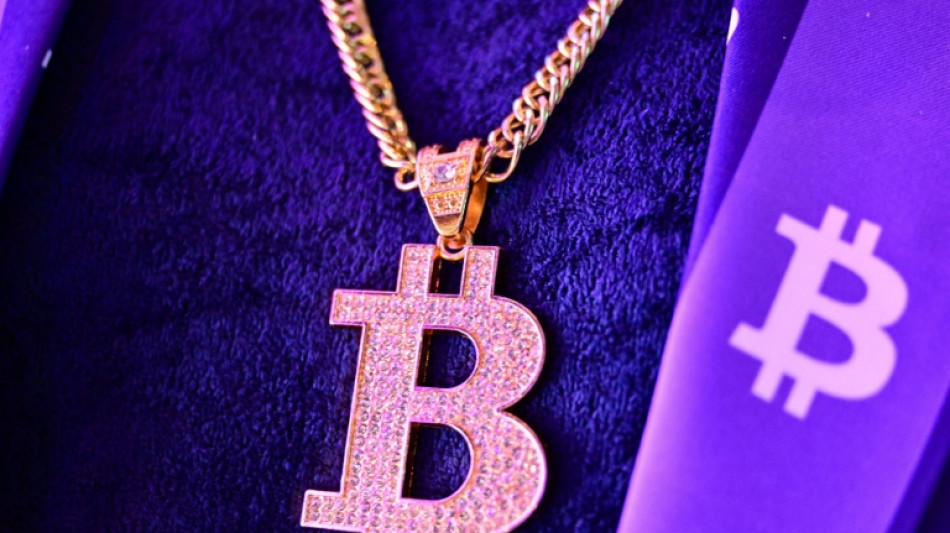
US House set to vote on landmark crypto bills this week / Photo: Giuseppe CACACE - AFP

 Zambia voters weigh Hichilema's economic record

 SBCFX to Showcase Trading Innovation, Regional Growth Strategy, and Future Vision at iFX EXPO Asia 2026

 Hodgkinson sets up Werro showdown after Euro 800m drama

 'How many will die?': the mysterious ailment killing Kenyan elephants

 Arteta coy over Lewis-Skelly's Arsenal future after 'emotional' celebration

 Romania shuts down nuclear plant as Danube drops

 German steel giant Thyssenkrupp weighs options as Rhine drops

 US ambassador denounces settler siege as Israel dispatches troops

 Hasan takes 6-55 as Bangladesh claim opening day of Australia Test

 Taiwan says AI agents used in cyberattacks targeting island

 Japan protests Putin's first visit to disputed islands

 Kiss wants fit-again Wallabies playmaker Gordon to 'open up' Japan

 British eccentrics push humble garden shed to new heights

 Zambia votes with president's economic record on the line

 Germany's dry rivers spark battle on engineering vs restoration

 Senators demand inquiry into conditions aboard USS Abraham Lincoln

 All Blacks' Proctor out of South Africa series, Mo'unga called up

 Bangladesh quick Hasan reduces Australia to 74-4 at lunch

 Seoul tech leads Asian stock gains as traders cheer US inflation

 Farage and Count Binface go head-to-head in snap UK poll

 Afghan students divided over smartphone ban at universities

 Japan go back to school for second Australia Test

 Matthew McConaughey on his sweet return to the big screen

 President's economic record on the line as Zambia votes

 U.S. Polo Assn. Takes No. 1 Spot for All Sports Brands and Climbs to No. 22 Overall on License Global's 2026 'Top Global Licensors' Ranking

US lawmakers are on the verge of passing landmark legislation that will give the much-maligned crypto world much-wanted legitimacy, riding on President Donald Trump's recent embrace of the industry.
The US House of Representatives is set to vote on three pieces of legislation this week, including one on the use of stablecoins -- cryptocurrencies pegged to safe assets like the dollar -- that if passed would immediately go to Trump for his signature.
The raft of legislation comes after years of suspicion against the crypto industry amid the belief in the Biden administration that the sector, born out of the success of bitcoin, should be kept on a tight leash and away from mainstream investors.
But after crypto investors poured millions of dollars into his presidential campaign last year, Trump reversed his own doubts about the industry, even launching a Trump meme coin and other ventures as he prepared for his return to the White House.
According to federal financial disclosure forms released last month, Trump pocketed more than $57 million from the crypto venture, World Liberty Financial, that he launched with his sons last year.
Trump has, among other moves, appointed crypto advocate Paul Atkins to head the Securities and Exchange Commission (SEC).
He has also established a federal "Strategic Bitcoin Reserve" aimed at auditing the government's bitcoin holdings, which were mainly accumulated by law enforcement from judicial seizures.
And thanks to his backing, Trump could soon be signing the stablecoin bill -- dubbed the GENIUS Act -- that the US Senate passed last month and that sets rules such as requiring issuers to have reserves of assets equal in value to that of their outstanding cryptocurrency.
- 'Long time coming' -
Stablecoins are considered the safest and least volatile of digital currencies because their value is tied to traditional currency or secure assets such as gold.
Another provision of the bill empowers banking regulators to oversee stablecoin issuers in the United States.
The legislation could extend the US dollar's influence in the world of cryptocurrency, with dollar-backed stablecoins seen as financial havens from local currencies prone to big fluctuations.
The US House is also considering the CLARITY Act that would establish a clearer regulatory framework for digital assets -- including cryptocurrencies and other blockchain-based assets. If passed the bill would require passage in the Senate.
The act would clarify and divide regulatory authority between the Securities and Exchange Commission (SEC) and the Commodity Futures Trading Commission (CFTC).
Gerald Gallagher, General Counsel at Sei Labs, a digital asset firm, said the bills could be a game changer for the industry.
"GENIUS and CLARITY provide security and certainty for investors that previously were not available, either intentionally or unintentionally," he told AFP.
"This has been a long time coming."
The Republican-led House is also considering a bill it calls the Anti-CBDC Surveillance State Act that aims to block the issuance of a central bank digital currency (CBDC) – a digital dollar issued by the US Federal Reserve.
Republicans argue that a CBDC could enable the federal government to monitor, track, and potentially control the financial transactions of private citizens, undermining privacy and civil liberties.
It also would require passage in the Senate before going to Trump for his signature.
J.Oliveira--PC