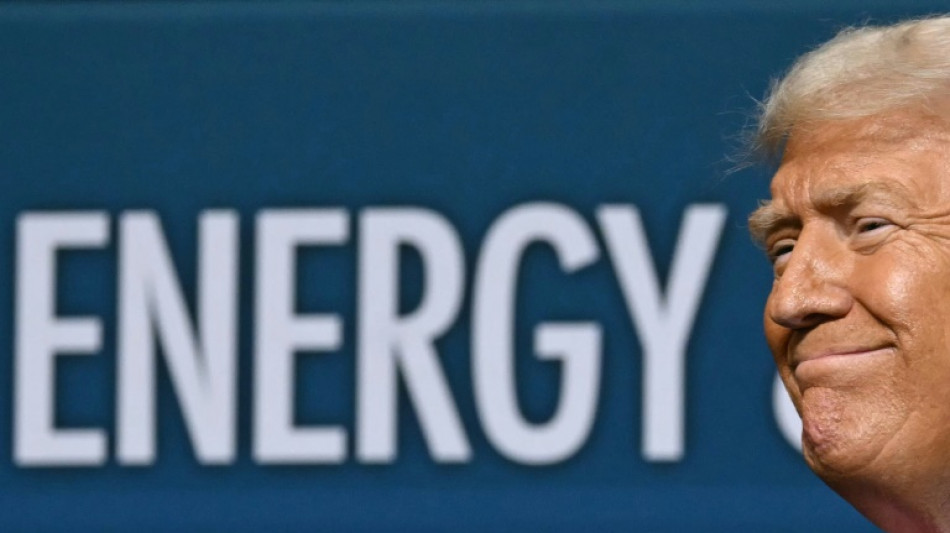
Trump unveils investments to power AI boom / Photo: ANDREW CABALLERO-REYNOLDS - AFP

 Best Pet Advent Calendars for Christmas 2026: Dog Treats and Cat Toys

 Grattan Institute Releases Blueprint to Target Specialists Over Excessive Fees

 Arizona Science Center Hosts Girls in STEM Astro Adventures for Students

 New Turkish Cafe, Japanese BBQ, and Korean Restaurants Open Across East Bay

 Knowle Move Four Points Clear at Top After Histon Victory

 Physicians Urge Arizona to Ban Medical Gag Clauses and Enable Private Lawsuits

 New Campaign Highlights Knowledge Gaps on Carbon Monoxide Safety Among Americans
US President Donald Trump went to Pennsylvania on Tuesday to announce $92 billion in energy and infrastructure deals intended to meet big tech's soaring demand for electricity to fuel the AI boom.
Trump made the announcement at the inaugural Pennsylvania Energy and Innovation Summit at Carnegie Mellon University, with much of the talk about beating China in the global AI race.
"Today's commitments are ensuring that the future is going to be designed, built and made right here in Pennsylvania and right here in Pittsburgh, and I have to say, right here in the United States of America," Trump said at the event.
The tech world has fully embraced generative AI as the next wave of technology, but fears are growing that its massive electricity needs cannot be met by current infrastructure, particularly in the United States.
Generative AI requires enormous computing power, mainly to run the energy-hungry processors from Nvidia, the California-based company that has become the world's most valuable company by market capitalization.
Officials expect that by 2028, tech companies will need as much as five gigawatts of power for AI -- enough electricity to power roughly five million homes.
Top executives from Palantir, Anthropic, Exxon and Chevron attended the event.
The funding will cover new data centers, power generation, grid infrastructure, AI training, and apprenticeship programs.
- Race to beat China -
Among investments, Google committed $25 billion to build AI-ready data centers in Pennsylvania and surrounding regions.
"We support President Trump's clear and urgent direction that our nation invest in AI... so that America can continue to lead in AI," said Ruth Porat, Google's president and chief investment officer.
The search engine giant also announced a partnership with Brookfield Asset Management to modernize two hydropower facilities in Pennsylvania, representing 670 MW of capacity on the regional grid.
Investment group Blackstone pledged more than $25 billion to fund new data centers and energy infrastructure.
US Senator David McCormick, from Pennsylvania, said the investments "are of enormous consequence to Pennsylvania, but they are also crucial to the future of the nation."
His comments reflect the growing sentiment in Washington that the United States must not lose ground to China in the race to develop AI.
"We are way ahead of China and the plants are starting up, the construction is starting up," Trump said.
The US president launched the "Stargate" project in January, aimed at investing up to $500 billion in US AI infrastructure -- primarily in response to growing competition with China.
Japanese tech investor SoftBank, ChatGPT-maker OpenAI, and Oracle are investing $100 billion in the initial phase.
Trump has also reversed many policies adopted by the previous Biden administration that imposed checks on developing powerful AI algorithms and limits on exports of advanced technology to certain allied countries.
He is expected to outline his own blueprint for AI advancement later this month.
L.Torres--PC

