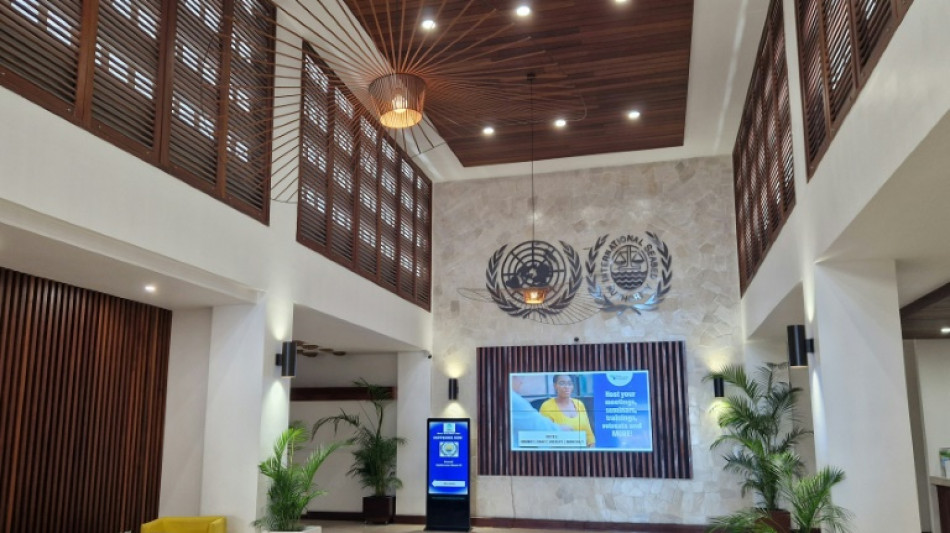
Restoring sea floor after mining may not be possible, researchers warn / Photo: Amélie BOTTOLLIER-DEPOIS - AFP/File

 Arteta coy over Lewis-Skelly's Arsenal future after 'emotional' celebration

 Romania shuts down nuclear plant as Danube drops

 German steel giant Thyssenkrupp weighs options as Rhine drops

 US ambassador denounces settler siege as Israel dispatches troops

 Hasan takes 6-55 as Bangladesh claim opening day of Australia Test

 Taiwan says AI agents used in cyberattacks targeting island

 Japan protests Putin's first visit to disputed islands

 Kiss wants fit-again Wallabies playmaker Gordon to 'open up' Japan

 British eccentrics push humble garden shed to new heights

 Zambia votes with president's economic record on the line

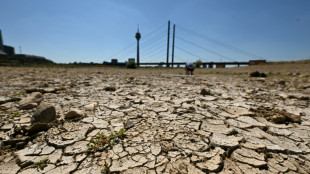 Germany's dry rivers spark battle on engineering vs restoration

 Senators demand inquiry into conditions aboard USS Abraham Lincoln

 All Blacks' Proctor out of South Africa series, Mo'unga called up

 Bangladesh quick Hasan reduces Australia to 74-4 at lunch

 Seoul tech leads Asian stock gains as traders cheer US inflation

 Farage and Count Binface go head-to-head in snap UK poll

 Afghan students divided over smartphone ban at universities

 Japan go back to school for second Australia Test

 Matthew McConaughey on his sweet return to the big screen
 President's economic record on the line as Zambia votes

 U.S. Polo Assn. Takes No. 1 Spot for All Sports Brands and Climbs to No. 22 Overall on License Global's 2026 'Top Global Licensors' Ranking

 Trump 'low-key' bets on economic pressure against Iran
 Pitch invaders take selfies with Fernandes during Man Utd friendly

 No-stress Sabalenka won't fret over lackluster 2026 results

 Hometown hero Hudson-Smith basks in Euro glory

Scientists present at the latest effort to hash out international rules for deep-sea mining say it's unclear if it's possible to restore damaged sea floor ecosystems -- or how long it would take.
One of the last wild zones on the planet, the sea floor is a coveted frontier for companies and countries eager to access minerals that are in high demand for emerging technologies such as electric cars.
Particularly coveted are potato-sized nodules containing cobalt, nickel, copper and manganese, that are found in abundance on the seabed in the central Pacific Ocean.
Companies eager to vacuum up these polymetallic nodules say they can do it with minimal risk to the deep-sea environment.
But ocean defenders have battled against what they see as the advent of an industry that will threaten isolated ecosystems that are not yet well understood.
That threat was underscored by European scientists who presented findings this week on the sidelines of a meeting in Kingston, Jamaica of the International Seabed Authority, which is trying to finalize future rules for seabed mining.
"If we remove nodules from the seabed, we do not know what we lose, only that it's lost forever," was one of the conclusions of DEEP REST, a sea floor conservation research project.
The DEEP REST study cautioned against using seabed restoration "as a management action for impacted habitats."
"So far, all the restoration operations we have attempted within our DEEP REST project have been short-term. And what we observed, is that in the given time, that is to say a few years, the ecosystems do not recover," said Jozee Sarrazin, a researcher at the French Institute for Ocean Science, or Ifremer.
"If restoration is possible, it will take a very long time, and at the moment we don't have the data to be able to say if that will be 100 years or 1000 years," the DEEP REST coordinator told AFP.
Despite the pressure, the cold, the total darkness, and the lack of nutrition sources at the bottom of the ocean, it is teeming with life.
The number of species who live on the deep seabed is not yet known but estimated to be in the millions.
- Soft corals, sea anemone -
Broad swathes of the Pacific Ocean where polymetallic nodules are found shelter fauna such as sponges, soft corals or sea anemones.
The fauna "only exists in these areas because they need the hard substrate of the nodule to attach," said Matthias Haeckel of the German research center GEOMAR, which presented results of the MiningImpact project in Kingston this week.
Vacuuming up these nodules and spreading sediment over the impacted areas reduces population densities, biodiversity and the functioning of ecosystems, MiningImpact's study found.
"To make the story short, in the end, we're talking about recovery times of thousands of years," Haeckel said. The nodules themselves form over millions of years.
Some research on restoration efforts is underway but the results are not yet in.
"We designed artificial nodules made of deep-sea clay and we placed them at different sites" at depths of about 4,500 meters (14,700 feet), Sabine Gollner, a biologist at the Royal Netherlands Institute for Sea Research, told AFP.
"But when you take into account the slow growth rates in the deep sea, the slow processes, it will take quite some more years to find out if restoration is effective and to what degree," she said.
Massive deposits of sulfide -- a type of mineral deposit found in underwater vents that spit out seawater heated by magma -- should be off-limits, the researchers suggest.
These types of underwater geysers are teeming with astonishing and unique biodiversity.
"If we extract massive sulfides near active vents, we know what we lose, and we must prevent loss," the DEEP REST study says.
But according to Gollner, it would be good to incorporate restoration goals into the mining code being negotiated by the International Seabed Authority's member states.
"It's good to include it but with a clear statement that at this moment in time, it cannot be taken into account to reach agreed environmental goals," she said.
"For example, a contractor shouldn't be allowed to use that argument to mine a larger area."
R.J.Fidalgo--PC