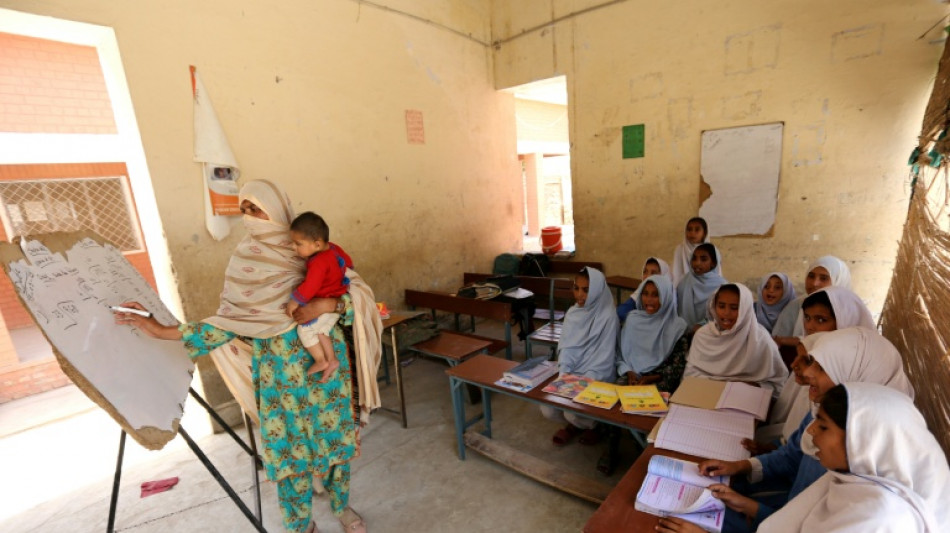
Without papers: Ghost lives of millions of Pakistanis / Photo: Shahid Saeed MIRZA - AFP

 US ambassador denounces settler siege as Israel dispatches troops
 Hasan takes 6-55 as Bangladesh claim opening day of Australia Test

 Taiwan says AI agents used in cyberattacks targeting island
 Japan protests Putin's first visit to disputed islands

 Kiss wants fit-again Wallabies playmaker Gordon to 'open up' Japan

 British eccentrics push humble garden shed to new heights

 Zambia votes with president's economic record on the line

 Germany's dry rivers spark battle on engineering vs restoration

 Senators demand inquiry into conditions aboard USS Abraham Lincoln

 All Blacks' Proctor out of South Africa series, Mo'unga called up

 Bangladesh quick Hasan reduces Australia to 74-4 at lunch

 Seoul tech leads Asian stock gains as traders cheer US inflation
 Farage and Count Binface go head-to-head in snap UK poll

 Afghan students divided over smartphone ban at universities
 Japan go back to school for second Australia Test
 Matthew McConaughey on his sweet return to the big screen

 President's economic record on the line as Zambia votes

 Grieving Messi available for Miami in Leagues Cup clash

 Colombia enters 'final phase' of quake search as toll hits 265

 Father-figure Christie helps guide Kounta to European silver

 McIlroy returns to St. Jude to launch marathon PGA playoff push

 Guimaraes makes Arsenal debut in Como friendly

 Travis Kelce says wedding to Taylor Swift was 'best night of my life'

 US stocks mostly up after data shows slightly lower inflation in July

 Caracas protest denounces secrecy of Venezuela transition talks

Ahmed Raza is invisible in the eyes of his government, unable to study or work because, like millions of other Pakistanis, he lacks identification papers.
In the South Asian nation of more than 240 million people, parents generally wait until a child begins school at the age of five to obtain a birth certificate, which is required for enrolment in most parts of Pakistan.
Raza slipped through the cracks until the end of elementary school, but when his middle school requested documentation, his mother had no choice but to withdraw him.
"If I go looking for work, they ask for my ID card. Without it, they refuse to hire me," said the 19-year-old in the megacity of Karachi, the southern economic capital.
He has already been arrested twice for failing to present identification cards when stopped by police at checkpoints.
Raza's mother Maryam Suleman, who is also unregistered, said she "didn't understand the importance of having identity documents".
"I had no idea I would face such difficulties later in life for not being registered," the 55-year-old widow told AFP from the single room she and Raza share.
Pakistan launched biometric identification cards in 2000 and registration is increasingly required in all aspects of formal life, especially in cities.
In 2021, the National Database and Registration Authority estimated that around 45 million people were not registered. They have declined to release updated figures or reply to AFP despites repeated requests.
To register, Raza needs his mother's or uncle's documents -- an expensive and complex process at their age, often requiring a doctor, lawyer or a newspaper notice.
The paperwork, he says, costs up to $165 -- a month and a half's income for the two of them, who earn a living doing housework and odd jobs in a grocery shop.
Locals whisper that registration often requires bribes, and some suggest the black market offers a last resort.
"Our lives could have been different if we had our identity cards," Raza said.
- 'No time or money' -
In remote Punjab villages like Rajanpur, UNICEF is trying to prevent people from falling into the same fate as Raza.
They conduct door-to-door registration campaigns, warning parents that undocumented children face higher risks of child labour and forced marriage.
Currently, 58 percent of children under five have no birth certificate, according to government figures.
Registration fees depend on the province, ranging from free, $0.70 to $7 -- still a burden for many Pakistanis, about 45 percent of whom live in poverty.
"Our men have no time or money to go to the council and miss a day's work," said Nazia Hussain, mother of two unregistered children.
The "slow process" often requires multiple trips and there is "no means of transport for a single woman," she said.
Saba, from the same village, is determined to register her three children, starting with convincing her in-laws of its value.
"We don't want our children's future to be like our past. If children go to school, the future will be brighter," said Saba, who goes by just one name.
Campaigns in the village have resulted in an increase of birth registration rates from 6.1 percent in 2018 to 17.7 percent in 2024, according to UNICEF.
This will improve the futures of an entire generation, believes Zahida Manzoor, child protection officer at UNICEF, dispatched to the village.
"If the state doesn't know that a child exists, it can't provide basic services," she said.
"If a child does not have an identity, it means the state has not recognised their existence. The state is not planning for the services that the child will need after birth."
Muhammad Haris and his brothers, who have few interactions with the formal state in their border village in the mountainous province of Khyber Pakhtunkhwa, have not registered any of their eight children.
"The government asks for documents for the pilgrimage visa to Mecca," a journey typically made after saving for a lifetime, he told AFP.
For him, this is the only reason worthy of registration.
sam-jma-la-vid/sbh/ecl/lb/dhw
E.Paulino--PC