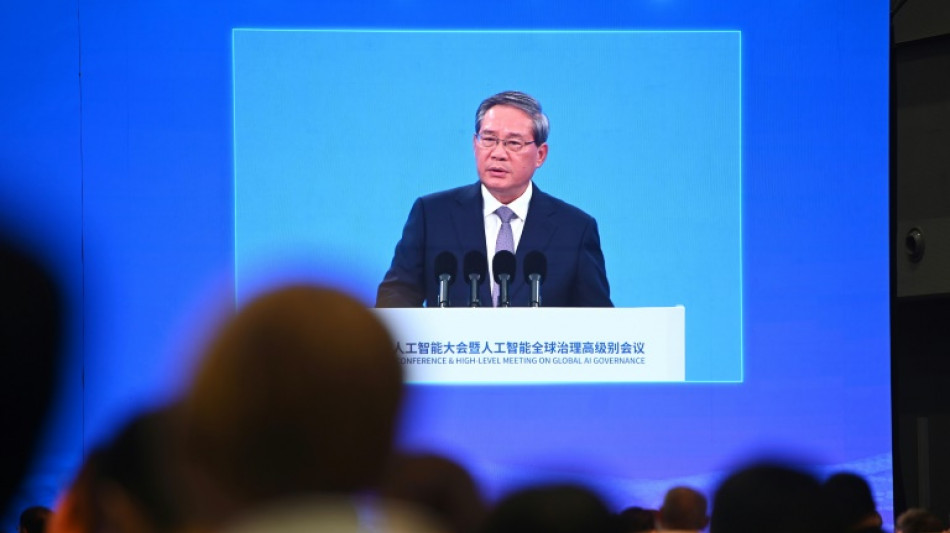
China urges global consensus on balancing AI development, security / Photo: Agatha Cantrill - AFP

 Best Pet Advent Calendars for Christmas 2026: Dog Treats and Cat Toys

 Grattan Institute Releases Blueprint to Target Specialists Over Excessive Fees

 Arizona Science Center Hosts Girls in STEM Astro Adventures for Students

 New Turkish Cafe, Japanese BBQ, and Korean Restaurants Open Across East Bay

 Knowle Move Four Points Clear at Top After Histon Victory

 Physicians Urge Arizona to Ban Medical Gag Clauses and Enable Private Lawsuits

 New Campaign Highlights Knowledge Gaps on Carbon Monoxide Safety Among Americans

China's Premier Li Qiang warned Saturday that artificial intelligence development must be weighed against the security risks, saying global consensus was urgently needed even as the tech race between Beijing and Washington shows no sign of abating.
His remarks came just days after US President Donald Trump unveiled an aggressive low-regulation strategy aimed at cementing US dominance in the fast-moving field, promising to "remove red tape and onerous regulation" that could hinder private sector AI development.
Opening the World AI Conference (WAIC) in Shanghai on Saturday, Li emphasised the need for governance and open-source development, announcing the establishment of a Chinese-led body for international AI cooperation.
"The risks and challenges brought by artificial intelligence have drawn widespread attention... How to find a balance between development and security urgently requires further consensus from the entire society," the premier said.
Li said China would "actively promote" the development of open-source AI, adding Beijing was willing to share advances with other countries, particularly developing ones.
"If we engage in technological monopolies, controls and blockage, artificial intelligence will become the preserve of a few countries and a few enterprises," he said.
"Only by adhering to openness, sharing and fairness in access to intelligence can more countries and groups benefit from (AI)."
The premier highlighted "insufficient supply of computing power and chips" as a bottleneck.
Washington has expanded its efforts in recent years to curb exports of state-of-the-art chips to China, concerned that these can be used to advance Beijing's military systems and erode US tech dominance.
For its part, China has made AI a pillar of its plans for technological self-reliance, with the government pledging a raft of measures to boost the sector.
In January, Chinese startup DeepSeek unveiled an AI model that performed as well as top US systems despite using less powerful chips.
- 'Pet tiger cub' -
At a time when AI is being integrated across virtually all industries, its uses have raised major ethical questions, from the spread of misinformation to its impact on employment, or the potential loss of technological control.
In a speech at WAIC on Saturday, Nobel Prize-winning physicist Geoffrey Hinton compared the situation to keeping "a very cute tiger cub as a pet".
"To survive", he said, you need to ensure you can train it not to kill you when it grows up.
In a video message played at the WAIC opening ceremony, UN Secretary-General Antonio Guterres said AI governance would be "a defining test of international cooperation".
The ceremony also saw the French president's AI envoy, Anne Bouverot, underscore the "an urgent need" for global action.
At an AI summit in Paris in February, 58 countries including China, France and India -- as well as the European Union and African Union Commission -- called for enhanced coordination on AI governance.
But the United States warned against "excessive regulation", and alongside the United Kingdom, refused to sign the summit's appeal for an "open", "inclusive" and "ethical" AI.
Nogueira--PC

