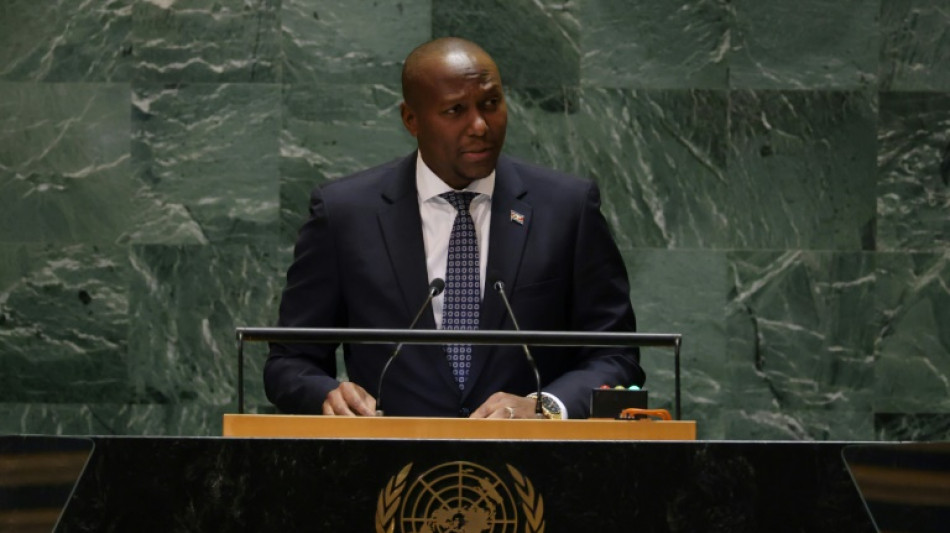
Questions swell in Eswatini over five men deported from US / Photo: Charly TRIBALLEAU - AFP/File

 Best Pet Advent Calendars for Christmas 2026: Dog Treats and Cat Toys

 Grattan Institute Releases Blueprint to Target Specialists Over Excessive Fees

 Arizona Science Center Hosts Girls in STEM Astro Adventures for Students

 New Turkish Cafe, Japanese BBQ, and Korean Restaurants Open Across East Bay

 Knowle Move Four Points Clear at Top After Histon Victory

 Physicians Urge Arizona to Ban Medical Gag Clauses and Enable Private Lawsuits

 New Campaign Highlights Knowledge Gaps on Carbon Monoxide Safety Among Americans

In the small African kingdom of Eswatini, the arrival of five men deported from the United States under Washington's aggressive anti-immigrant measures has sparked a rare wave of public dissent.
The five, nationals of Vietnam, Laos, Yemen, Cuba and Jamaica, were flown to Eswatini's administrative capital of Mbabane on July 16 on a US military plane and incarcerated after US authorities labelled them "criminal illegal aliens".
The US Department of Homeland Security said the men were convicted of violent crimes "so uniquely barbaric that their home countries refused to take them back".
The government of Eswatini, formerly known as Swaziland, has confirmed their presence.
But spokesman Thabile Mdluli said they would not stay permanently, and "will be repatriated in due course to their different countries".
That assurance, though, has not quelled a tide of questions and concerns that has risen within the kingdom about the operation.
Civic and rights groups are wondering whether further deportees from the United States will arrive, and what rights the five men detained have.
Public outrage at the lack of transparency led to 150 women protesting outside the US embassy in Mbabane on Friday.
The protest, organised by the Eswatini Women's Movement, demanded the prisoners be returned to the United States and queried the legal basis Eswatini relied on to accept them.
The five men are being held in the Matsapha Correctional Centre, 30 kilometres (20 miles) south of Mbabane.
The facility, notorious for holding political prisoners and overcrowding, has been undergoing renovations and expansions since 2018, reportedly funded by the United States as part of a program covering all 14 of the country's penal centres.
- Solitary confinement -
Sources within the penitentiary administration said the men were being held in solitary confinement in a high-security section of the facility, with their requests to make phone calls being denied.
The sources said the men have access to medical care and the same meals as the thousand other inmates, as well as a toilet, shower and television in their cells.
Prime Minister Russell Dlamini has dismissed calls by lawmakers and from other quarters for the secrecy surrounding the agreement with Washington to be lifted.
"Not every decision or agreement is supposed to be publicly shared," he said.
Eswatini is the second African country to receive such deportees from the United States, after South Sudan earlier this month accepted eight individuals.
The situation has sparked concerns about the potential implications for Eswatini, a country already grappling with its own challenges under the absolute monarchy of King Mswati III.
The 57-year-old ruler has been criticised for his lavish lifestyle and has faced accusations of human rights violations.
US President Donald Trump has used the threat of high tariffs against other countries, such as Colombia, to coerce them to take in people deported from America.
Eswatini is currently facing a baseline US tariff of 10 percent -- less than the 30 percent levelled at neighbouring South Africa -- which the government has said will negatively impact the economy.
Trump has directed federal agencies to work hard on his campaign promise to expel millions of undocumented migrants from the United States.
His government has turned to so-called third-country deportations in cases where the home nations of some of those targeted for removal refuse to accept them.
Rights experts have warned the US deportations risk breaking international law by sending people to nations where they face the risk of torture, abduction and other abuses.
E.Borba--PC

