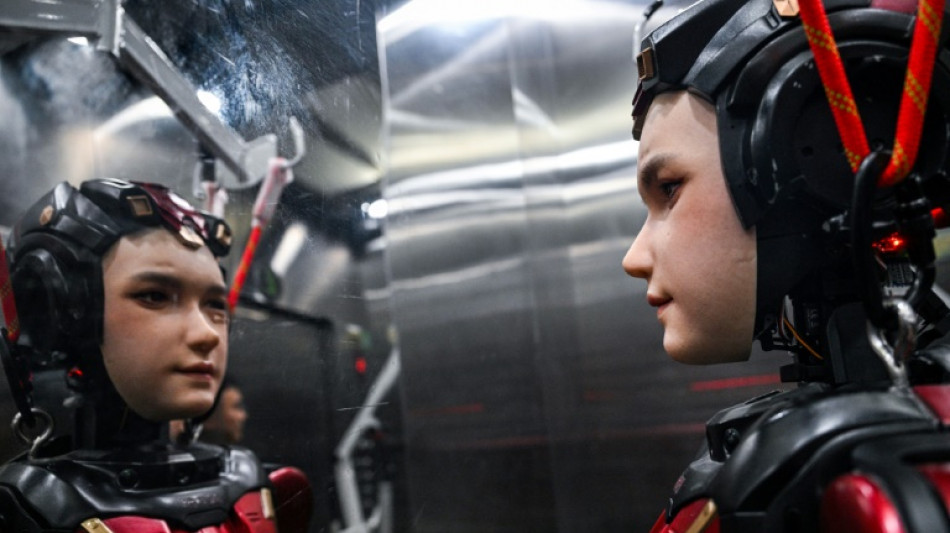
'Marathon at F1 speed': China bids to lap US in AI leadership / Photo: Hector RETAMAL - AFP

 Japan protests Putin's first visit to disputed islands

 Kiss wants fit-again Wallabies playmaker Gordon to 'open up' Japan

 British eccentrics push humble garden shed to new heights

 Zambia votes with president's economic record on the line

 Germany's dry rivers spark battle on engineering vs restoration
 Senators demand inquiry into conditions aboard USS Abraham Lincoln
 All Blacks' Proctor out of South Africa series, Mo'unga called up
 Bangladesh quick Hasan reduces Australia to 74-4 at lunch
 Seoul tech leads Asian stock gains as traders cheer US inflation
 Farage and Count Binface go head-to-head in snap UK poll
 Afghan students divided over smartphone ban at universities
 Japan go back to school for second Australia Test
 Matthew McConaughey on his sweet return to the big screen

 President's economic record on the line as Zambia votes
 Grieving Messi available for Miami in Leagues Cup clash
 Colombia enters 'final phase' of quake search as toll hits 265

 Father-figure Christie helps guide Kounta to European silver

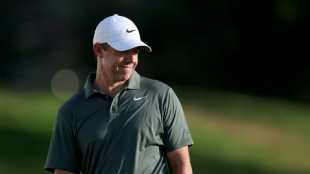 McIlroy returns to St. Jude to launch marathon PGA playoff push

 Guimaraes makes Arsenal debut in Como friendly

 Travis Kelce says wedding to Taylor Swift was 'best night of my life'
 US stocks mostly up after data shows slightly lower inflation in July

 Caracas protest denounces secrecy of Venezuela transition talks

 Hudson-Smith regains Euro 400m title on home track

 Rob Reiner son denies grand jury murder charges
 Spain darkens as solar eclipses races south from Arctic

Beyond dancing robots and eager-to-help digital avatars, Shanghai's World AI Conference saw China stake its claim to global artificial intelligence leadership and frame itself as a clear alternative to the United States.
Assumptions that the US was far ahead in the fast-moving field were upended this year when Chinese start-up DeepSeek unveiled a chatbot that matched top American systems for an apparent fraction of the cost.
With AI now at the forefront of the superpowers' tech race, the World AI Conference (WAIC) that ended Tuesday saw China set out its case to take charge on shaping its global governance too.
China, the United States and other major economies are "engaged in a marathon at Formula One speed", said Steven Hai, assistant professor of tech innovation at Xi'an Jiaotong-Liverpool University.
"Which country will attain the upper hand can only be assessed dynamically over the course of development."
China and the United States dominate the AI sector -- only 10 to 15 percent of models developed in recent years were built without either's participation, according to Epoch AI, a non-profit research institute.
While US companies like Google and OpenAI are still industry-leading, the institute labelled 78 percent of Chinese models "state-of-the-art" compared to 70 percent of models built with American participation.
Beijing's stated aim is to become the world's leading AI "innovation centre" by 2030.
"Now China is neck-and-neck with the United States in terms of core tech, that play (for global leadership) is more relevant than ever," said Tom Nunlist, associate director for tech and data policy at Trivium China.
"With a solid AI offering and the US turning inward, the question is will Beijing's vision gain greater global traction?"
In May, Microsoft's Brad Smith told the US Senate that "the number-one factor" in the tech race "is whose technology is most broadly adopted in the rest of the world".
- 'Sovereign AI' -
China's offer is technical and economical.
"One of the biggest differences (with the US sector) is that most of the leading models in China... are open-weight and open-source," former Google CEO Eric Schmidt told an audience at WAIC.
That means they can be adapted by other countries to fit their own needs, said George Chen, partner at Washington-based policy consultancy The Asia Group.
"We already see some countries like Mongolia, Kazakhstan, even Pakistan are trying to adopt the DeepSeek model to build their own," he said.
"China has a chance to win in the aspect of sovereign AI to export its model to those countries."
The comparative low cost of Chinese technology -- software but also hardware, for example through firms like Huawei -- will be a big factor, especially for developing countries, Chen added.
On Monday another Chinese start-up, Zhipu, announced its new AI model -- also open-source -- would cost less than DeepSeek to use.
In June, OpenAI accused Zhipu of having close ties with Chinese authorities and noted it was working with governments and state-owned firms across Southeast Asia, the Middle East and Africa.
"The goal is to lock Chinese systems and standards into emerging markets before US or European rivals can," it said.
Washington has moved to protect its lead in AI, expanding efforts to curb exports of state-of-the-art chips to China in recent years.
"While limiting China's share of the global AI hardware market, (these measures) have accelerated indigenous innovation and led Chinese firms to exploit regulatory loopholes," said assistant professor Hai, referring to "rife" smuggling and circumvention.
- Issues of trust? -
Other challenges to homegrown firms include the closed nature of the Chinese internet, and "general issues of trust when it comes to using Chinese tech", Trivium's Nunlist said.
At WAIC, China sought to present itself as a responsible power.
Premier Li Qiang emphasised the risks of AI and pledged to share technology with other nations, especially developing ones.
His remarks contrasted sharply with US President Donald Trump's aggressive low-regulation "AI Action Plan" launched just days before and explicitly aimed at cementing US dominance in the field.
China released its own action plan at WAIC, following a meeting attended by delegates from dozens of countries.
Li also announced the establishment of a China-led organisation for international AI cooperation.
However, China's foreign ministry did not respond to a request from AFP for details on the set-up of the organisation -- including any international participants -- and several foreign delegates said they had not been briefed on the announcement beforehand.
Analyst Grace Shao wrote it was clear AI was still in its "infancy stage".
"You can sense that vibrant energy but also the immaturity of the space," she wrote on Substack.
"There just shouldn't be a definitive conclusion on who is 'winning' yet."
Ferreira--PC