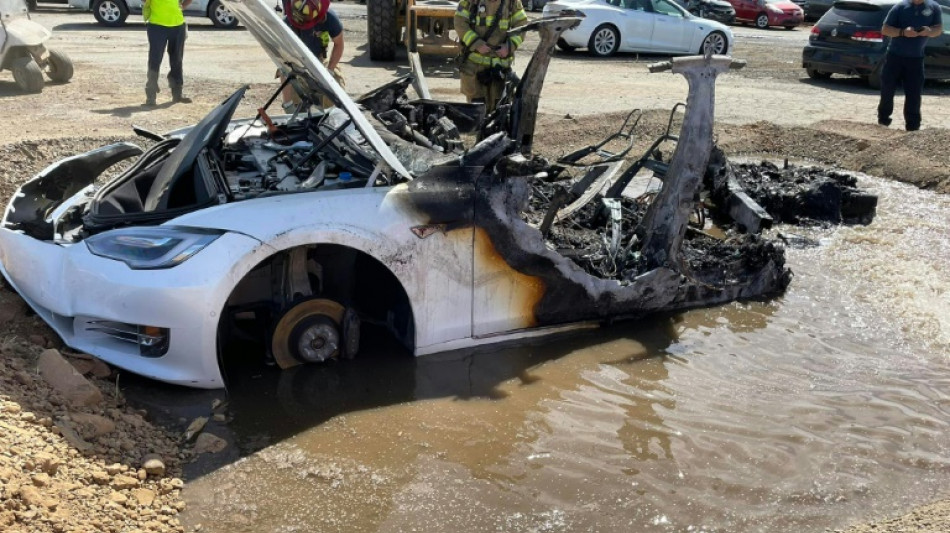
US firefighters adapt to 'new hazards' in electric car blazes / Photo: - - Sacramento Metropolitan Fire District/AFP

 Germany blames Russia for airport drone incident, hits back with sanctions
 Iran president urges return to truce, hails Russian support

 Aster and World Liberty Financial Launch USD1 RWA Boost: Phase 1, Offering 125M $WLFI + 6.25M USD1 in Rewards

 Tronchon sprints to Vuelta stage 10 win, Mas keeps red jersey

 Germany defender Rudiger announces international retirement
 Musk defends AI data centers, slams EU rules at G20
 Activists blame Kenya for Ugandan opposition figure's plight

 Iran president offers US olive branch, hails Russian support

 TrustFinance Community Choice Awards 2026 Opens Global Voting

 Nepal disaster a climate 'warning signal': foreign minister

 France winger Diaby returns to Leverkusen until 2031

 Barcelona confirm Jesus arrival from Arsenal

 EU official says it's not time to 'normalize' Russia at G20 finance talks

 RedHill Announces Transformational Acquisition of Commercialization Rights to Ferring’s Rebyota® and Clenpiq®
 TrendEadvisor Launches Global Multi-Asset Platform Combining Online Investing with Social Trading

 India's top court drops criminal cases against protesters

 Philippine couple married in hip-deep floodwaters

 Villa sign Senegal winger Mbaye from PSG

 Former Peru minister last-minute contender for UN labour agency helm

 Messi legacy will 'live forever', says Beckham
 'Literally tasting the smoke': Malaysians suffer as haze worsens

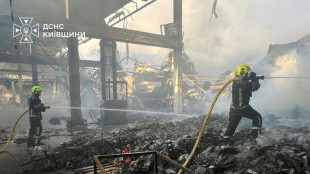 Kyiv's defences, 'hybrid' threat from Moscow headline EU talks

 Oil extends gains, stocks mostly down as Trump issues fresh Iran warning
 ThinkMarkets Expands Weekend Trading Offering, Launches Weekend League Competition

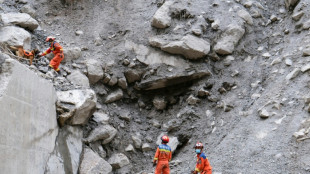 Tibet activists accuse China of downplaying floods

California firefighters ended up using a water-filled pit to douse stubborn flames in a Tesla's battery compartment earlier this month, illustrating the distinct difficulties in battling electric vehicle blazes.
As the number of electric cars on America's roads has jumped, fire crews have had to learn how to attack flames in them that can require hours -– and thousands of gallons of water -– to put out.
Though they can require particular procedures to fight, early indications point to fires in battery-powered cars being no more frequent than their fossil fuel-powered cousins, yet the US government is still gathering data.
US carmaker GM announced Thursday a new training initiative for emergency responders and Tesla has put out guides on how to get a burning battery bank under control. But it's still up to crews in the field to handle these fires.
"We're kind of just creeping into the future of firefighting," said Capt. Parker Wilbourn, a spokesman for the Sacramento Metropolitan Fire District, which handled the burning Tesla.
"This is a new age fire and so we're having to adapt and find solutions," he added.
The main difference with electric vehicles is their power source, and lithium-ion batteries burn hot, fast and require large amounts of water to fully extinguish when they catch fire.
Tesla, which dominates America's electric vehicle market, says it can take 3,000-8,000 gallons (11,000-30,000 liters) of water to put out and cool a battery fire.
"Always establish or request additional water supply early," Elon Musk's car company recommends in its emergency response guide.
Meanwhile, electric-powered vehicles are a steadily growing minority of the over the 275 million vehicles on the road in the United States.
Electrics and hybrids represented nearly 10 percent of US car purchases last year, according to Cox Automotive.
In the case of the June 9 Tesla fire in California, the car was seriously damaged in a crash about three weeks prior and was parked at a junkyard waiting to be dismantled when it started to burn.
- Risk of 'thermal runaway' -
Investigators were working to figure out what caused the fire that took some 4,500 gallons of water to douse, but said there was no indication humans had sparked the blaze.
The batteries can reignite hours or even days after an initial incident, with Tesla recommending the monitoring of battery temperatures for at least 24 hours after a fire.
"It's not necessarily that they're more dangerous," said Michael Gorin, a program manager at nonprofit National Fire Protection Association (NFPA), referring to electric cars.
"It's just that it's a new technology, a new set of hazards," he added.
He noted electric car blazes don't appear to be more frequent or dangerous than in fossil fuel-powered vehicles, but America's road safety agency NHTSA says it does not have enough data to reach conclusions about the rate at which they catch fire.
Lithium-ion batteries can however undergo so-called "thermal runaway" –- an ominous sounding term that refers to an uncontrolled increase in temperature and pressure -– in one cell that can spread to another in a bank of batteries.
The US accident investigation agency NTSB warned in late 2020 of that and other risks linked to the batteries, and recommended car makers follow a common template for their fire response guides in order to help emergency crews.
Fire crews around the world have had to learn the particularities of dealing with the tenacious fires in electric car batteries, and over 250,000 emergency responders in the United States have done training with NFPA, the fire prevention non-profit.
“But I believe it's 1.1 million firefighters in the United States today," said Gorin, an NFPA program manager.
GM, in announcing its new training initiative, noted that a key part of encouraging "mass adoption" of electric vehicles is to "support those who play a vital role in the responsible deployment" of the cars: firefighters.
The perception of the vehicles' safety is key, especially after GM advised owners of some electric Chevrolet Bolt cars last year not to park them indoors or charge them unattended overnight, before initiating a massive recall of all model years.
Wilbourn, the California fire captain, said one way to ensure safety in the booming electric car market could be some kind of internal fire firefighting capacity built into electric cars.
"Maybe one of those solutions is putting that back on the manufacturer," he said, noting fire suppression is already a requirement in homes and businesses.
A.P.Maia--PC