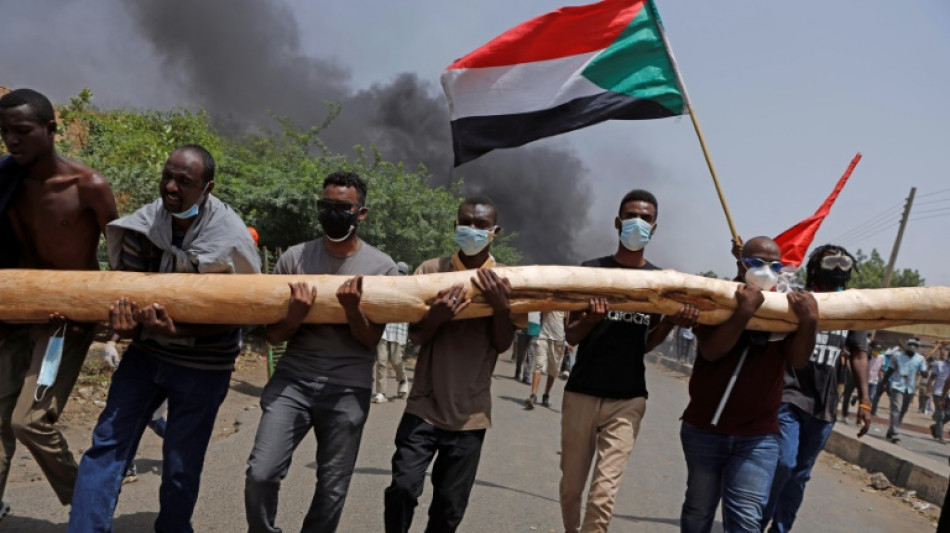
Nine anti-coup protesters killed in Sudan mass rallies / Photo: - - AFP

 KUFOS Signs MoU With Old Dominion University to Expand Academic Ties

 Karen Wazen Launches First Standalone Boutiques in Cairo

 Municipal Elections: How Service Failure Becomes a Public Health Crisis in South Africa

 Rene Eyre Revisits Autobiographical Performance 'Say A Little Prayer' in London

 UAE's HCT Holds Record Graduation and Announces Major Training Expansion

 NASA Awards $10B Lunar Contract Framework to SpaceX, Blue Origin

 Katy Perry Tells Fans Ex-Husband Russell Brand 'Should Be in Jail' During UK Concert
At least nine Sudanese demonstrators were killed Thursday as security forces sought to quash mass rallies of protesters demanding an end to military rule, pro-democracy medics said.
In one of the most violent days this year in an ongoing crackdown on the anti-coup movement, AFP correspondents reported security forces firing tear gas and stun grenades to disperse tens of thousands of protesters.
"Even if we die, the military will not rule us," protesters chanted, urging the reversal of an October military coup by army chief Abdel Fattah al-Burhan that prompted foreign governments to slash aid, deepening a chronic economic crisis.
At least seven of the nine killed were shot in the chest or the head, the Central Committee of Sudan Doctors said, raising the overall death toll to 111 from protest-related violence since October.
One of them was a minor, the doctors said, killed by "a bullet in the chest".
"Down with Burhan's rule," crowds chanted, with protests and violence flaring in both the capital Khartoum and its suburbs, including the twin city of Omdurman, on the other side of the Nile river.
Security forces fired powerful water cannons, as protesters set fire to tyres.
Medics also reported "several attempts to storm hospitals in Khartoum," with security forces firing tear gas into one hospital, where some of those injured during the protests had been taken.
Protests in Khartoum were larger than normal, and beyond the capital, demonstrations also took place in Wad Madani in the south, the western Darfur region, the eastern states of Kassala and Gedaref as well as the city of Port Sudan, witnesses said.
Internet and phone lines had been disrupted since the early hours of Thursday, a measure the Sudanese authorities often impose to prevent mass gatherings.
By Thursday evening, communications were partially restored.
Security was tight in Khartoum despite the recent lifting of a state of emergency imposed after the coup.
Troops and police blocked roads leading to both army headquarters and the presidential palace, witnesses said. Shops around the capital were largely shuttered.
- 'Violence needs to end' -
Demonstrations continued in Omdurman as night fell with crowds trying to remove security barricades in a bid to cross bridges to reach Khartoum, witnesses said.
Thursday's rallies showed a "change in the balance of power in favour of the mass movement and its goals of seizing complete civil authority and defeating the coup," said the Forces for Freedom and Change, an alliance of civilian groups whose leaders were ousted in the coup.
UN special representative Volker Perthes said Thursday that "violence needs to end", while the US embassy in Khartoum urged restraint and "the protection of civilians so that no more lives are lost".
The latest protests come on the anniversary of a previous coup in 1989, that toppled the country's last elected civilian government and ushered in three decades of iron-fisted rule by Islamist-backed General Omar al-Bashir.
It is also the anniversary of 2019 protests demanding that the generals, who had ousted Bashir in a palace coup earlier that year, cede power to civilians.
Those protests led to the formation of the mixed civilian-military transitional government which was toppled in last year's coup.
Sudan has been roiled by near-weekly protests as the country's economic woes have deepened since Burhan seized power last year.
Alongside the African Union and regional bloc IGAD, the United Nations has been attempting to facilitate talks between the generals and civilians, but they have been boycotted by the main civilian factions.
The UN has warned that the deepening economic and political crisis has pushed one-third of the country's population of more than 40 million towards life-threatening food shortages.
A.Santos--PC

