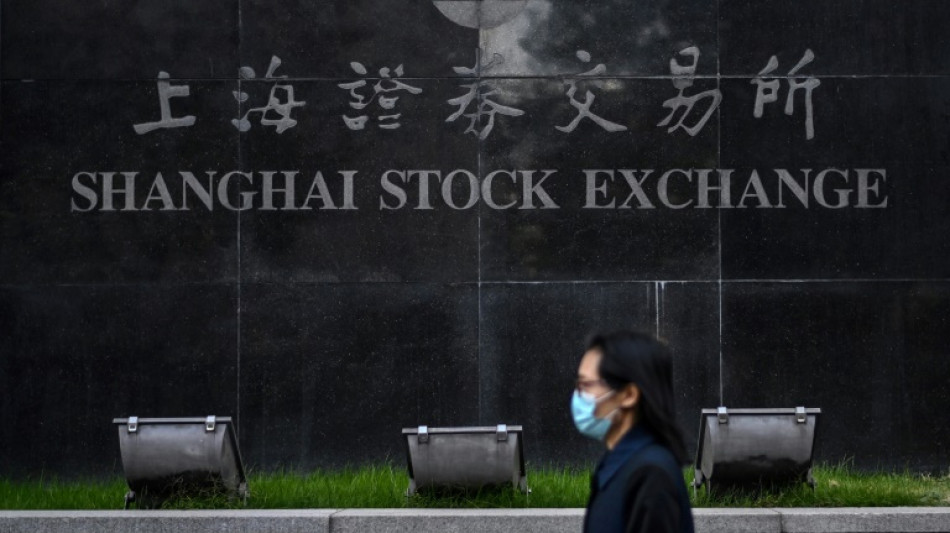
Asian markets drop with traders gripped by recession fear / Photo: Hector RETAMAL - AFP

 KUFOS Signs MoU With Old Dominion University to Expand Academic Ties

 Karen Wazen Launches First Standalone Boutiques in Cairo

 Municipal Elections: How Service Failure Becomes a Public Health Crisis in South Africa

 Rene Eyre Revisits Autobiographical Performance 'Say A Little Prayer' in London

 UAE's HCT Holds Record Graduation and Announces Major Training Expansion

 NASA Awards $10B Lunar Contract Framework to SpaceX, Blue Origin

 Katy Perry Tells Fans Ex-Husband Russell Brand 'Should Be in Jail' During UK Concert
Asian markets struggled again Friday following another selloff on Wall Street fuelled by recession fears, with warnings of a bleak outlook for the global economy as central banks slam on the brakes to battle soaring inflation.
Data showing US consumers -- the backbone of the world's top economy -- were growing increasingly reticent about spending dealt a fresh blow to equities Thursday, with the S&P 500 suffering its worst January-June since 1970.
With the war in Ukraine showing no sign of ending -- keeping energy costs elevated -- there is an expectation that borrowing costs will continue to rise and send economies into recession.
"If anyone thinks that equities can rally into the back of the year, they are making the assumption that the Fed is going to let go of its entire focus on price stability and step back from that," Seema Shah, at Principal Global Investors, told Bloomberg Television.
"We have a very different view. We think things are going to get pretty tough."
After a broad retreat on Thursday in Asia, markets battled to recover but with little conviction.
Tokyo, Shanghai, Seoul, Sydney, Mumbai, Singapore, Jakarta and Wellington all fell, though there were small gains in Bangkok.
Taipei shed more than three percent to fall into a bear market -- a 20 percent drop from its recent peak.
Hong Kong was closed for a holiday.
London, Paris and Frankfurt extended losses at the open.
Losses across world markets this week come after a rally last week fuelled by hopes that an economic slowdown or signs of recession would lead central banks to ease off their monetary tightening drive.
But comments from top finance chiefs, including Federal Reserve boss Jerome Powell, suggest they are willing to endure the pain of a contraction as long as they can rein in prices -- which are rising at their fastest pace in 40 years.
"With central banks shifting towards accepting that monetary tightening is impossible without some economic damage, the market narrative has swung 180 degrees this week," said SPI Asset Management's Stephen Innes.
He added that sharp rate hikes by the Fed and other central banks were being front-loaded in the hope inflation will ease earlier and allow them to cut borrowing costs more quickly.
"The hope is that by the November midterm elections, when the economy has chilled enough, it will be possible to pause or at least significantly slow further hikes to allow investors to enjoy a Santa Claus rally; otherwise, it could be a winter of discontent," Innes said.
But markets strategist Louis Navellier suggested that the economy was not in as bad a shape as feared.
"The amazing thing is that we are not in an 'earnings recession' and the analyst community remains largely positive," he said in a note.
"Frankly, the analyst community is smarter than the macro strategists that keep calling for a recession. The bottom line is fear sells, so negative news continues to overpower positive analyst comments."
Oil prices fell, putting the commodity on course for a third successive week of losses owing to concerns that a recession will hit demand.
That has overshadowed a tight market caused by sanctions on Russia over its Ukraine invasion and an expected jump in demand from China as it emerges from its Covid lockdowns.
Innes added: "With energy bulls having a good run this year, investors seem more inclined to take money off the table in the face of growing uncertainty as the energy crisis moves onto the global recession phase.
"As the adage goes, the best cure for high prices is high prices."
The grim economic outlook also weighed on Bitcoin, which was struggling below $20,000, having fallen as low as $18,632 earlier.
- Key figures at around 0720 GMT -
Tokyo - Nikkei 225: DOWN 1.7 percent at 25,935.62 (close)
Shanghai - Composite: DOWN 0.3 percent at 3,387.64 (close)
London - FTSE 100: DOWN 0.8 percent at 7,112.31
Hong Kong - Hang Seng Index: Closed for a holiday
West Texas Intermediate: DOWN 0.6 percent at $105.16 per barrel
Brent North Sea crude: DOWN 0.4 percent at $108.59 per barrel
Dollar/yen: DOWN at 134.85 yen from 135.75 yen Thursday
Euro/dollar: DOWN at $1.0453 from $1.0487
Pound/dollar: DOWN at $1.2115 from $1.2177
Euro/pound: UP at 86.25 pence from 86.08 pence
New York - Dow: DOWN 0.8 percent at 30,775.43 (close)
A.Santos--PC

