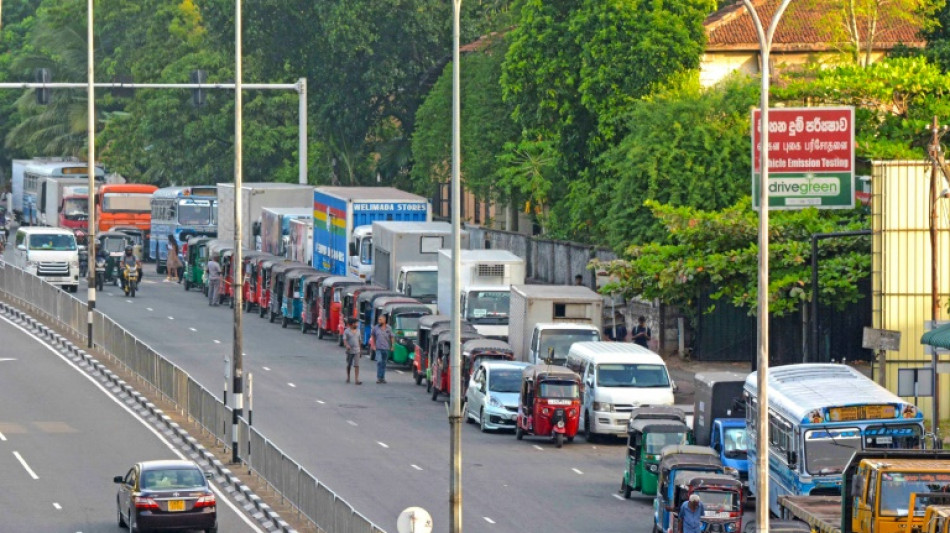
Sri Lanka grinds to a halt as fuel reserves shrink / Photo: - - AFP

 KUFOS Signs MoU With Old Dominion University to Expand Academic Ties

 Karen Wazen Launches First Standalone Boutiques in Cairo

 Municipal Elections: How Service Failure Becomes a Public Health Crisis in South Africa

 Rene Eyre Revisits Autobiographical Performance 'Say A Little Prayer' in London

 UAE's HCT Holds Record Graduation and Announces Major Training Expansion

 NASA Awards $10B Lunar Contract Framework to SpaceX, Blue Origin

 Katy Perry Tells Fans Ex-Husband Russell Brand 'Should Be in Jail' During UK Concert
Sri Lanka has less than a day's worth of fuel left, the energy minister said Sunday, with public transport grinding to a halt as the country's economic crisis deepened.
Petrol and diesel queues snaked through the capital for kilometres, though most pumping stations have been without fuel for days.
Energy minister Kanchana Wijesekera said petrol reserves in the country were about 4,000 tonnes, just below one day's worth of consumption.
"The next petrol shipment is expected between the 22nd and 23rd (of July)," Wijesekera told reporters in Colombo.
"We have contacted other suppliers, but we can't confirm any new supplies before the 22nd."
Last week, cash-strapped Sri Lanka announced a two-week halt to all fuel sales except for essential services to save petrol and diesel for emergencies.
Most shops were closed Sunday, with the situation expected to worsen when banks and offices reopen on Monday.
Desperate people were seen trying to flag down the few vehicles on the road hoping for a ride.
Privately owned buses, which account for two-thirds of the country's fleet, said they operated a skeleton service on Sunday as they were badly affected by the fuel shortage.
"We operated about 1,000 busses across the country out of the 20,000 owned by our members," Private Bus Operators Association chairman Gemunu Wijeratne said.
"The situation will certainly get worse tomorrow because we have no way of getting diesel."
He said services would be curtailed further on Monday and saw no immediate solution.
Three-wheel taxis -- a popular last-mile transport -- were also off the streets, with most seen in days-long queues to get a ration of six litres of petrol.
A shortage of foreign currency to finance even the most essential imports has led to the country's worst economic crisis, with its 22 million people facing severe hardships daily.
The country has also faced record-high inflation and lengthy power blackouts since late last year.
All non-essential government institutions and schools have been ordered shut until July 10 to reduce commuting and save energy.
Local media reported there had been sporadic clashes outside fuel stations.
Last week, troops opened fire to disperse a mob protesting against the military jumping the queue.
Sri Lanka is currently in talks with the International Monetary Fund for a possible bailout after the country defaulted on its $51 billion external debt in April.
A.Seabra--PC

