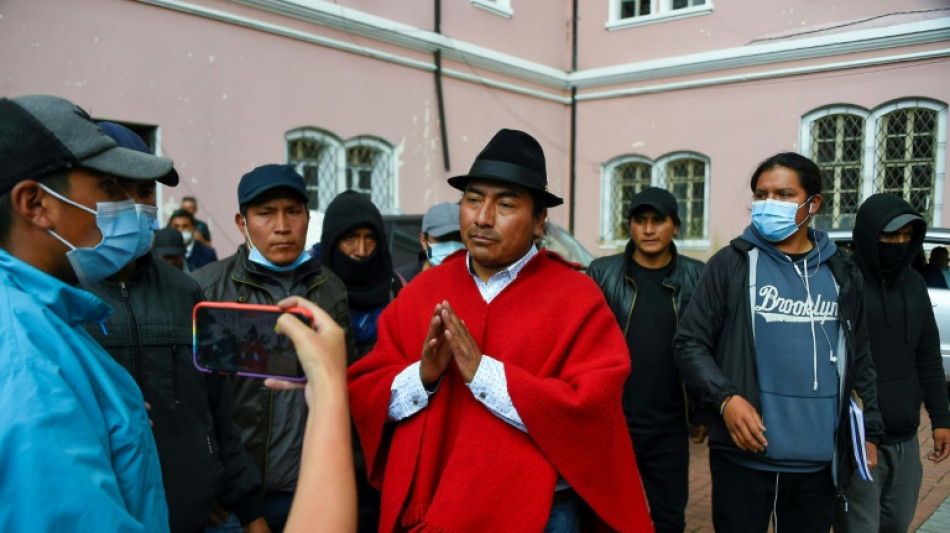
Indigenous protests cost Ecuador $1 bn, central bank says / Photo: Rodrigo BUENDIA - AFP

 KUFOS Signs MoU With Old Dominion University to Expand Academic Ties

 Karen Wazen Launches First Standalone Boutiques in Cairo

 Municipal Elections: How Service Failure Becomes a Public Health Crisis in South Africa

 Rene Eyre Revisits Autobiographical Performance 'Say A Little Prayer' in London

 UAE's HCT Holds Record Graduation and Announces Major Training Expansion

 NASA Awards $10B Lunar Contract Framework to SpaceX, Blue Origin

 Katy Perry Tells Fans Ex-Husband Russell Brand 'Should Be in Jail' During UK Concert
Eighteen days of protests over the cost of living by Indigenous Ecuadorans who blocked roads and oil wells cost the country at least $1 billion, the central bank said Monday as the movement's leader went on trial.
Of the total losses, more than three-quarters were incurred by the private sector and the rest by the State, specifically the all-important oil sector, central bank boss Guillermo Avellan told the Teleamazonas channel.
The protests, which stopped production at over 1,000 wells, saw Ecuador's oil production more than halved from about 520,000 barrels per day, according to the government.
By Sunday, three days after the government and protest leaders signed an agreement to end the crippling standoff, extraction had recovered to 461,600 barrels per day.
Crude is Ecuador's biggest export.
Protest leader Leonidas Iza, head of the powerful Confederation of Indigenous Nationalities (Conaie), made his first appearance Monday in a court in the town of Latacunga.
He was arrested on the second day of protests, and held for 24 hours before being freed pending trial for the illegal road closures.
The charge of paralyzing a public service is punishable by up to three years in jail.
An estimated 14,000 Ecuadorans took part in a mass show of discontent -- most of them in Quito -- against deepening hardship in an economy dealt a serious blow by the coronavirus pandemic.
The protest was called by Conaie, which is credited with unseating three presidents between 1997 and 2005.
Last Thursday, the government and protest leaders signed an agreement to end the sometimes violent demonstrations that left six people dead and more than 600 injured.
The government agreed to reduce already-subsidized fuel prices by up to eight percent -- less than the 21-percent cut sought by protesters but enough to convince them to leave the streets where many had manned burning roadblocks.
Avellan said the augmented fuel subsidy will cost the State about $3 billion a year.
The government had also increased a monthly aid payment to the country's poorest inhabitants, halted the repayment of small bank loans held by rural Ecuadorans, and agreed to review certain mining activities in Indigenous areas.
Prior to the unrest, said Avellan, the central bank had anticipated raising its economic growth projection for 2022, currently at 2.8 percent.
Raul Ilaquiche, a lawyer for Iza, told AFP his trial would last several days, with several witnesses to be called.
Some 2,000 Iza supporters gathered near the court building, blocked off by metal fences and police, according to municipal officials.
V.Dantas--PC

