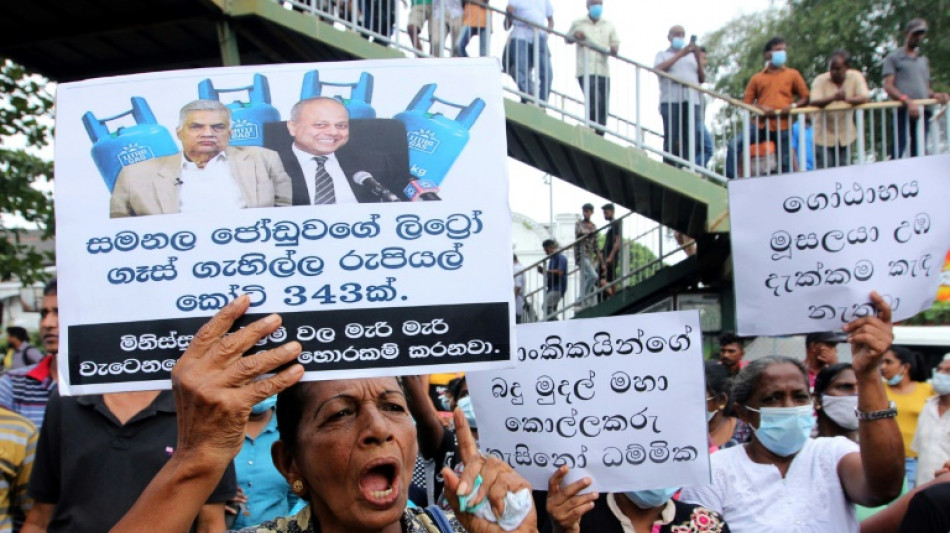
Sri Lanka hikes interest rates, warns trouble ahead / Photo: - - AFP

 Belgian PM Bart De Wever Given New Deadline to Resolve €10 Billion Budget Deadlock

 $1.8 Billion Pledged for Biodiversity at COP17 as Monaco Reaffirms Commitment

 Phoenix Symphony Resumes Performances Amid Financial Uncertainty

 Turkish Energy Minister Highlights Qatar as Key Partner for Regional and Global Energy Security

 London Museum Granted 24/7 License Ahead of November Opening

Cash-strapped Sri Lanka raised interest rates one percentage point Friday, the second sharp hike in three months, as the central bank warned of 80 percent inflation and a painful recession.
The Central Bank of Sri Lanka ramped up its benchmark deposit and lending rates to 14.5 percent and 15.5 percent respectively, after data showed inflation soared to a record 54.6 percent last month.
Officials said the hike was aimed at containing runaway prices, which were forecast to rise 80 percent by year's end, and reduce any build-up of demand pressures in the shattered economy.
Acute shortages of food and fuel, alongside lengthy electricity blackouts, have led to months of widespread anti-government demonstrations calling for President Gotabaya Rajapaksa's resignation.
The central bank said the economy could go into a recession this year, having grown 3.7 percent last year and contracted 3.6 percent in 2020.
Prime Minister Ranil Wickremesinghe told parliament the economy could shrink as much as 7.0 percent.
The bank said economic activity in the second quarter of this year had been severely affected by electricity and fuel shortages, while all non-essential offices and schools have been told to shut in a bid to reduce commuting and save scarce energy.
The country is officially out of petrol and diesel, while fresh supplies are at least two weeks away.
The government defaulted on its $51 billion foreign debt in April and is negotiating a possible bailout with the International Monetary Fund.
"Significant progress has been made with respect to negotiations with the IMF towards reaching a staff-level agreement on the Extended Fund Facility (EFF) arrangement in the near term," the central bank said.
It added that negotiations were also underway with several bilateral and multilateral partners to secure bridging financing.
S.Pimentel--PC

