After war, Syrians in Jordan find joy and jobs in dance / Photo: Khalil MAZRAAWI - AFP

 At last: Straight sets win over Tabilo puts Zverev in US Open last 16

 Jovic 'loses sanity five times over' to oust friend Eala in US Open epic
 China's memories of Mao fade to nostalgia 50 years after his death

 US envoys discuss with Putin 'substantive' plans for steps to end Ukraine war

 Zheng stuns Keys as US Open upsets dim American hopes
 Jovic 'loses sanity five times over' to oust Eala and book Gauff clash

 'Like a jewel': Japan's luxury ice revered by bars worldwide
 'The flood is coming': How a Nepal principal saved 900 students

 Kiss's winning run ends as Argentina hold Australia to draw

 Alcaraz excited to face 'dangerous' Paul for US Open quarter-final berth

 Prince William to represent King Charles III at Norway late King Harald's funeral

 Inter and Roma roar back to win thrillers and share top spot

 Don't stop them now: fans party for Freddie Mercury's 80th birthday

 AFP photographer wins top prize for Madagascar protest coverage

 Keys: 'I felt like I couldn't play tennis'

 Simmonds stars as Pau upset Montpellier

 Inter roar back in five-goal thriller with Napoli

 Haaland keeps Man City perfect in Premier League, blunt Spurs held

 Hamilton worried by Ferrari pace while Antonelli prepares for a fight

 Vuelta stage 15 shortened due to extreme heat, Mas consolidates lead

 Putin meets US envoys for Ukraine war talks

 Modric available for Croatia in Nations League

 Potapova upsets 2025 US Open runner-up Anisimova

 Gasly a 'class act' says Alpine boss after Monza pole

 Athletic Bilbao crush Simeone's flat Atletico
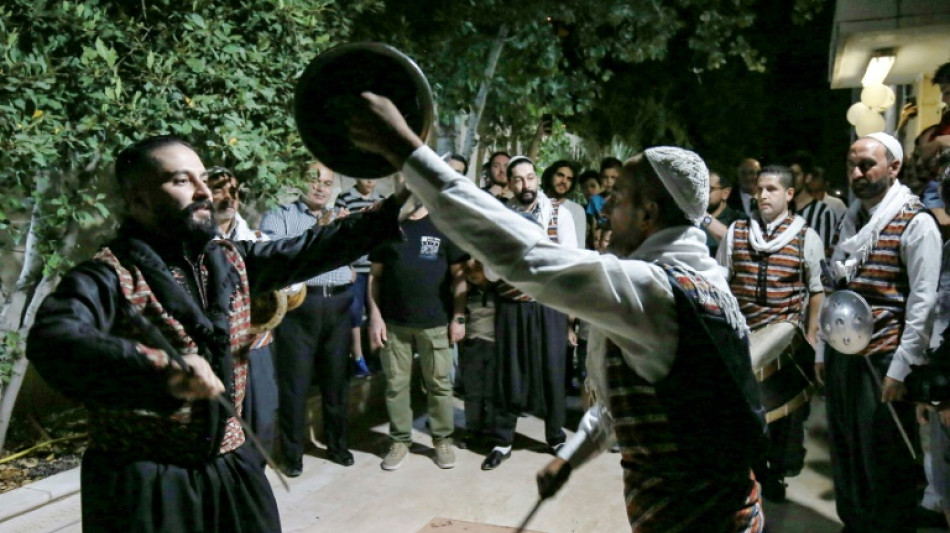
Singing joyfully to beating drums, Syrian refugees who fled brutal civil war perform traditional "Arada" dances in neighbouring Jordan, honouring their home culture and earning extra income.
Their performances, featuring traditional robes and whirling swords, have become increasingly popular in Jordan for marking festivities like weddings and parties.
"They add an atmosphere of joy to our celebration," said Fahed Shehadeh, who hired the Bab al-Hara dance troupe in the capital Amman to mark the graduation of his two sons from university.
"I am Jordanian but of Syrian origin, and I brought the group because I admire their dancing skills, music, clothes and their songs," said 55-year-old Shehadeh, celebrating with family, friends and neighbours.
Traditionally seen at weddings, the popularity of Arada -- rooted in the Arabic for a "performance" -- has had its songs modified to fit various celebrations.
A troupe typically consists of 10 to 20 dancers, wearing loose-fitting black trousers, white cotton shirts, embroidered vests, white skullcaps and a shawl wrapped around the waist.
- Whirling swords -
Swords and decorative shields are worn, and the dance culminates in members spinning their blades in the air, before engaging in ceremonial fighting.
The troupe leader, Moutaz Boulad, 60, said Arada had grown in popularity in Amman, with daily events in the summer months and several engagements each week in winter.
Boulad, who left Syria in 1988, says the shows have become an important means to earn cash for some of those who fled the war that erupted in 2011.
"Some of the dancers were not good when they first came to us, but they learned from my sons and I in order to improve their financial situation," he said.
Syria's war is estimated to have killed nearly half a million people and displaced millions; more than 6.6 million fled to neighbouring Jordan, Turkey and Lebanon.
Jordan hosts almost 650,000 Syrians registered with the United Nations, but Amman estimates close to 1.3 million Syrians have arrived since 2011.
The UN has said that close to 80 percent of Syrians in Jordan live below the national poverty line, surviving on three dollars per day or less.
Boulad said his dancers came from various professional backgrounds.
"Most dancers have different jobs beside the Arada," Boulad said. "Some are university students, accountants, restaurant workers, tailors and electricians -- but this is something that gives an amount of money to help cope with life."
For dancers like Ahmed Abu Shadi, 43, who fled Syria in 2013 and works as a plumber, performing the Arada helps him raise his three children.
"With plumbing there are days when I work, and days with no customers," he said. "For Arada, they pay me 15 dinars ($20) every time I go out to dance. Although it is a small amount, it helps in my life."
- 'Identity, heritage' -
Another member, who worked in a medical laboratory and asked for his name to be withheld, fled the Syrian city of Homs in 2018.
The dancing helps add some $300 each month to his regular $700 salary from the laboratory to support his family, while they wait for applications through the UN refugee agency to be processed.
"I have applied for asylum through the UNHCR and hope we can start a new life abroad," he said.
Despite displacement and financial challenges, dancing the Arada remains a key part of Ahmed Abu Shadi's life.
"This dance is a very important part of our Syrian identity, heritage, culture and our daily life -- we must preserve and teach it to our children and grandchildren," he said.
"This art is in my blood, I love it, I can't imagine myself, my life without this."
He dreams of one day dancing again on his home soil.
"I will continue to dance wherever I go," he said.
"But of course, I prefer that the situation improves one day so that we can all return to our country, Syria."
B.Godinho--PC