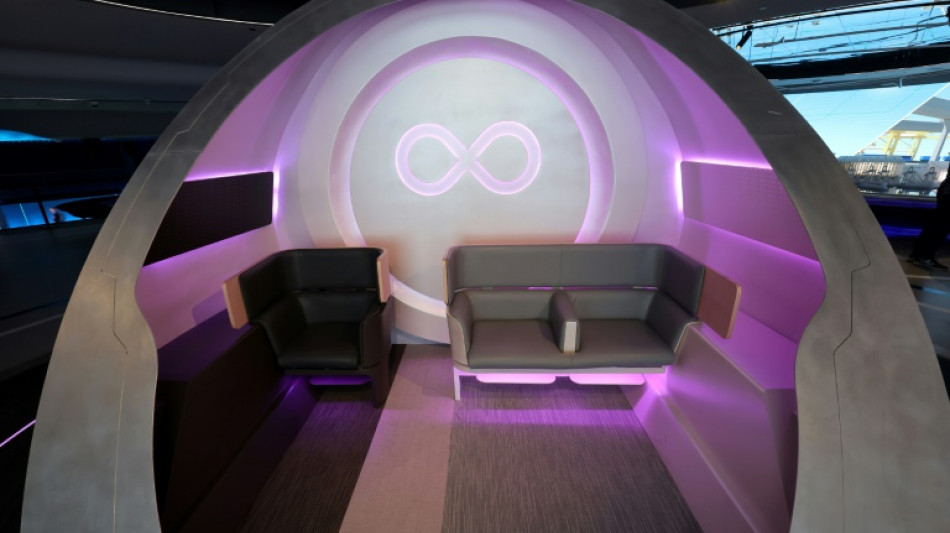
Musk's hyperloop still captivates despite decade of setbacks / Photo: Giuseppe CACACE - AFP/File

 Carreras reverts to fullback as Argentina change four for Australia Test
 Wilson back to lead Australia as Kiss rotates team for Argentina
 Yen surges on new intervention talk, US stocks rally

 Japan's Ueda fires Lille top of Ligue 1 on debut

 Arsenal chief executive reveals 'dynasty' ambition
 Spanish PM says no 'solid proof' Morocco planned migrant rush

 Iran war is not a war, US VP Vance says

 Khachanov stuns third-seeded Auger-Aliassime in US Open second round
 Bordeaux facing sixth-tier football after French federation upholds relegation
 Stoic Verstappen looking beyond 'painful' Monza weekend
 OpenAI begins rollout of new powerful AI model GPT-6 Astra

 FIFA blasts UEFA 'smear campaign,' fights World Cup plan disclosures
 Zelensky hopes to host US envoys in Kyiv in 'coming days'

 Martinelli joins Al-Hilal from Arsenal for reported £60 million
 Tesla's semi-autonomous driving could be adapted to EU norms: France

 37 people die from fumes during oil pipeline theft in Nigeria: NGO

 Ahead of elections, Israel tests West's patience on West Bank violence
 Antonelli will obey Mercedes orders to help 'tow' teammate Russell
 UK fintech Revolut gains conditional US banking licence

 Mara sisters channel childhood energy for twins performance at Venice
 UN's Sudan probe says foreign fighters fuelling conflict
 Violence erupts at S.Africa anti-migrant protest
 Nothing left: Nepal flood survivors face loss and uncertainty

 Tesla to launch self-driving 'Cybercab' in Texas
 Europe struggles to respond as Russia escalates shadow warfare
A decade ago, Elon Musk proposed a new form of transport that would shoot passengers through vacuum tunnels in levitating pods at almost the speed of sound -- he called it "hyperloop".
Since then, cities from Abu Dhabi to Zurich have been touted as destinations, research projects have gobbled up millions of dollars and a host of commercial ventures have sprung up -- even Richard Branson got involved.
"The transportation network has not had a new mode for over 100 years," said Rick Geddes, a transport infrastructure expert at Cornell University in the United States, who compared the excitement to the early days of aviation.
But nobody has come close to making the hyperloop work.
The difficulties have ranged from costs and finding suitable locations, to simply persuading people that travelling through a narrow tunnel at speeds faster than a jet plane is a good idea.
Musk's initial proposal would have been a "barf ride", transport blogger Alon Levy wrote at the time.
Despite all the problems, though, the hyperloop idea still energises university campuses, corporate board rooms and city halls across the world.
Hidde de Bos, a 22-year-old engineering student, first heard of it four years ago.
His university at Delft in the Netherlands excelled in competitions run by Musk's SpaceX firm, which invited students to develop pods to fire through vacuum tunnels.
- Musk returns -
"It made me really excited to see what the possibilities were," he told AFP.
He is now chief engineer of Delft Hyperloop, a non-profit university spin-off.
De Bos said the SpaceX competitions, which were discontinued in 2019, were too focused on speed and became like "drag races in a tunnel".
Now, his team is taking part in a student-led competition, European Hyperloop Week, which he hopes will refocus on sustainable energy and developing levitation systems.
And Musk himself recently gave a jolt to the hyperloop fraternity by tweeting that his tunnelling firm The Boring Company would "attempt to build a working Hyperloop" in the coming years.
Musk first mentioned the idea in a 2012 media interview before publishing a white paper about it a year later.
But his direct involvement has been sporadic, and he has always encouraged others to develop the idea.
Los Angeles-based firm Hyperloop TT, among the first and most enthusiastic firms to run with Musk's idea, welcomed his return.
Rob Miller, the firm's chief marketing officer, told AFP it was "further validation" for the concept.
- 'More cautious' -
But he stressed that hyperloop was now much bigger than just one man.
Bearing out his point, new proposals have emerged in recent months from local authorities ranging from Italy to India.
However, proposals are one thing, and revolutionising public transport is quite another.
In its early years, Hyperloop TT signed exploratory deals in India, China and beyond.
In 2019, the firm promised a 10-kilometre (six-mile) track would open in the UAE the following year.
None of these projects has come to fruition.
"We're a little more cautious now about those types of announcements," said Miller.
Virgin Hyperloop, a firm briefly helmed by Richard Branson but majority-owned by DP World, which runs Dubai's ports, has also had to scale back its promises.
- Prestige vs price -
It was the first company to fire humans along a hyperloop test track back in 2020.
Branson had mooted a 45-minute journey between London and Scotland.
But Virgin Hyperloop recently abandoned the idea of carrying passengers altogether, shed half its staff and is now focused on a potential freight line in UAE.
Musk has also promised various hyperloop projects that failed to materialise.
Virgin Hyperloop and The Boring Company did not respond to AFP requests for comment.
Critic Alon Levy says the hyperloop is caught between unrealistic prestige projects across short distances and longer routes that cost too much.
The Abu Dhabi-Dubai route promised by Hyperloop TT is just 130 kilometres, "not even a distance for high-speed rail", he said.
But potential routes like New York to Miami or Chicago would need around $50 billion just to get started, Levy reckons.
- 'Bring it to life' -
"You don't get that from private investors," he told AFP.
Levy does see one ray of light -- newer designs featuring longer bends seem to have resolved the "barf" problem.
And enthusiasts still radiate positivity.
"We'll keep doing what we're doing and we'll bring it to life," said Miller.
But he conceded his firm had been "overly optimistic about timelines".
He now predicts the first city-to-city track within five years but won't divulge the location.
Geddes is also optimistic about the future, though he also reflected that past promises weighed heavy.
"We used to say five to 10 years," he said. "That was five years ago. Maybe it's five to 10 years now."
A.S.Diogo--PC