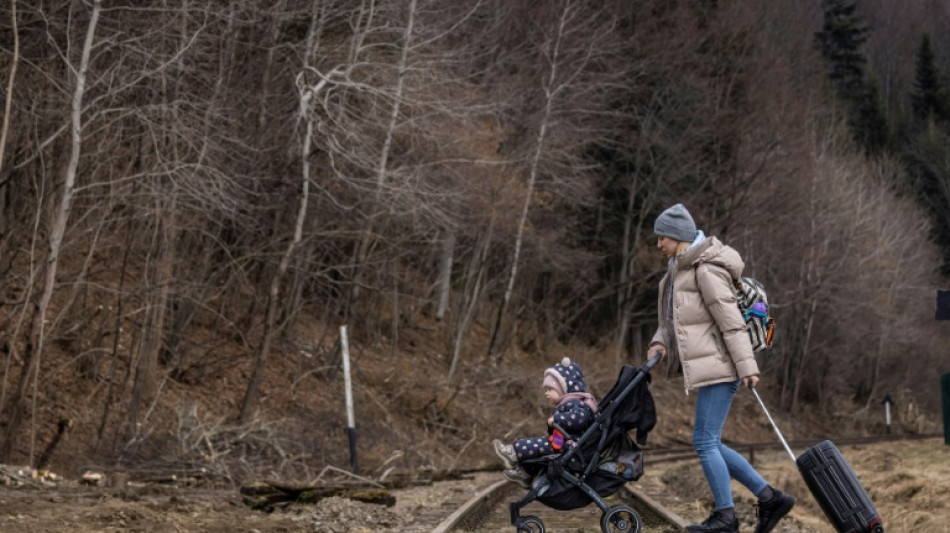
War fatigue, Europe inflation hit Ukraine aid response / Photo: Wojtek RADWANSKI - AFP/File

 Carreras reverts to fullback as Argentina change four for Australia Test
 Wilson back to lead Australia as Kiss rotates team for Argentina
 Yen surges on new intervention talk, US stocks rally

 Japan's Ueda fires Lille top of Ligue 1 on debut

 Arsenal chief executive reveals 'dynasty' ambition

 Spanish PM says no 'solid proof' Morocco planned migrant rush

 Iran war is not a war, US VP Vance says

 Khachanov stuns third-seeded Auger-Aliassime in US Open second round
 Bordeaux facing sixth-tier football after French federation upholds relegation

 Stoic Verstappen looking beyond 'painful' Monza weekend

 OpenAI begins rollout of new powerful AI model GPT-6 Astra

 FIFA blasts UEFA 'smear campaign,' fights World Cup plan disclosures

 Zelensky hopes to host US envoys in Kyiv in 'coming days'

 Martinelli joins Al-Hilal from Arsenal for reported £60 million

 Tesla's semi-autonomous driving could be adapted to EU norms: France

 37 people die from fumes during oil pipeline theft in Nigeria: NGO

 Ahead of elections, Israel tests West's patience on West Bank violence

 Antonelli will obey Mercedes orders to help 'tow' teammate Russell
 UK fintech Revolut gains conditional US banking licence

 Mara sisters channel childhood energy for twins performance at Venice

 UN's Sudan probe says foreign fighters fuelling conflict
 Violence erupts at S.Africa anti-migrant protest

 Nothing left: Nepal flood survivors face loss and uncertainty

 Tesla to launch self-driving 'Cybercab' in Texas

 Europe struggles to respond as Russia escalates shadow warfare
Ruslana Hrytskiv has helped "dozens, maybe hundreds" of refugees since Russia invaded Ukraine, but her task is getting tougher as war fatigue sets in and Europe battles soaring prices and record inflation.
When she tried to find shoes for Ukrainian children on Facebook this week, she found herself entangled instead in a debate on the health aspects of wearing second-hand footwear.
Her argument that the mother, who gave birth to a third child en route to Prague, simply could not afford something new for her twins failed to impress.
"The response is slower than it used to be," said Hrytskiv, a Ukrainian who has lived in the Czech Republic for over two decades.
"At the beginning, people were unexpectedly forthcoming," she noted.
Hrytskiv's experience is echoed by aid organisations across eastern Europe, which has welcomed hundreds of thousands of Ukrainian refugees, mostly women with children.
Like the rest of the continent, the region is grappling with runaway prices that make people think twice about their spending.
The record-high inflation, which reached 15.6 percent in Poland in June for instance, is fuelled by a spike in energy prices due largely to the Russian invasion that began on February 24.
"We can see somewhat less interest now in helping than at the beginning of the war," said Eszter Bakondi-Kiss, a volunteer with the Hungarian Habitat for Humanity group coordinating refugee accommodation.
"We received far more offers or applications to be a part of these programmes then," she told AFP.
Almost five months into the conflict, those helping Ukrainian refugees detect a slowing aid response as the region battles soaring living costs.
- Economic woes -
In neighbouring Slovakia, the People In Need aid group has seen donations fall from 650,000 euros ($661,000) in February and March to 85,000 euros in May, said spokeswoman Simona Stiskalova.
"This is only natural. When the cause is hot, there's interest in the beginning and then this interest dwindles," said Svilena Georgieva, head of the Bulgarian foundation Za Dobroto.
"But 90 percent of the funds we receive are still for the Ukraine campaign," she told AFP.
For Prague sociologist Daniel Prokop the number of people threatened with poverty is growing.
"And there may be concerns that aid to Ukraine would actually overshadow aid to locals," he told AFP.
Klara Splichalova, head of the Prague-based Donors Forum, said that although donations had been more substantial when the war started, the inflow of funds was nowhere near drying out.
"And since no peaceful solution seems to be in sight, people are aware it is necessary to help in the long term and repeatedly."
Lavinia Varodi, from the Save the Children Fund in Romania, said individuals and companies were giving less because they "have exhausted their budgets".
"What remains are organisations that are larger and allocate special funds for this category," she told AFP.
Agnes Baranyai, a volunteer at a Budapest hostel hosting refugees, blamed the diminished willingness to help in part on summer holidays.
- Changing needs -
"Everyone wants to return a little to living their own lives," she said.
Another factor was fewer incoming refugees.
"The will to help remains the same but the needs are changing," said Dominika Pszczolkowska, migration researcher at the University of Warsaw.
"The Ukrainians are now trying to integrate into the labour market and they do not seek social benefits, which is appreciated by Poles," she told AFP.
Nearly 300,000 Ukrainian war refugees have found a job in Poland, albeit often below their education or skill level.
Poland has handled 4.5 million refugees altogether, with some staying and others moving to other countries.
"Ukrainian citizens who arrived in Poland on account of the war... are plugging the gaps in certain sectors," Poland's family ministry said on Friday.
The smaller Czech Republic has provided jobs to 77,000 out of nearly 400,000 Ukrainian refugees.
They include a mother-of-two from Odessa, accommodated by Hrytskiv shortly after the invasion, who now works at a bakery in another town.
"Companies don't want to give them long-term contracts, which is a bit of a problem, but they give them jobs at once," said Hrytskiv, who is now hosting another refugee.
"I'm always ready to start the car and go and help. I can see how grateful they are, and that's the best reward."
burs-frj-amj/bp
P.Cavaco--PC