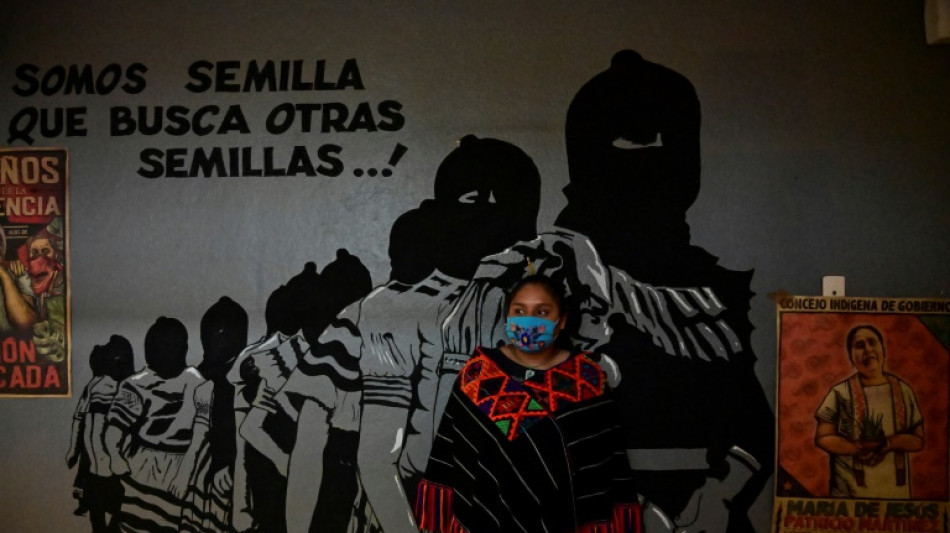
Mexican schoolboy set on fire for being Indigenous / Photo: PEDRO PARDO - AFP/File

 How a Dostoevsky novella took TikTok by storm

 Zverev goes the distance again to reach US Open third round
 German AfD's love for Simson mopeds dismays Jewish family behind brand

 Two trapped tunnel workers rescued in Nepal 'miracle'

 Ex-Pakistan coach Gillespie tells Javed 'look in the mirror' over sackings

 Monfils falls to Tien in US Open in Grand Slam farewell

 Arsenal brace for Chelsea test as Spurs seek spark

 Efficient Rybakina reaches US Open third round

 Taiwan boxer Lin considered 'graceful exit' after Paris Games gold

 'I miss my home': Cambodians displaced by conflict start over
 Ailing Auger-Aliassime falls at US Open as Swiatek, Osaka and Gauff advance

 Tesla launches self-driving 'Cybercab' in Texas

 'Wallace & Gromit' creators turn 50 with spook-tacular Shaun yarn

 New York's Muslims reclaim their city after 9/11 backlash

 Premier League transfer windfall a lifeline for ailing French clubs
 Chile protesters see shades of Pinochet in new security plan
 Carreras reverts to fullback as Argentina change four for Australia Test

 Wilson back to lead Australia as Kiss rotates team for Argentina
 Yen surges on new intervention talk, US stocks rally

 Japan's Ueda fires Lille top of Ligue 1 on debut

 Arsenal chief executive reveals 'dynasty' ambition
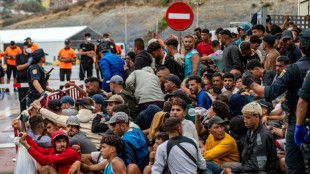 Spanish PM says no 'solid proof' Morocco planned migrant rush

 Iran war is not a war, US VP Vance says

 Khachanov stuns third-seeded Auger-Aliassime in US Open second round

 Bordeaux facing sixth-tier football after French federation upholds relegation

A Mexican schoolboy was set on fire and badly burned in a classroom -- his "only crime" was speaking an Indigenous language in a country struggling to end racial discrimination.
Two classmates are accused of pouring alcohol on Juan Zamorano's seat at a high school in the central state of Queretaro in June.
When the 14-year-old realized his trousers were wet and stood up, one of them set Zamorano on fire, according to his family.
He suffered second and third degree burns and was only this week discharged from hospital.
Juan had already suffered weeks of bullying because of his Indigenous Otomi roots, according to his family's lawyers, who filed complaints against the alleged attackers and school authorities.
With an estimated population of 350,000, the Otomi are one of dozens of Indigenous groups in the Latin American country.
The Otomi language is Juan's mother tongue "but he doesn't like to speak it much because it's a cause of ridicule, harassment and bullying," Ernesto Franco, one of the family's lawyers, told AFP.
The family has alleged to the media that even Zamorano's teacher harassed him because of his origin.
"She thinks that we're not her class, we're not her race," Zamorano's father, who described the attack as "attempted murder," told the newspaper El Universal.
- 'Recurring attacks' -
Queretaro state prosecutors have announced an investigation into the attack and the alleged perpetrators face possible legal proceedings.
President Andres Manuel Lopez Obrador said that if necessary, the country's attorney general's office might handle the case.
Juan's "only crime was speaking Otomi," tweeted Lopez Obrador's spokesman Jesus Ramirez, who said that eradicating racism was everyone's responsibility.
Mexico's National Institute of Indigenous Peoples urged the authorities to "sanction minors and adults involved in harassment and recurring attacks on minors."
Urgent measures are needed in schools to prevent further cases of discrimination and racism, it said.
Discrimination is common in Mexico, a country of 126 million where 23.2 million people identify as Indigenous and more than 7.3 million speak an Indigenous language, according to a 2020 census.
In a case in March, an Otomi woman accused staff at a restaurant in a trendy Mexico City neighborhood of preventing her from using the toilet, telling her it was only for customers.
- Systemic racism -
Around 40 percent of the Indigenous population complained of having faced discrimination in a survey published by the national statistics agency in 2018.
Almost half felt that their rights were respected little or not at all.
The survey also revealed prejudices against the Indigenous population.
Three out of 10 people questioned agreed with the statement: "The poverty of Indigenous people is due to their culture."
Cases like Zamorano's are not isolated but part of systemic racism, said Alexandra Haas, the Mexico head of the international charity Oxfam.
In 2019, an Oxfam study in Mexico found that speaking an Indigenous language, identifying with an Indigenous, Black or mixed ethnicity community, or having a darker skin tone, meant less chance of educational and labor advancement.
Mexico has a law aimed at preventing discrimination and has created institutions responsible for dealing with complaints.
Even so, Zamorano's case is a stark illustration of "how far discrimination can go," according to Haas, a former president of the country's National Council to Prevent Discrimination.
"We can't say that it was impossible to predict. There have been centuries of racial, Indigenous and very structural discrimination," she said.
P.Serra--PC