Johannesburg transport project digs into wounds of the past / Photo: EMMANUEL CROSET - AFP

 Africa bigger, US smaller - UN adopts new map

 Bad weather will not affect All Blacks, says captain Savea

 Mbappe misses penalty as Parrott lifts Betis past Real Madrid
 PSG still winless in Ligue 1 as Monaco go top

 Defending champion Alcaraz reaches last 16 at US Open

 Lyles ends season before Budapest due to injury flare ups
 US Republicans announce probe into environment groups

 Sabalenka survives despite 'tricky' weed smell at US Open
 S&P Revises Outlook on Freedom Holding Corp. and Core Subsidiaries to Positive

 Job growth but record-high diesel prices -- Trump's midterms mixed bag

 Women's NBA comissioner Engelbert to retire at season's end
 Luis Enrique extends contract as PSG coach until 2030

 Duplantis pulls out of Diamond League finals

 Defending champ Sabalenka, Pegula lead way into US Open fourth round

 UK hard-right party rallies behind leader after new donation scandal

 Nigeria's Dangote refinery looks to raise $1.6 bn in IPO
 Portugal extends talks to privatise national carrier TAP
 Brazil great Formiga says 2027 World Cup will 'change players' lives'
 Job growth, but surging diesel prices - Trump's midterms mixed bag
 Top seed Sabalenka powers into US Open fourth round
 Russia rights group boss fears post-election crackdown

 WHO says key warehouse destroyed by attack in Ukraine
 Hesson says Pakistan players used to 'chaos' after shake-up

 Bosnian Serb war criminal to be buried Monday, amid EU backlash
 Julio Iglesias faces new abuse complaint
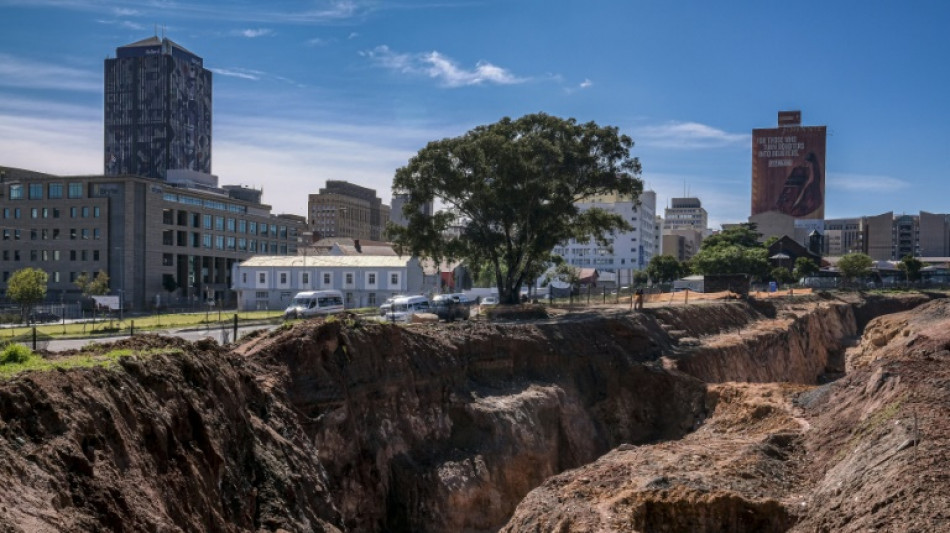
Off Johannesburg's main highway, surrounded by skyscrapers, heavy machinery has unearthed one of the city's original wounds -- a deep gash left by the 1880s gold rush.
The entire city centre is built over tunnels dug by generations of miners who extracted gold from the richest deposits the world has ever discovered.
The city of around six million grew around cavernous pits and mountainous dumps, which eventually became the physical barriers of racial segregation.
Now the rather poetic challenge of healing wounds both social and geological has fallen to property developers, who are turning this symbol of division into a bus terminal, connecting the city and the region.
"This is a gateway site," said Richard Bennett, marketing director for iProp, the company tasked with rehabilitating the site.
"It will allow the South African populace in Johannesburg and surrounds to gain easy access to public or effective transport."
- Connections -
In the 1880s, the mine was one of the first places where prospectors dug with pickaxes, and eventually dynamite, hauling the gold 40 metres (130 feet) back up to the ground.
After the easiest finds were depleted, this crevice -- which looks like a canyon in the middle of the city -- was simply filled with sand and used as a parking lot.
The sand has now been hauled off, readying the pit to be refilled with a cement-like material that is to support the construction of a new, large bus terminal.
The gold once mined there fuelled both fabulous wealth and deep social divides that persist to this day.
But the future of the city depends on connecting people with better transport and more walkable streets, said David van Niekerk, CEO of the Johannesburg Inner City Partnership, a group working to revive the city centre after decades of official neglect.
"Mixing is an important concept for the future of this city, and mixing in the widest possible sense," van Niekerk said.
"The vision that I certainly have for this city is to turn it into a walkable city," he added.
"A city that's walkable is a city that works for everyone, and I'm talking about from the homeless person to the major international corporate investor, and everyone in between."
It's a big challenge in a starkly divided country.
A World Bank study last year found that the top one percent of South Africans own 55 percent of the nation's wealth.
The wealth of the poorest half of the country is actually negative -- their debts outweigh their assets.
The top 0.01 percent, or about 3,500 people, own more than the bottom 90 percent, representing 32 million people.
- Miners' suffering -
Much of that inequality stems from the early days of mining, which took a tremendous and largely uncounted toll on the mostly black miners, while a few owners -- wealthy whites -- pocketed most of the profits.
"Those early mines were done very chaotically and very hastily. There were no proper plans, and a lot of people died... in rockfalls and such," said author Fred Khumalo.
His novel "The Longest March" centred on black mine workers in early Johannesburg who lived in compounds where "the conditions were really appalling," he said.
"People slept on cement blocks. There were no cushions, no mattress whatsoever. The blankets they provided were flimsy, and Johannesburg winters can be cold. People fell sick, and some of them died from exposure."
As the city braced for war between British and white Afrikaners settlers in 1899, the mines shut down and food supplies were cut off, leading to riots.
- Segregation -
In later decades, black mine workers who built homes nearby were forcibly removed as the gold digging expanded.
When apartheid fully took hold, blacks were pushed to designated areas to the outskirts of the city with poor access to transport -- and needed a "pass book" to access the city at all.
Almost three decades after the end of white rule, transport links remain patchy and residents of black townships who can afford it drive cars into the city, clogging its roads.
A new transit hub could help ease some of that traffic, as thousands of commuters would replace the migrant workers who once toiled there.
"In a way, it's a philosophical level, paying tribute to how those spaces were created in the first place," Khumalo said.
"The prosperity of this country owes a lot to what happened back then."
G.M.Castelo--PC