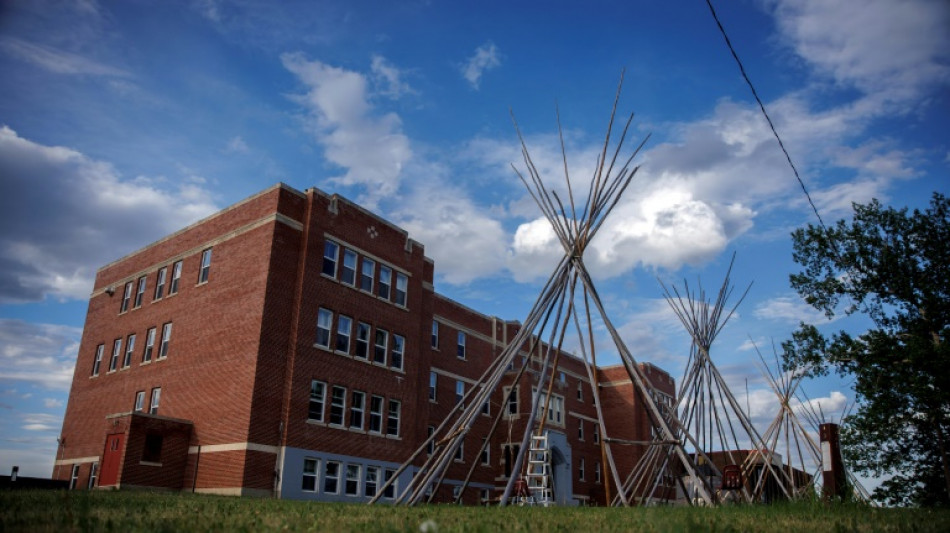
Canada Indigenous university helps students reconnect to their language / Photo: Cole Burston - AFP

 Gauff into round four at US Open after straight-set win

 Bordeaux hammer Racing in Top 14 start as Bielle-Biarrey extends deal

 Zheng, Potapova pull off upsets to reach US Open last 16

 Swiatek into US Open fourth round in tight two-setter
 Werro wins in Brussels, as Russell and Dos Santos shine

 Kolbe breaks jaw and shoulder injury sidelines Savea

 US military strikes oil tankers as Iran vows tougher reprisals

 Zheng rallies to stun Keys, Anisimova out in US Open third round

 Bayern held to draw by stubborn Schalke

 Lens lose again ahead of Champions League date

 Olympic champion Zheng storms home to reach US Open last 16

 Big-spending Spurs must make better attacking decisions, says De Zerbi

 South Africa dominate New Zealand in second half to lead series

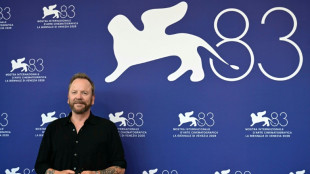 Kiefer Sutherland still in action, but ibuprofen lending helping hand

 'Are we ready?' Oasis film captures band's frosty reunion

 Commemoration held for late Bosnian Serb war criminal Ratko Mladic

 Haaland keeps new-look Man City perfect in Premier League, blunt Spurs held

 Alpine's Gasly takes shock pole for Italian Grand Prix

 Nwaneri helps Dortmund to comeback win on Bundesliga debut

 US military says destroys Iranian oil tankers after missile attacks
 US envoys in Moscow for Ukraine war negotiations
 Commemoration held for late Serbian war criminal Ratko Mladic

 Russell on top ahead of Hamilton in final Italian GP practice

 Motorsport governing body rejects Alpine boss's claims of impartiality
 Flick hoping Barca's Yamal can face Valencia after knock
Signage in Cree that was once forbidden, artwork on the walls, and a teepee on the lawn: in this former state boarding school in Canada, associated for decades with abuse, Indigenous students are reclaiming their language and traditions.
"I was told that we were no good, we were below someone else and I believed that most of my life," said former student Veronica Fraser, now aged 60.
She sobbed as memories of her time in the school -- part of a system where Indigenous children were forcibly separated from their families, cultures and languages -- flooded back.
When local First Nations bands took over the school, renaming it the University nuhelot'ine thaiyots'i nistameyimakanak Blue Quills in 2015 -- Fraser decided to return.
"I had to get my pride back," she said.
She said the university's Bachelor of Arts in nehiyawewin (Cree language) has helped her to reconnect with her roots.
Now, she looks forward to a day when she can speak it fluently with her children and grandchildren.
The century-old, red-brick building near St. Paul, Alberta -- some 120 miles (200 kilometers) northeast of provincial capital Edmonton -- was once part of the sprawling network of schools across Canada.
Up to the 1990s, some 150,000 Indigenous, Inuit and Metis children were sequestered in those schools, often run by churches.
They were cut off from their families, language and culture as part of a failed policy of assimilation, and many suffered violent abuse.
Thousands are believed to have died of neglect and malnutrition, and the discovery over the past year of at least 1,300 unmarked graves at these sites has prompted widespread soul-searching.
Alberta province had the most residential schools, and it is here that Pope Francis plans to apologize next week for the Church's role in that system.
- 'Very challenging' languages to learn -
Many parents did not pass their languages on to their children, either to protect them from the same abuses they had suffered, or because they themselves had forgotten their mother tongue after their time in the state schools.
"But their children suffered anyway because they don't have the language," university president Sherri Chisan said.
Some 250 students now take courses here in economics, sociology, Cree and Dene languages and cultural practices.
Staff point out reminders of the institution's painful past: a dusty boiler room where boys were made to work, a staircase that children had to scrub clean. An old confessional has been replaced by the office of the librarian.
"We are reclaiming what was once stolen from us," says Wayne Jackson, head of the Cree language program. "We are reclaiming our heritage, our language, our culture, our customs, our histories."
The reappropriation of St. Paul's Boarding School started with a sit-in by parents in 1970 demanding to be given control of their children's education.
A deal with the federal government made it the first Indigenous-administered school in Canada, and later it became a university.
- Difficult to translate -
Cree is the most widely spoken Indigenous language in Canada, according to a 2016 census. But Indigenous languages generally are only spoken by older generations and are on the decline.
Some students have enrolled at the university to improve their language skills in order to teach Cree to youngsters in their respective communities.
The original school was "designed to take away my ancestors' language," says student Edwin Thomas, a 43-year-old former oil industry worker.
"To be able to come back to it... it's very touching," he said.
Concentrating intensely on a moose hide, fellow student Tarryn Cardinal explains that tanning animal hides -- part of the curriculum -- helps her to learn about both her culture and language.
"They are linked," she says, before adding that "some Indigenous things just don't translate into English."
In her second year of study, she is delighted to be able to have short conversations with her grandmother in Cree.
"I feel proud of myself because of that, I feel like we are closer, more connected -- me and my culture, me and my grandma, me and my other people," says the beaming 26-year-old.
Despite his students' enthusiasm, Jackson still frets about the survival of Cree.
"All it takes is one generation of speakers to not speak the language, and we lose it," he says.
R.J.Fidalgo--PC