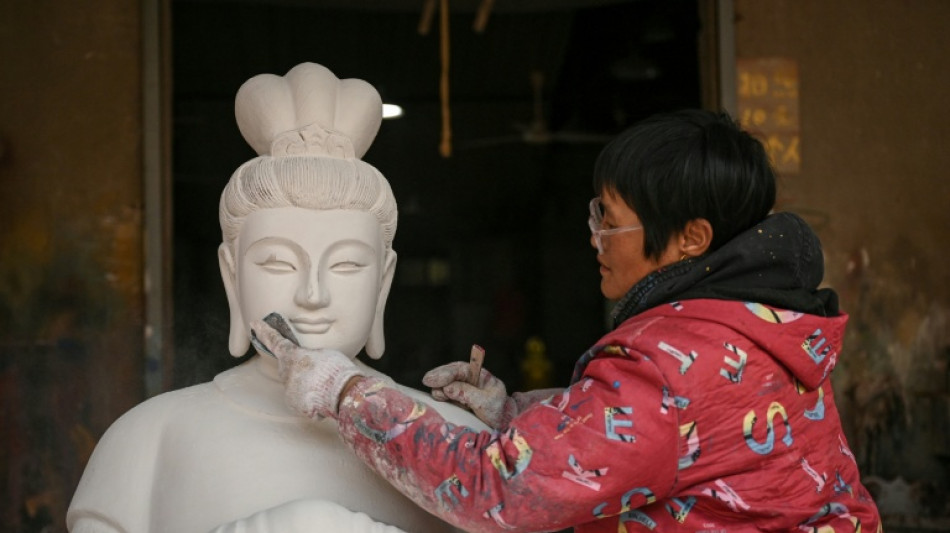
China's Buddha artisans carve out a living from dying trade / Photo: Jade GAO - AFP

 Physicians Urge Arizona to Ban Medical Gag Clauses and Enable Private Lawsuits

 New Campaign Highlights Knowledge Gaps on Carbon Monoxide Safety Among Americans

 GoodData.AI Launches the Agentic Serving Plane, a New Category of Enterprise Data Infrastructure for AI Agents
 US Government Questions Effectiveness of Waymo’s School Bus Software Fix

 Panthers expected to begin 2027 NRL season away from new stadium

 Sweet As app launches restaurant discovery platform

 MLA seeks inquiry into reported sectarian gestures on Ormeau Road
 Louise O’Reilly attacks Simon Harris over unemployment remarks
In a dimly lit workshop in eastern China, craftsman Zhang measured and shaped a block of wood into a foot as dozens of half-completed life-sized Buddha statues looked on silently.
Zhang is one of a dwindling number of master woodcarvers in the village of Chongshan near the city of Suzhou, where generations of residents have made a living creating Buddhist and Taoist sculptures for display in temples across China.
Carving the intricate statues, which are often adorned with bright paint and gold leaf, was an art he learned from his father as a teenager.
"My grandpa and my grandpa's grandpa were also craftspeople," Zhang told AFP in his dusty studio.
But "once our generation retires, there will be no one left to carry on the tradition".
He blamed a combination of unattractive pay and youngsters' unwillingness to dedicate time and energy to mastering the craft.
"You need to do this for at least five or six years before you can set up shop on your own."
Zhang said the village had received a boom in orders starting in the late 20th century, after a loosening of tight government restrictions on worship led to a resurgence of interest in religion across the country.
But now, fewer people are commissioning new pieces with the market already "saturated" and most temples around the country already furnished with statues, Zhang told AFP.
Gu, a 71-year-old artisan at another workshop in Chongshan, said she remembered producing secular handicrafts during the Cultural Revolution, when religion was considered an archaic relic to be eliminated from society by leader Mao Zedong's followers.
"At the time, the temples were all closed," Gu told AFP.
Gu, who specialises in carving the heads of Buddha sculptures, proudly showed off the subtle expressions on the faces of a row of gilded figures in her storeroom.
"Every face has an expression, smiling or crying," Gu said.
She grinned as she explained that some sculptures of famed Buddhist monk Ji Gong even showed him smiling on one side of his face and frowning on the other.
In comparison, wood carver Zhang took a more practical view of his craft.
"People look at us like we're artists," he said. "But to us, we're just creating a product."
E.Raimundo--PC

