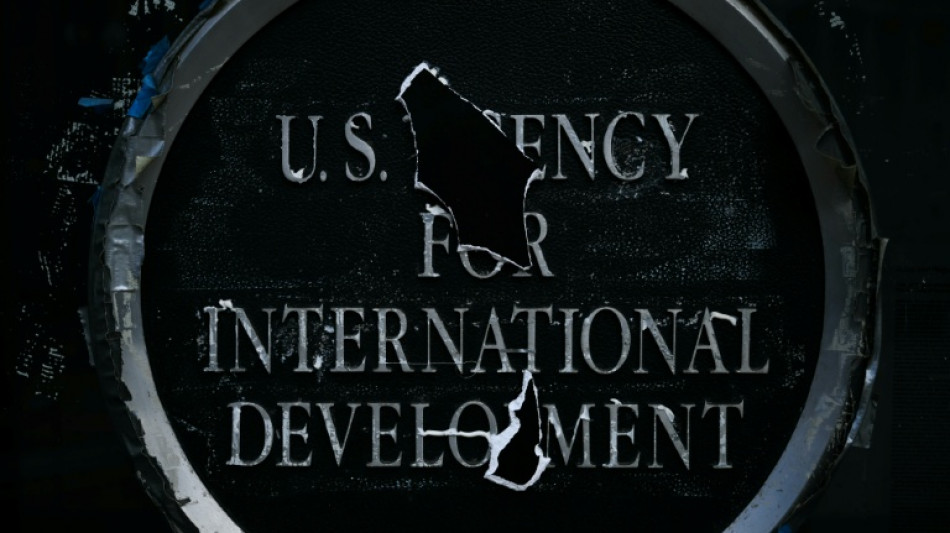
The impact of Trump's foreign aid cuts, one year on / Photo: Brendan SMIALOWSKI - AFP/File

 Vollering wins Tour de France Femmes after war of nerves

 BMW’s next chapter accelerates with New Class rollout

 Five dead in new Russia, Ukraine strikes

 PSG sign France full-back Digne from Villa

 Sinner withdraws from Cincinnati Open with knee injury

 Fernandez's 'perfect' race earns him British MotoGP Grand Prix win
 Iran Guards say won't reopen Hormuz without US meeting Tehran's demands
 Hogh's hat-trick inspires Celtic to 5-1 victory over Kilmarnock

 London grants first licences for supervised Uber robotaxis

 Erasmus hopeful Kolisi hamstring injury not 'too bad'

 Luxury car buyers trade prestige for mainstream value

 Students, teachers mourn girl killed in Thailand school shooting

 Jacobson to lead New Zealand for first time against Sharks

 Typhoon Dolphin makes landfall in China after flight cancellations, evacuations

 South Korea FA apologises after sex scandal adds to controversies

 Indonesia closes national park as wildfire spreads
 ZXMoto leads China's charge to dominate the global motorbike market

 Top-ranked Sabalenka, Pegula stunned in Toronto fourth round
 Japan nuclear debate unnerves proponents of pacifism

 Spanish teen Jodar ousts eighth seed Lehecka at Montreal

 Angers mounts in US over vast network of car license plate cams
 Darderi to face Nakashima in Montreal quarter-finals
 Espresso power fires Darderi past Borges in Montreal

 Shnaider upsets Pegula to book Toronto quarter-final with Swiatek

 Mount injury overshadows Man Utd draw with Paris Saint-Germain

The Trump administration's dismantling of US foreign aid, which started a year ago on Tuesday, has caused the preventable deaths of hundreds of thousands of people and will contribute to millions more, researchers have estimated.
Humanitarian efforts to fight diseases such as HIV, malaria and tuberculosis in some of the world's poorest nations have been massively disrupted since Donald Trump froze US humanitarian aid immediately after being sworn in for a second term on January 20, 2025.
The freeze was initially said to be temporary.
However, in a cost-cutting spree advised by the world's richest person Elon Musk, Trump eliminated 83 percent of programmes by the US Agency for International Development (USAID), which was then dismantled.
Other major Western donors including Britain, France and Germany then announced deep cuts to their own aid budgets, compounding funding shortfalls for already reeling humanitarian efforts.
Researchers have since been working to estimate the impact of the cuts by the United States, which previously contributed more than 40 percent of all global aid.
Given how crucial the funding had become to so many sectors in developing countries, most numbers are rough estimates based on modelling research.
- Deadly impact -
The Impact Counter website estimates the USAID cuts have so far caused more than 750,000 deaths -- over 500,000 of them children.
That works out to be 88 people every hour, according to the analysis by Brooke Nichols, an infectious disease mathematical modeller at Boston University, which has not been peer-reviewed.
Different research conducted by the Barcelona Institute for Global Health (ISGlobal) projects that more than 22 million people could die from preventable causes by 2030 due to the US and European aid cuts.
The research, first exclusively reported by AFP in November, will be published in The Lancet Global Health journal, principal investigator Davide Rasella said.
Other research by the US-based Institute for Health Metrics and Evaluation warned last month that 16 million additional children under the age of five would die by 2045 if the aid cuts become permanent.
- HIV setback -
The US funding cuts are the most significant setback in the fight against HIV in decades, UNAIDS has warned.
While the Trump administration has said it resumed critical HIV services under its PEPFAR programme, many people in developing countries have lost access to life-saving HIV drugs such as antiretrovirals.
Impact Counter estimates that more than 170,000 people, including over 16,000 infants, have died due to the disruptions in PEPFAR funding.
A survey released on Tuesday found the cuts have seriously affected the services of 79 community HIV organisations across 47 countries.
Access to drugs that prevent HIV transmission called PrEP has been halved in 80 percent of the organisations, according to the survey by Coalition PLUS and other groups.
The aid cuts are also "causing widespread and profound damage" to healthcare infrastructure in many countries, it added.
- Other diseases -
More than 48,000 people have already died from tuberculosis due to the cuts, according to Impact Counter, which projected this toll would rise to more than 2.2 million by 2030.
Over 160,000 children have died from pneumonia, 150,000 from malnutrition, and 125,000 from diarrhoea as a result of the cuts, the site said.
Impact Counter also estimated that more than 70,000 people -- three-quarters of them children -- have died from malaria.
However the true death toll of the slashed aid may never be known.
After the dismantling of USAID, many of the systems that once tracked deaths and diseases in developing countries simply "no longer exist," Caterina Monti, a co-author of the ISGlobal study, told AFP.
- 'No fumes' left -
Sarah Shaw, advocacy director of the charity MSI Reproductive Choices, told AFP that USAID funding was "like an iceberg".
Underneath the visible parts -- such as money for drugs -- the United States provided key funding for transportation, warehouses, software, training and education.
Monti gave the example of a child in a remote area suffering from diarrhoea.
The child not only needs access to a medical centre with a supply of drugs -- they need clean drinking water, proper sanitation and to be informed about the condition in the first place.
"It's a very complex system -- if you cut one piece, then the other pieces won't work," Monti said.
Shaw said that over the last year, many charities were able to find supplies still lingering in warehouses.
"But now all of that is gone," she added.
"Last year we were running on fumes -- this year there will be no fumes."
Nogueira--PC