
South Korea's economy grew just 1% in 2025, lowest in five years / Photo: Jung Yeon-je - AFP

 Physicians Urge Arizona to Ban Medical Gag Clauses and Enable Private Lawsuits

 New Campaign Highlights Knowledge Gaps on Carbon Monoxide Safety Among Americans

 GoodData.AI Launches the Agentic Serving Plane, a New Category of Enterprise Data Infrastructure for AI Agents

 US Government Questions Effectiveness of Waymo’s School Bus Software Fix

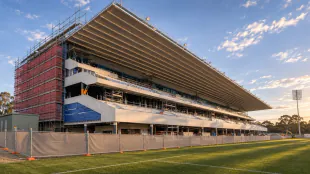 Panthers expected to begin 2027 NRL season away from new stadium

 Sweet As app launches restaurant discovery platform

 MLA seeks inquiry into reported sectarian gestures on Ormeau Road

 Louise O’Reilly attacks Simon Harris over unemployment remarks
South Korea logged its slowest growth in half a decade in 2025, the country's central bank said Thursday, while exports rose on the back of a boom in artificial intelligence.
Asia's fourth-largest economy has struggled with sluggish demand, a troubled housing market and the fallout of former president Yoon Suk Yeol's martial law declaration, which plunged the country into political chaos.
Last year's one percent growth was the slowest since 2020, when the economy shrank following the outbreak of Covid-19.
Exports were a bright spot, rising by 4.1 percent, the country's central bank said, while imports were up 3.8 percent.
"The growth of exports continued and the growth of private consumption and government consumption expanded," it said.
A decline in construction investment widened, it added, linked to persistent trouble in the real estate market.
"The decline in construction widened and the growth of manufacturing slowed," the central bank said.
The economy also contracted in the October–December period, the central bank added.
An official said that the slump was expected due to the "base effect" from strong growth in the third quarter.
But the weak construction investment also played a role in dragging down overall growth, he said.
The central bank had projected in its November report that the economy would grow 1.8 percent this year, citing "a recovery in domestic demand and a robust semiconductor cycle".
South Korea is home to key semiconductor manufacturers -- Samsung Electronics and SK hynix -- whose products have become crucial to sustaining and further expanding infrastructure for the global artificial intelligence market.
On the back of robust demand, the benchmark index Kospi broke 5,000 for the first time on Thursday.
"Today's rally is being driven mainly by semiconductor manufacturers, especially Samsung Electronics and SK hynix, amid growing expectations of robust earnings in the sector," Chung Hae-chang, analyst at Daishin Securities, told AFP.
A.P.Maia--PC

