
Artist chains up thrashing robot dog to expose AI fears / Photo: Adek BERRY - AFP/File

 Physicians Urge Arizona to Ban Medical Gag Clauses and Enable Private Lawsuits

 New Campaign Highlights Knowledge Gaps on Carbon Monoxide Safety Among Americans

 GoodData.AI Launches the Agentic Serving Plane, a New Category of Enterprise Data Infrastructure for AI Agents

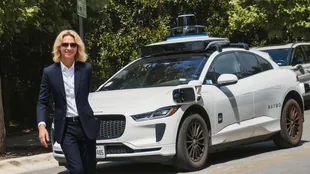 US Government Questions Effectiveness of Waymo’s School Bus Software Fix

 Panthers expected to begin 2027 NRL season away from new stadium

 Sweet As app launches restaurant discovery platform

 MLA seeks inquiry into reported sectarian gestures on Ormeau Road

 Louise O’Reilly attacks Simon Harris over unemployment remarks

 Virginia overwhelms Arkansas 91-72 behind balanced scoring

 Second major storm brings destructive winds and outages to British Columbia

 Godzilla Minus Zero leads North American box office with $31.6m

The agile robot dog springs up on all fours, takes a step forward and charges at the tense crowd at a Tokyo exhibit, held back by a simple yet strong metal chain.
The silver mechanical creature then starts thrashing around violently, to gasps and exclamations from spectators at the installation, designed to probe humanity's relationship with increasingly realistic machines.
The Japanese media artist behind it told AFP he hoped the audience would consider the dangers posed by artificial intelligence but also feel "pity" for the struggling robot.
"Our future is going to be stressful, because people treat robots as objects, but we feel empathetic stress with these movements and reactions," said Takayuki Todo, 40.
Global tech giants are investing vast sums into humanoid and other lifelike robots, with grand plans for factory automation, home help and other futuristic "physical AI" services.
But so far actual use cases remain scarce and fully automated robots are still a rare sight, with most impressive displays -- including Todo's -- relying on remote operators to control the robot's movements.
For the artist, the point of the three-day installation at the Tokyo Prototype festival is to provoke thought.
Like the metal leash, "we are protected by an unreliable, thin chain of ethics. And if it's cut off, we will be killed by this technology," said Todo.
- 'Robot abuser' -
For his installation, titled "Dynamics of a Dog on a Leash" and first shown last year, Todo purchased three robot canines made by Chinese startup Unitree, costing thousands of dollars each.
One is already broken and repairs are needed for another, as the dogs often get tangled in the chain and end up crashing onto the floor.
Todo, who said he had been attacked online "as a robot abuser", visited Unitree in China last year to excuse himself for the unconventional treatment of their device.
The short hourly display, on show through Saturday in a business district skyscraper, is drawing large crowds, with many spectators including children curious to see a robot of this kind for the first time.
"It gave me the chills," said 34-year-old student and food service worker Kimie Furuta.
"Imagining it actually attacking like that... it could be terrifying to face."
On the brighter side, robots and AI could one day help ease staff shortages, including in the catering sector, she said.
Anatol Ward, a Tokyo resident in his 50s, said the robot reminded him of a guard dog.
"In some sense it was scary. But also it was fascinating -- like, what the robot was capable of."
Todo said that "of course" he was afraid of military uses for such robots, but noted it is not just a future concern.
"Robots and drones are killing soldiers in Ukraine or Palestine," he said.
"We feel it's a distant place, but as an artist we have to imagine it's in front of us."
M.A.Vaz--PC

