Rural India powers global AI models / Photo: Arun SANKAR - AFP

 Jacobson to lead New Zealand for first time against Sharks
 Typhoon Dolphin makes landfall in China after flight cancellations, evacuations

 South Korea FA apologises after sex scandal adds to controversies

 Indonesia closes national park as wildfire spreads

 ZXMoto leads China's charge to dominate the global motorbike market

 Top-ranked Sabalenka, Pegula stunned in Toronto fourth round

 Japan nuclear debate unnerves proponents of pacifism

 Spanish teen Jodar ousts eighth seed Lehecka at Montreal

 Angers mounts in US over vast network of car license plate cams
 Darderi to face Nakashima in Montreal quarter-finals

 Espresso power fires Darderi past Borges in Montreal

 Shnaider upsets Pegula to book Toronto quarter-final with Swiatek

 Mount injury overshadows Man Utd draw with Paris Saint-Germain

 Ukraine denies targeting Bulgaria as drone explodes near pipeline

 Vollering grabs Tour de France lead in Nice

 Euros to showcase new TV guidelines on non-sexualisation of women athletes

 'Calm' Kiss savours first win as Wallabies boss

 Duplantis bids for fourth European title as stars align in Birmingham

 Ukraine warns of tough winter as Russia strikes kill 4 in Kyiv region

 Recovering Marchand to skip medleys at European swim champs
 MotoGP leader Martin speeds to British Grand Prix pole

 Drone enters Bulgaria, explodes near pipeline at Romanian border: Bulgarian PM

 Arsenal sign Brazil midfielder Guimaraes from Newcastle

 Atletico will not sell Alvarez, says Simeone

 Ford Fathom turns affordable electric pickup into reality

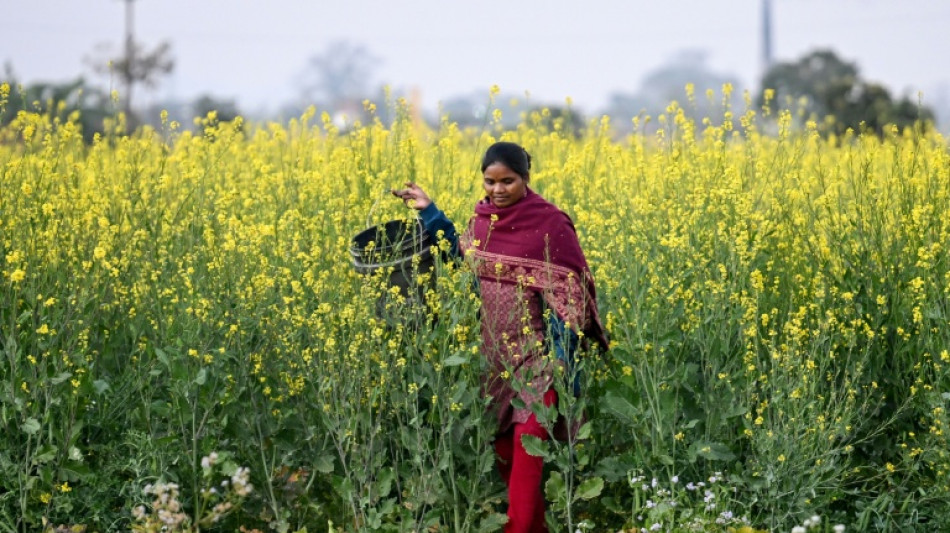
Tending crops by day and then logging on for a night shift of data labelling, 27-year-old Chandmani Kerketta is part of a rising rural Indian workforce helping power an artificial intelligence revolution.
From her home in India's eastern Jharkhand state, Kerketta is part of an AI-driven labour shift that the government hopes will transform lives, including by bringing more women into the workforce.
The work is basic but essential for machine learning: data labelling, annotation and quality checks.
It is the type of information key for driverless cars, for example.
"This job helped me finish my studies, and help at home on our farm," Kerketta said as she tended tomatoes and peas.
Kerketta, from one of India's constitutionally recognised tribal communities, was the first in her family to attend college.
She initially worked as an office assistant at a data-processing firm in Jharkhand's capital Ranchi, where she watched employees working at computers.
But after a computer course at her village school, Kerketta joined an estimated workforce of at least 200,000 annotators in India's villages and small towns -- a growing figure, and roughly half of the world's data-labelling workforce, according to US-based Scry AI.
Rural-based workers can label hundreds of images, videos and documents during eight-hour shifts, either from home or from modest internet-connected centres.
"After my night shift of data work, I sleep a little, and then help in farming," said Kerketta, who now holds a history degree. "In Jharkhand, farming is everything."
Anju Kumari, 25, another rural AI worker in Jharkhand using a national fibre-optic cable network laid by Indian Railways, said the job had provided her with a pathway to a wider world.
Kumari said work can include painstaking "labelling videos frame-by-frame", giving the example of teaching AI whether a person using an ATM is "likely a burglar, or someone genuinely drawing cash".
- Small-town offices -
India, which will host an international AI summit next month, has ambitious plans.
It is now third in a global AI power ranking, overtaking South Korea and Japan, based on more than 40 indicators from patents to private funding calculated by Stanford University's Institute for Human-Centered AI.
In recent months, US tech giants including Google, Microsoft and Amazon have announced multi-billion-dollar investments to build some of the world's biggest data centres in India.
The country is no stranger to back-end work for global technology firms.
Cities such as Bengaluru, Hyderabad and Chennai host major international players, but India's AI push is also expanding into more remote regions.
In Tamil Nadu state, along a winding rural road, Indu Nadarajan travels to a small-town office where she labels images for autonomous vehicles, such as road markings, headlights and animals.
Nadarajan works for NextWealth, an AI-enabling services firm headquartered in Bengaluru, with offices across small towns, supporting clients from the United States, Europe and Asia.
"Many go to Chennai and Bengaluru to learn about AI," said Nadarajan, who has a master's degree in mathematics.
"But being here in our hometown and learning about AI makes me feel very proud."
- 'Anybody can be anywhere' -
Every AI model relies on vast amounts of labelled data, regardless of its complexity. The more precise the labelling, the better the technology performs.
"When I can design a product for a US company 5,000 miles away, why can't I do it from 200 miles away?" said NextWealth founder Sridhar Mitta, 80, a former chief technology officer at Indian tech giant Wipro.
"Anybody can be anywhere and do the things, because the value goes through the internet."
His scattered employees earn anywhere between $275 to $550 a month.
While AI-driven automation may render some jobs obsolete, Mitta believes it will also generate opportunities.
"Micro-entrepreneurship will be the next phase for small towns," Mitta said.
"It may not be another billion-dollar company, but they will produce something which will be useful to the region."
As AI reaches rural India, it is quietly reshaping lives -- particularly for women from conservative backgrounds.
For Amala Dhanapal, a colleague of Nadarajan and the first graduate in her family -- her father is a tailor and her mother a homemaker -- working in AI has changed attitudes.
"It's a big thing," Dhanapal said, saying it both provided a gateway to learning and greater financial independence.
"Most girls find it difficult to even pursue their education due to their family background."
When Kerketta first began her data-annotation work, villagers mocked her.
"Now, when they see me going around on my scooter, they look at me with pride," she said. "Just like I do myself."
J.Oliveira--PC