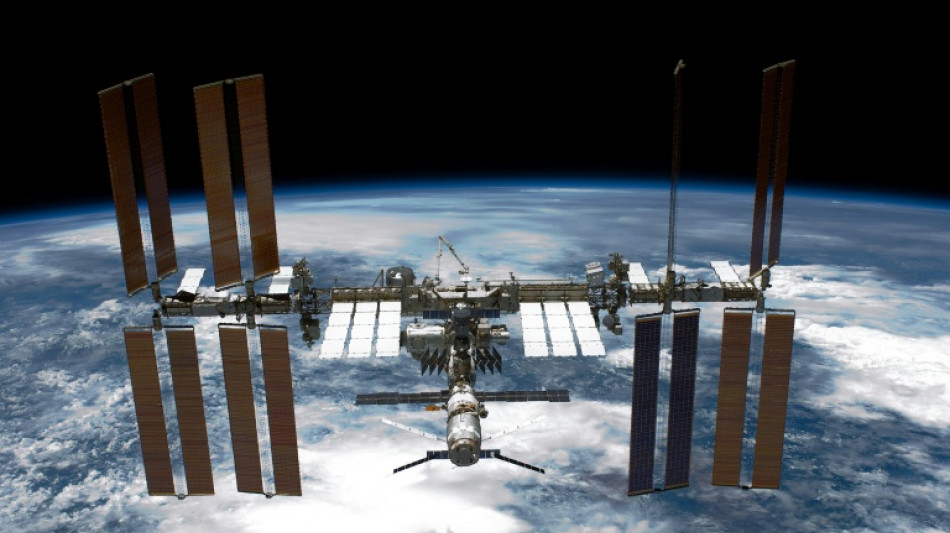
The coming end of ISS, symbol of an era of global cooperation / Photo: NASA - GETTY IMAGES NORTH AMERICA/AFP/File

 Jacobson to lead New Zealand for first time against Sharks

 Typhoon Dolphin makes landfall in China after flight cancellations, evacuations

 South Korea FA apologises after sex scandal adds to controversies

 Indonesia closes national park as wildfire spreads

 ZXMoto leads China's charge to dominate the global motorbike market

 Top-ranked Sabalenka, Pegula stunned in Toronto fourth round

 Japan nuclear debate unnerves proponents of pacifism

 Spanish teen Jodar ousts eighth seed Lehecka at Montreal

 Angers mounts in US over vast network of car license plate cams

 Darderi to face Nakashima in Montreal quarter-finals
 Espresso power fires Darderi past Borges in Montreal

 Shnaider upsets Pegula to book Toronto quarter-final with Swiatek

 Mount injury overshadows Man Utd draw with Paris Saint-Germain

 Ukraine denies targeting Bulgaria as drone explodes near pipeline

 Vollering grabs Tour de France lead in Nice

 Euros to showcase new TV guidelines on non-sexualisation of women athletes

 'Calm' Kiss savours first win as Wallabies boss

 Duplantis bids for fourth European title as stars align in Birmingham

 Ukraine warns of tough winter as Russia strikes kill 4 in Kyiv region

 Recovering Marchand to skip medleys at European swim champs

 MotoGP leader Martin speeds to British Grand Prix pole

 Drone enters Bulgaria, explodes near pipeline at Romanian border: Bulgarian PM

 Arsenal sign Brazil midfielder Guimaraes from Newcastle

 Atletico will not sell Alvarez, says Simeone

 Ford Fathom turns affordable electric pickup into reality

When the International Space Station comes back to Earth in 2030, it will mark the end of three decades of peaceful international cooperation -- and an era when space became central to our daily lives.
Since November 2000, there have always been several humans on board the football field-sized scientific laboratory, whipping around the planet at eight kilometres per second.
With a new crew of astronauts set to blast off for the station as soon as next week, some of those who have helped the station from the ground are nostalgic about its looming demise.
"The ISS is a cathedral to human cooperation and collaboration across borders, languages and cultures," John Horack, the former manager of NASA's Science and Mission Systems Office, told AFP.
"For more than 25 years, we have had people in space, 24/7/365," added Horack, who now holds the Neil Armstrong Chair in aerospace policy at Ohio State University.
"It is a testament to how we can 'figure it out' rather than 'fight it out' when we wish to interact with each other."
The ISS was first proposed in the aftermath of the Cold War, illustrating a newfound spirit of cooperation between space race rivals Russia and the United States.
While many ties between Russia and the West have been severed over Moscow's war in Ukraine, cooperation has continued on board the space station.
"The history of human spaceflight is first and foremost the space race," Lionel Suchet of France's space agency CNES told AFP.
"This is a very interesting moment in the evolution of space exploration," said Suchet, who coordinated several early ISS projects after witnessing its predecessor, the Mir space station, de-orbiting in 2001.
- Back to Earth -
However, the ISS is getting old and its equipment is outdated.
NASA announced last year it had selected Elon Musk's SpaceX to build a vehicle that can push the station back into Earth's atmosphere in 2030, where it will break up.
"This large rocket engine will slow down the ISS, and enable it to have a precise re-entry over the Pacific Ocean, far from land, people or any other potential hazards," Horack explained.
Several spacecraft and telescopes -- including Mir -- have met a similar fate, splashing down at an isolated spot in the ocean called Point Nemo.
After 2030, the only space station orbiting Earth will be China's Tiangong.
For the future, the US is focusing more on space stations built and operated by private companies.
"We are moving into an era where space stations have a much more commercial dimension," similar to what has already happened with rockets and satellites, Horack said.
National space agencies would then need to pay these companies to stay on board.
Several companies, including Jeff Bezos's Blue Origin and Axiom Space, are already working on plans to build the first commercial space station.
Suchet emphasised that "the business model will still be largely institutional because countries are always interested in sending astronauts into low-Earth orbit".
Scientific research and exploration also remain an "objective of all humanity", he added, pointing to treaties that govern how nations are supposed to act in space.
Whether these treaties will hold once humans make it to the Moon -- the US and China both have plans to build lunar bases -- remains to be seen.
- 'Quite sad' -
For Horack, the end of the ISS could be seen as "quite sad".
His children "had a lifetime of going out into the backyard to watch the ISS fly over".
But the end of this era will mark the opening of another, he added.
"We must grow as humans in our space-faring capacity, in our exploration of space, and in the use of space to generate social, economic, educational and quality of life outcomes for all people everywhere."
He finished by quoting the former head of the European Space Agency, Jean-Jacques Dordain: "If you want to go fast, go alone. If you want to go far, go together."
P.Mira--PC