
Digital euro delay could leave Europe vulnerable, ECB warns / Photo: Kirill KUDRYAVTSEV - AFP

 Physicians Urge Arizona to Ban Medical Gag Clauses and Enable Private Lawsuits

 New Campaign Highlights Knowledge Gaps on Carbon Monoxide Safety Among Americans

 GoodData.AI Launches the Agentic Serving Plane, a New Category of Enterprise Data Infrastructure for AI Agents

 US Government Questions Effectiveness of Waymo’s School Bus Software Fix

 Panthers expected to begin 2027 NRL season away from new stadium

 Sweet As app launches restaurant discovery platform

 MLA seeks inquiry into reported sectarian gestures on Ormeau Road

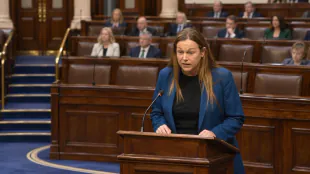 Louise O’Reilly attacks Simon Harris over unemployment remarks

 Virginia overwhelms Arkansas 91-72 behind balanced scoring

 Second major storm brings destructive winds and outages to British Columbia

 Godzilla Minus Zero leads North American box office with $31.6m

The European Central Bank urged the European Union on Friday to swiftly press ahead with adopting a digital euro, warning that delays would leave the continent reliant on foreign "big tech" players.
"Delays in the legislative process would risk breaking the momentum," Piero Cipollone, a European Central Bank executive board member, said in a speech in Cyprus.
"They would further entrench our dependence on international card schemes and increase our exposure to non-European big tech payment solutions," he said.
He did not mention particular companies by name, but worries have been growing about Europe's heavy reliance on US tech firms as ties between the continent and United States sour under US President Donald Trump.
The EU has long been working on a digital euro, which dozens of economists called an "essential safeguard of European sovereignty" in an open letter in January.
Supporters say a well-designed digital single currency would allow Europeans to make online payments without relying on US card companies or payments systems.
However, some critics fear it would allow governments to surveil citizens' payments or even cut them off from the money supply.
Addressing such fears, Cipollone said the ECB would "continue to issue banknotes" and was "working hard to ensure physical cash remains widely accepted and available".
"As European citizens, we want to avoid a situation where Europe is overly dependent on payment systems that are not in our hands," he added.
The ECB began work on its own digital currency in 2020 and plans to launch a pilot scheme in 2027. The European Parliament is expected to reach a decision on whether to press ahead with the project this year.
"Once the legislation is adopted, the digital euro standards can be finalised and made available," Cipollone said.
"As merchants renew their payment terminals, they can ensure that the new devices are 'digital euro-ready'," he added.
European banks meanwhile are wary that a digital euro could reduce demand for their online and electronic banking services.
Some have launched their own payments systems, such as Wero, as an alternative to US options like Visa, Mastercard and PayPal.
A.F.Rosado--PC

