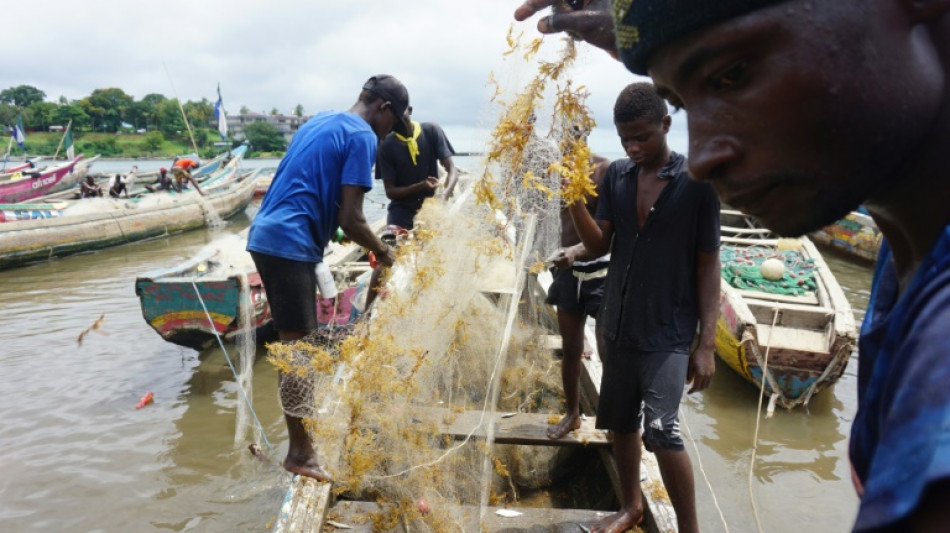
Seaweed onslaught disrupts S.Leone fishing and tourism / Photo: Saidu BAH - AFP

 Belgian PM Bart De Wever Given New Deadline to Resolve €10 Billion Budget Deadlock

 $1.8 Billion Pledged for Biodiversity at COP17 as Monaco Reaffirms Commitment

 Phoenix Symphony Resumes Performances Amid Financial Uncertainty

 Turkish Energy Minister Highlights Qatar as Key Partner for Regional and Global Energy Security

 London Museum Granted 24/7 License Ahead of November Opening

A mass of brown seaweed has for weeks choked the coastline of Sierra Leone's capital Freetown, damaging fishing gear and disrupting tourism in a country otherwise known for its white-sand beaches.
The West African state has experienced the phenomenon several times in the past, but local people say the problem seems far worse this year.
"There is an unprecedented deposit this year," Amidu Kamara, a fisherman at Freetown's Tambakula wharf, told AFP.
He said dead seaweed had destroyed fishing nets and clogged boat engines.
"We have to move from one spot to the other to escape the seaweed, but it keeps coming", he added.
The stuff is believed to come from the Sargasso Sea, in the middle of the Atlantic Ocean, according to Paul Lamin, a director at the government's Environmental Protection Agency.
"My department received reports from other countries in West Africa where the seaweed was found in March and April this year, but in Sierra Leone it usually occurs during the rainy season and the quantity fluctuates on yearly basis," he said.
- Business slow -
Normally, Lumley Beach in the west end of the city is packed with young people at the weekends.
But nowadays it is desolate.
At the Sugarland Beach resort, manager Aruna Foday complained that rotting seaweed had hurt the bottom line.
"We are closing the bar and restaurant for now due to the heavy stench from the seaweed and hope to resume after the rains", he said. "Business has been slow for us."
Not all beach-goers were deterred, however.
Mohamed Bangura, 23, was kicking a football around with friends on a recent, overcast Sunday afternoon.
"We use our bare hands to clean up spaces to play football every weekend," he said, noting that it nonetheless "stinks disgustingly".
Though July and August -- when seaweed normally tends to appear -- is the low season for tourism, the National Tourist Board has nonetheless launched a clean-up effort.
"It's a difficult task because the seaweed keeps coming on an hourly basis," said general manager, Fatmata Kroma, who appealed for help from the community.
She noted that man-made waste was also washing up on beaches and posing a further challenge to the tourism industry.
"The ocean is not a dustbin," she said.
L.Mesquita--PC

