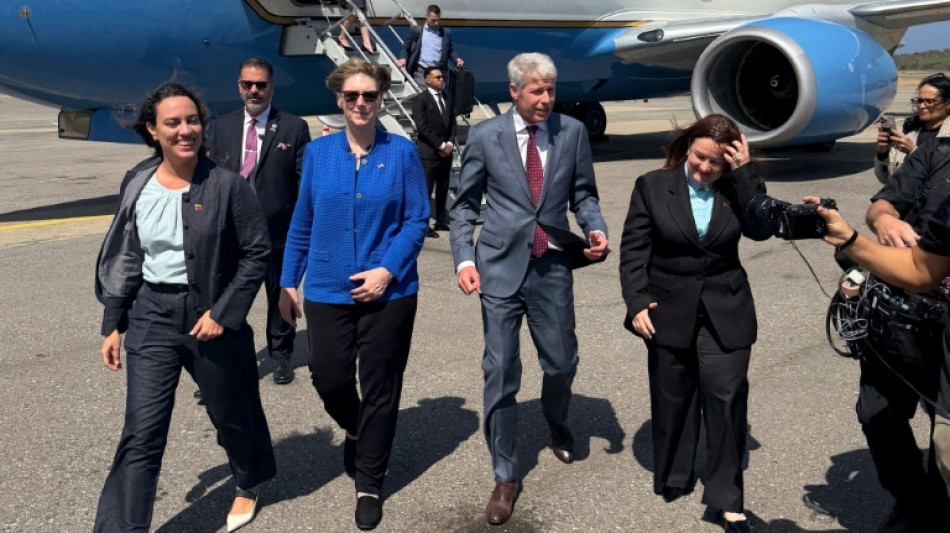
US pushes for 'dramatic increase' in Venezuela oil output / Photo: Handout - US Embassy in Venezuela/AFP

 Physicians Urge Arizona to Ban Medical Gag Clauses and Enable Private Lawsuits

 New Campaign Highlights Knowledge Gaps on Carbon Monoxide Safety Among Americans

 GoodData.AI Launches the Agentic Serving Plane, a New Category of Enterprise Data Infrastructure for AI Agents

 US Government Questions Effectiveness of Waymo’s School Bus Software Fix

 Panthers expected to begin 2027 NRL season away from new stadium

 Sweet As app launches restaurant discovery platform

 MLA seeks inquiry into reported sectarian gestures on Ormeau Road

 Louise O’Reilly attacks Simon Harris over unemployment remarks

 Virginia overwhelms Arkansas 91-72 behind balanced scoring

 Second major storm brings destructive winds and outages to British Columbia

 Godzilla Minus Zero leads North American box office with $31.6m

US Energy Secretary Chris Wright on Wednesday vowed to power a "dramatic increase" in Venezuelan oil output as part of a plan to "make the Americas great again" after talks with acting president Delcy Rodriguez in Caracas.
Wright is the highest-ranking US official to travel to Venezuela since US special forces captured and overthrew longtime socialist leader Nicolas Maduro on January 3.
In a meeting with Rodriguez and oil industry executives he assured that President Donald Trump was "passionately committed" to transforming relations between the two former foes.
Rodriguez said she supported a "long-term productive partnership" that was "beneficial to both countries."
Trump approved former vice-president Rodriguez to replace her deposed boss Maduro on the condition that she comply with his demands on access to oil and on easing state repression.
Venezuela, once a major crude supplier to the Untied States, has the world's largest proven reserves with more than 303 billion barrels, according to global oil cartel OPEC.
This amounts to about a fifth of the world's oil reserves.
In 2024, the South American country produced only about one percent of the world's total crude, however -- its industry left haggard by years of underinvestment, mismanagement and US sanctions.
- 'Historical differences' -
Trump wants US oil majors to rapidly rebuild the sector and boost output by millions of barrels per day, saying the United States and Caracas will share the profits.
The United States carried out a first sale of Venezuelan oil last month that made the Caribbean country $500 million.
Wright called for a "dramatic increase" in Venezuela's production of oil, natural gas and electricity which would improve "the job opportunities, the wages and the quality of life" of all Venezuelans.
He said he and Rodriguez "spoke very candidly about the tremendous opportunities in front of us" as well as the challenges.
The president of Venezuelan state oil firm PDVSA, Venezuela's diplomatic representative to the United States and the US Charge d'Affaires in Caracas joined the talks.
Rodriguez said she welcomed the opportunity for their two countries "to address their historical differences in a mature manner."
- Dramatic thaw -
Wright's visit to Caracas comes amidst a dramatic thaw in US-Venezuelan relations, which Caracas broke off in 2019 after Washington refused to recognize Maduro as the winner of tainted elections.
In a series of head-spinning reforms since Maduro's fall, Rodriguez last month opened up the nationalized oil sector to private investment.
On Thursday, parliament is expected to adopt a landmark bill granting amnesty to political prisoners.
Washington for its part has eased sanctions on Venezuela's oil industry, allowing US companies to work with state oil firm PDVSA and the government.
The challenge now is to persuade oil companies to invest in Venezuela despite persisting political instability, security concerns, and the need for heavy investment to restore production capacity.
The country produced 1.2 million oil barrels per day in 2025 -- up from a historic low of about 360,000 in 2020 -- but still far from the 3.0 million bpd it was pumping 25 years ago.
Rodriguez's government aims to increase output by a further 18 percent this year.
V.Dantas--PC

