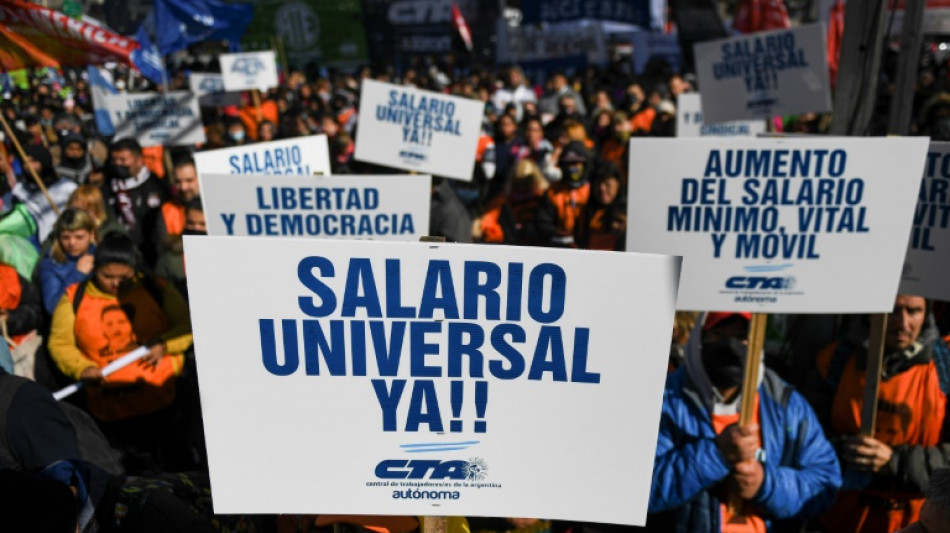
Argentine protesters demand universal living wage / Photo: Luis ROBAYO - AFP

 Belgian PM Bart De Wever Given New Deadline to Resolve €10 Billion Budget Deadlock

 $1.8 Billion Pledged for Biodiversity at COP17 as Monaco Reaffirms Commitment

 Phoenix Symphony Resumes Performances Amid Financial Uncertainty

 Turkish Energy Minister Highlights Qatar as Key Partner for Regional and Global Energy Security

 London Museum Granted 24/7 License Ahead of November Opening

Thousands of people demonstrated in Buenos Aires on Thursday, demanding a "universal salary" in crisis-ridden Argentina.
Protesters congregated outside the presidential palace, where center-left President Alberto Fernandez was meeting his economy minister Silvina Batakis, who is opposed to such an idea, as rumors abound that a cabinet reshuffle is in the works.
"Poverty has taken control of the country," Monica Sulle, a leader of the Socialist Workers' Movement (MST), told AFP.
Argentina is gripped by an economic crisis marked by soaring inflation and rapid currency devaluation.
Radical leftist groups close to the Frente de Todos (Everyone's Front) ruling coalition have for weeks been demanding a universal living wage.
They are angry at the government for the deteriorating social conditions faced by ordinary Argentinians.
Protesters want a minimum living wage worth 67,000 pesos (around $490 at the official exchange rate), which amounts to the cost of two basic food baskets, for the country's lowest earners.
Some 37 percent of Argentina's 45-million population live in poverty, while inflation for the first half of the year topped 36 percent.
"This unstoppable inflation is taking a seat at the family dinner table at every level of society, but in the poorest sectors it's a catastrophe," Vilma Ripoli, a Workers' Leftist Front (FIT) leader, told AFP.
Argentina, which earlier this year renegotiated repayments on a $44-billion loan with the International Monetary Fund, has committed to reducing its public deficit from three percent in 2021 to 0.9 percent by 2024.
Batakis has just returned to the country from Washington, where she met IMF managing director Kristalina Georgieva.
Local press has been speculating that Batakis, who has been in the post for less than a month since the resignation of Martin Guzman, could be one of the heads to roll in a cabinet reshuffle.
N.Esteves--PC