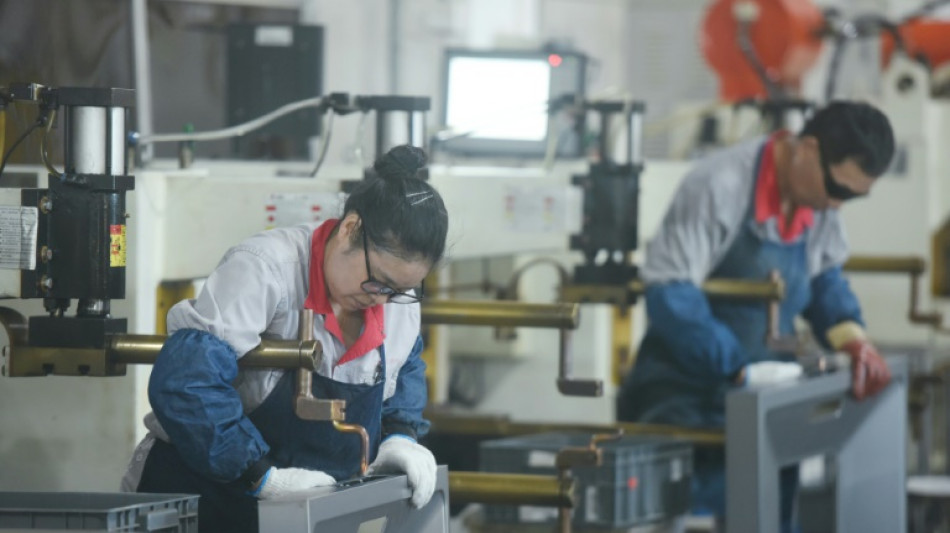
China's July factory activity weakens on soft demand / Photo: STR - AFP/File

 Belgian PM Bart De Wever Given New Deadline to Resolve €10 Billion Budget Deadlock

 $1.8 Billion Pledged for Biodiversity at COP17 as Monaco Reaffirms Commitment

 Phoenix Symphony Resumes Performances Amid Financial Uncertainty

 Turkish Energy Minister Highlights Qatar as Key Partner for Regional and Global Energy Security

 London Museum Granted 24/7 License Ahead of November Opening

China's manufacturing activity logged a surprise drop in July, official data showed Sunday, on the back of weak demand and as strict zero-Covid restrictions continue to cast a pall on growth.
The Purchasing Managers' Index (PMI), a key gauge of manufacturing activity in the world's second-biggest economy, came in at 49.0 in July, down from 50.2 June and below the 50-point mark separating growth from contraction, National Bureau of Statistics data showed.
While sweeping Covid curbs have eased in major cities such as Shanghai and Beijing, sporadic lockdowns around the country have kept businesses and consumers worried.
"In July, the manufacturing PMI dropped... due to factors such as the traditional off-season for production, insufficient release of market demand, and decline in prosperity of high-energy-consuming industries," said NBS senior statistician Zhao Qinghe in a statement.
Zhao added that sharp price fluctuations of raw materials had led some companies to adopt a wait-and-see approach, "weakening purchasing intentions".
The proportion of firms saying there was insufficient market demand had also increased for four consecutive months, he said, noting this was the "main difficulty" among manufacturers.
But officials show few signs of relaxing strict pandemic curbs, with policymakers appearing to emphasise zero-Covid over growth in a Politburo meeting this week, where they vowed to strive for "the best outcome" rather than to meet economic and social targets.
"In acknowledging the difficulties, the government has finally become flexible towards this year's growth target," ANZ Research analysts said in a note.
Chinese leaders had originally set a full-year GDP growth target of around 5.5 percent, but with economic expansion of just 0.4 percent in the second quarter, analysts believe it is unlikely to hit that goal.
China's non-manufacturing PMI dropped to 53.8 points as well in July, down from 54.7 in June, NBS data showed Sunday.
This follows policies to boost consumption and with a pick-up in construction activities, the NBS statement said.
P.Cavaco--PC