Richer childhood friends boost future income, Facebook data shows / Photo: Fred TANNEAU - AFP/File

 Hamilton worried by Ferrari pace while Antonelli prepares for a fight

 Vuelta stage 15 shortened due to extreme heat, Mas consolidates lead

 Putin meets US envoys for Ukraine war talks

 Modric available for Croatia in Nations League

 Potapova upsets 2025 US Open runner-up Anisimova

 Gasly a 'class act' says Alpine boss after Monza pole

 Athletic Bilbao crush Simeone's flat Atletico

 Stay far from battlefield, warns Japanese director in Vietnam War film

 Tens of thousands of Croatians protest over hazardous waste

 Haaland heads unconvincing Man City top of Premier League

 US envoys in Moscow as Russia and Ukraine vow not to hit capitals during talks

 Motorsport governing body rejects Alpine boss's claims of bias

 US envoy on West Bank visit says Israel has responsibility for Palestinians

 Ethiopian Miss World contestant spotlights pain of sister's murder

 'Leader' Raphinha rising to Barca striker challenge

 Oasis fans gather in Venice for band reunion film

 Two Nepal rescues revive hopes 10 days after flood

 Pogacar to miss worlds after season-ending Vuelta crash

 Greenwood, Guendouzi handed bans after Fenerbahce-Lyon brawl

 In Iceland, the mystery of the poet, the tomb and the Danish grocer

 Ratko Mladic: Bosnian Serb commander to convicted war criminal

 Bolivian army base blasts kill two, wound dozens
 Alcaraz, Sabalenka into US Open last 16 as Williams sisters lose on return

 Williams sisters fall in thrilling return to US Open doubles

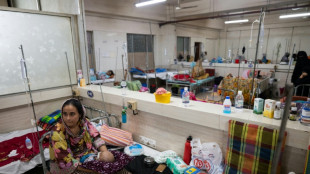 Bangladesh measles toll nears grim 1,000-child mark

An analysis of 21 billion Facebook friendships shows that children from poorer homes are likely to earn more later in life if they grow up in areas where they can become friends with wealthier kids.
It has long been believed that having rich friends can help children rise up out of poverty, but previous research has had small sample sizes or limited data, according to two studies published in the journal Nature on Monday.
So a team of US-based researchers turned to Facebook, the world's largest social database, with its nearly three billion users offering unprecedented scale and precision to examine the issue.
They analysed the privacy-protected data of 72 million US Facebook users aged between 25 and 44 years. The Facebook friendships were used to represent real-world friendships.
The researchers used an algorithm to rank users by socio-economic status, age and region, among other factors.
They then measured how much richer and poorer people interacted with each other and created the term "economic connectedness" to represent the share of a person's friends who were above or below the average socio-economic level.
They then compared this measure with previous research into children's ability to escape poverty in every US zip code.
The results were "strikingly similar", said Raj Chetty, an economist at Harvard University and the lead author of the two studies.
The first paper showed that economic connectedness "is one of the strongest predictors of economic mobility that anyone has identified to date," Chetty said.
The second paper sought to find out why children from richer or poorer backgrounds are more likely to make friends in some areas than others.
- Let's be friends -
The researchers found two major factors. One was how much the two groups are exposed to each other -- for example whether they attend different high schools or live in separate neighbourhoods.
Even if wealthy and non-wealthy students did go to the same school, however, they still might not hang out with each other -- a factor the researchers called friending bias.
Around half of social disconnection between the rich and poor was due to lack of exposure to each other, the study found.
"But the remaining half is explained by friending bias," Chetty said.
The findings showed that US policies aimed at reducing economic segregation between schools and regions were important but "not enough," he added.
Where richer and poorer children meet has a major influence on whether they become friends -- meaning that institutions play a major role, the study found.
For example, friendships in religious institutions like churches were "much more likely to cut across class lines," Chetty said.
The data on exposure and friending bias was published on socialcapital.org on Monday, with researchers hoping it will prompt authorities across the United States to act.
Chetty predicted that similar results would likely be found in other countries, urging researchers and governments worldwide to access their own Facebook data.
Noam Angrist of Oxford University and Bruce Sacerdote of Dartmouth College in New Hampshire said the research represented "an important contribution that will enable a deeper understanding of social capital".
"A sensible next step is to extend Chetty and colleagues' monumental data creation and analysis to countries beyond the United States," they wrote in a linked comment in Nature.
N.Esteves--PC