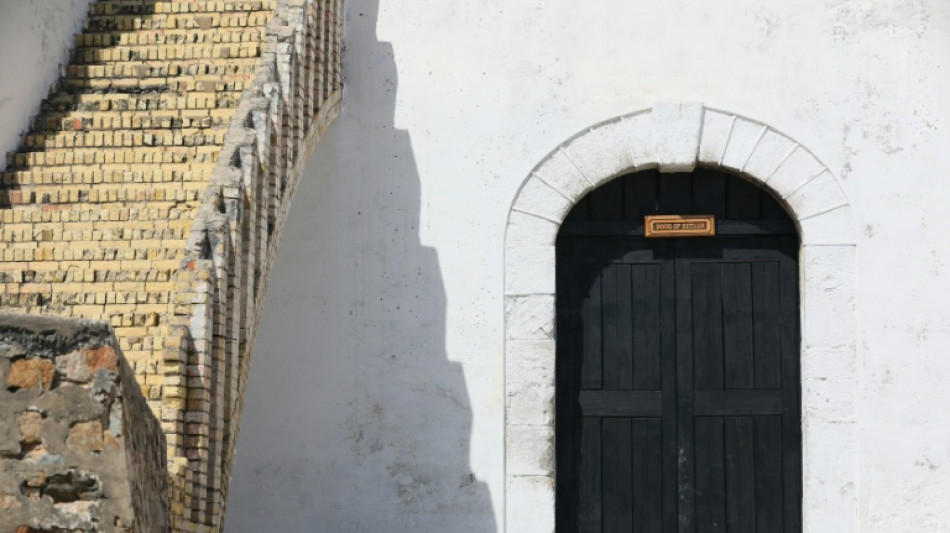
Joy, scepticism across west Africa after UN vote on slave trade / Photo: Nipah Dennis - AFP/File

 Europe’s electric car boom exposes a widening market divide

 US Senate confirms Trump's ex lawyer as attorney general
 Tibet conference in Nepal pushed online
 Nocturnal 'coffee frog' discovered in Costa Rica

 India's 'cockroach' protest movement keeps heat on Modi
 Russia's only anti-war party eyes support boost at elections
 Canada tries to adapt to a future of wildfires

 Death of NBA forward Clarke ruled accident due to heroin, cocaine

 Abelardo de la Espriella, Colombian president and flamboyant millionaire

 Maradona's 'Hand of God' ball heads to US auction
 Rybakina advances while Andreeva exits at Toronto

 Shelton storms to Montreal win as title defence solidifies

 All Blacks need to improve says coach after opening win against Stormers

 Spain imposes border checks on Italy as migrant showdown grows
 Bezzecchi smashes Silverstone track record in MotoGP qualifying
 Rashid Khan takes six wickets as Afghanistan thrash Ireland
 Flintoff quits England Lions role after Sydney Thunder appointment

 Movement, El Vecino and RISE Partner to Launch First Digital Dollar Wallet for Mexican Remittances
 FIFA chief Infantino travels to Colombia for presidential inauguration

 Niewiadoma seizes Tour de France Femmes lead on Mont Ventoux
 Trump's ex-lawyer all set for confirmation as US attorney general

 WHO urges Ervebo vaccine trial in DR Congo Ebola outbreak

 Hardline Trump ally De la Espriella to take office in Colombia

 Cambridge to review hiring process amid plagiarism row
 STARTRADER in Discussions with Trustpilot to Consolidate Review Profiles
Ghanaians in the streets of the capital Accra were full of pride -- and already looking toward future "justice" -- Thursday after the United Nations recognised the transatlantic slave trade as "the gravest crime against humanity."
The day prior, the resolution -- pushed for by Ghanaian President John Mahama, who travelled to New York for the vote -- was adopted to applause by a 123 in favor.
"It's not just a historic moment for us as a country, but it also validates the suffering of our ancestors and opens the door for justice," said Abigail Selikem Teye, a casually dressed student with a handbag slung over her shoulder.
The excitement was also evident in nearby Benin, which, like Ghana, has leaned into its painful past to encourage tourism and offer citizenship for descendants of slavery.
West and central Africa were devastated by the transatlantic slave trade, which from the 16th to 19th century saw millions of men, women and children shipped to the Americas to work in brutal -- and often deadly -- conditions.
In many of those same countries, black people continue to face discrimination and poverty today.
"This vote allows us to name things without fear of reprisals. The next step will, I hope, be an uninhibited call for reparations," said Ousmane Aledji, a Beninese writer in Cotonou, who told AFP he followed the vote "with much interest."
Others in the country's economic capital, like art historian Lylly Houngnihin, were "disturbed by the abstention of certain countries -- those which were the most enriched by the crime".
- 'Africa has suffered' -
Despite being non-binding the vote at the General Assembly headquarters in New York was contentious.
The United States, Israel and Argentina opposed the measure, while 52 member states abstained.
Critics including France said the resolution's designation of the transatlantic slave trade as "the gravest" crime "risks pitting historical tragedies against each other".
It also comes, however, as countries like the United States have been criticised for restricting education on slavery and black history.
The resolution did not mention other slave routes in Africa, including across the Sahara Desert or Indian Ocean.
But it singled out the transatlantic trade's duration, brutality of the "racialised chattel enslavement of Africans" -- as well as present-day consequences including "the persistence of racial discrimination and neo-colonialism".
It did not explicitly demand reparations, though it "encourages member states to support initiatives aimed at reparatory justice".
Many argue Africa is still living with the slave trade's dire consequences.
"Who will pay for all the problems this caused? Africa has unfortunately suffered the two greatest scourges in history: slavery and colonization," said Franck Ogou, director of a pan-African heritage preservation programme in Porto Novo.
Larissa Adjivon, a 42-year-old Beninese entrepreneur, told AFP: "Recognition is good, but concrete actions should follow."
"We talk about reparations or restitution, but for me, the question is, what does this change for Africa today?"
- 'Return' to Ghana, Benin -
For Obadele Bakari Kambon, if "enslavement in totality is the wound," then the "healing part of it comes through repatriation."
The African American professor became a Ghanaian citizen in 2016, part of a wave of black people from the United States and elsewhere that Ghana has pushed to "return" to the country.
In recent years, more than 1,000 people have reclaimed citizenship as the country has also encouraged tourism as a way for people to learn about slavery -- and for some, their direct family heritage.
At the end of last year, Benin also launched a citizenship programme for members of the African diaspora.
burs-fvl/nro/giv
L.Henrique--PC