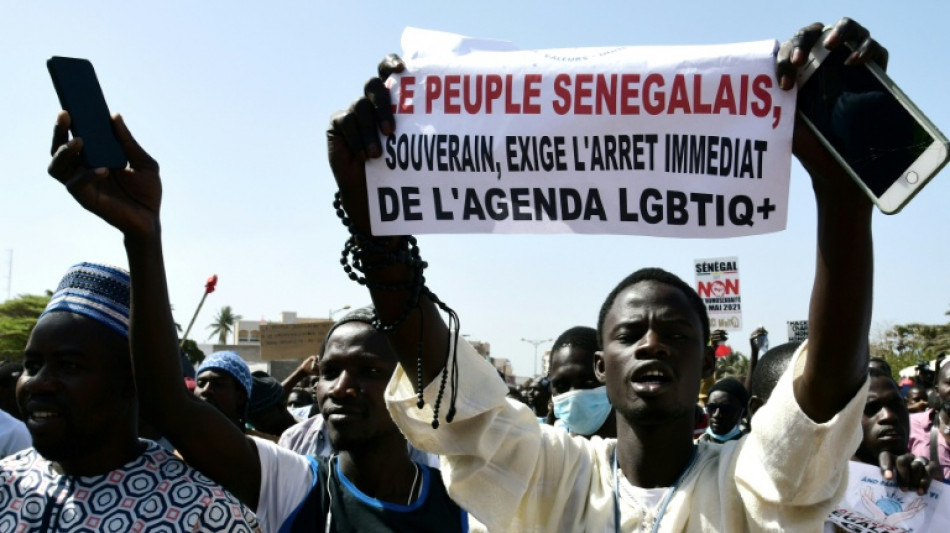
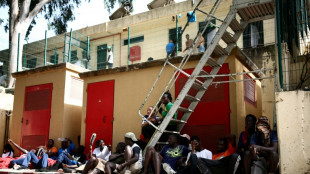
'Muted' international response as Senegal enacts same-sex relations law / Photo: Seyllou, SEYLLOU - AFP/File

 Ukraine's Zelensky visits Russian ally Serbia for talks

 Defending champion Shelton storms to Montreal win
 Exodus: West Bank hardships drive out Palestinian Christians

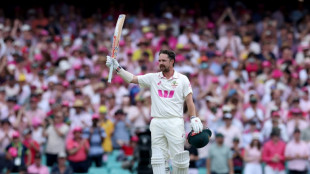 Travis Head wins Australian cricketer of the year gong
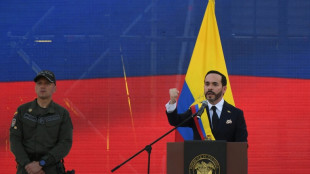 Colombia's new president vows to 'defeat narco-terrorists'
 Call for Infantino to resign comes amid wave of support
 Trump ally Abelardo de la Espriella sworn in as Colombia president

 FIFA chief Infantino gets backing of South American football

 Amazon behind massive private gas plant for new data centers

 Apple and OpenAI escalate legal battle over devices

 All Blacks strike late to secure opening win against Stormers
 Saudi Arabia, Turkey, Pakistan sign defence pact amid regional war

 Trump renews effort to remove US Fed Governor Lisa Cook

 Abelardo de la Espriella, the flamboyant millionaire taking power in Colombia
 Germany holds security meeting over explosive drone amid Russia protest

 Austrian writer Stefan Zweig, who fled Nazis, honoured in London
 Mexico and Peru reestablish ties after asylum spat

 Dollar drops, stocks climb as weak US jobs data eases rate fears
 Japan defender Tomiyasu joins Crystal Palace
 Celtic boss O'Neill out of hospital after 'small procedure'
 Man City reject Barcelona bid for Rodri - reports
 US unexpectedly loses jobs in blow to Trump ahead of midterms

 Dollar drops, stocks climb after surprise US jobs miss

 Thai students in disbelief after deadly school shooting

 McLaren boss glad of 'harmony' between F1 teammates Norris and Piastri
While recent restrictions by a number of African nations on LGBTQ rights have elicited fierce criticism, international reaction has been more tepid as Senegal doubled its penalty for same-sex relations this week.
Senegal's president signed the law, which appeared in the country's official gazette out Tuesday, amid a crackdown on the gay community that has seen dozens of arrests and an increase in heated anti-LGBTQ rhetoric.
After the bill passed parliament in mid-March, a regional Belgian minister made headlines by questioning the French-speaking Wallonia region's funding for climate cooperation in the west African nation, infuriating Senegal's leadership.
But further calls to action by international actors have been few and far between.
While the UN human rights chief and UNAIDS urged the president not to sign the bill, "government-level reaction has been notably muted", Arlana Shikongo, communications officer with Pan Africa ILGA, the regional chapter of the International Lesbian, Gay, Bisexual, Trans and Intersex Association, told AFP.
Experts consulted by AFP said that a variety of factors could be at play, from the US exit as a major humanitarian actor to reluctance from the West, including former colonial power France, to lecture what is seen as a relatively stable democracy and critical partner.
- 'Vacuum' -
Senegal's law was signed by President Bassirou Diomaye Faye after passing by an overwhelming majority in the National Assembly on March 11, where debate centred on whether the bill went far enough.
The new law punishes "acts against nature", a term used to signify same-sex relations, by five to 10 years' imprisonment, compared with one to five years previously.
It also provides for three to seven years in prison for those found guilty of promoting or financing same-sex relationships.
Same-sex relations are seen as deviant by many in Senegal, a Muslim-majority country where defence of LGBTQ rights is viewed as a Western import, incompatible with local values.
Videos of deputies ricocheted across the internet following the parliamentary debate, with lawmakers such as Diaraye Ba declaring that "homosexuals will no longer breathe in this country".
Ari Shaw, senior fellow at US-based LGBTQ research centre the Williams Institute, said that "anytime there are laws or policies passed that undermine the rights of LGBTQ people, that's something that demands global attention."
"The United States has historically been a primary driver of diplomatic pressure on LGBTQ rights globally," he told AFP.
But now under the administration of President Donald Trump "what we're seeing is a real vacuum in terms of global leadership on these issues."
Asked about the law, a US State Department spokesperson referred AFP "to the government of Senegal regarding legislation in its country".
- 'Important partner' -
That said, "Senegal is a really important partner in the Western context", Paul Melly, a consulting fellow with Chatham House, told AFP.
This holds true particularly for "France and Spain, for whom relations with Senegal are a higher priority", he said.
President Faye was in Spain last week for an official visit, his first to the country as head of state.
"There are some sensitivities around, particularly for the French as the one-time colonial power, on commenting" on internal affairs in Senegal, he added.
Cecile Neven, the Walloon minister, prompted an angry rebuke from Senegalese Prime Minister Ousmane Sonko, who campaigned on the issue and presented the legislation to parliament.
"We do not need their funding. They can go back to their own country and let us get on with our work," Sonko responded according to local media, adding that "sovereignty comes at a price".
- 'Increasing homophobia' -
The tepid response to Senegal's law could additionally be because it simply doubles "the theoretical prison term for something that was already punishable", Melly said.
When Uganda's Anti-Homosexuality Act became law in May 2023, it was seen as one of the harshest in the world, with penalties of up to life imprisonment for consensual same-sex relations, while "aggravated homosexuality" is punishable by death.
The World Bank subsequently suspended funding to the country, though it resumed in mid-2025.
Although rights group Amnesty International has been vocal on anti-LGBTQ legislation across Africa, it declined to comment when asked by AFP about Senegal's new law.
At least 32 out of Africa's 54 countries have laws prohibiting and punishing same-sex relations.
Passage of Senegal's law comes in an environment of "increasing homophobia and attacks on the continent and around the world", Shikongo of Pan Africa ILGA said.
Approximately 10 countries or territories in Africa impose sentences ranging from 10 years to life in prison, including Sudan, Kenya, Tanzania and Sierra Leone.
The death penalty is imposed in Uganda, Mauritania and Somalia.
C.Amaral--PC