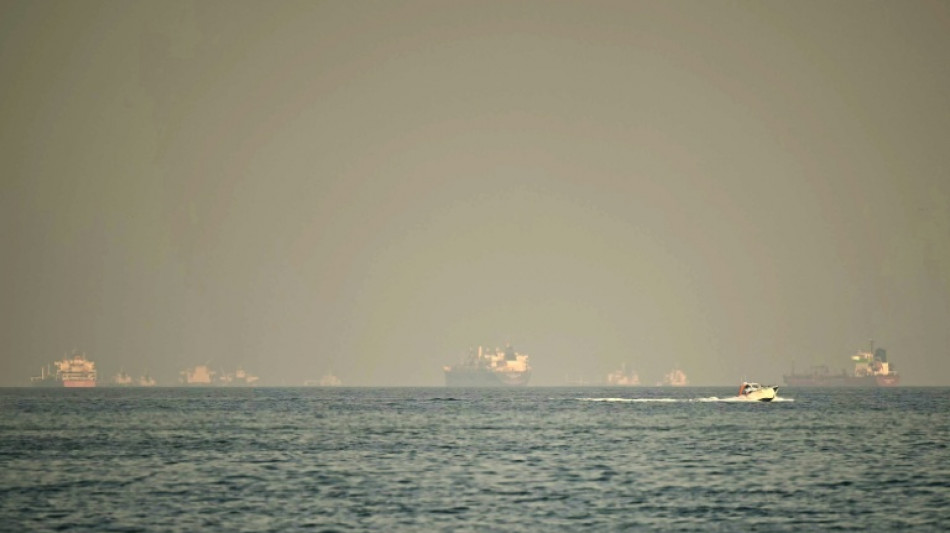
Shipping toll for Hormuz passage sharply divides nations / Photo: Giuseppe CACACE - AFP

 Nocturnal 'coffee frog' discovered in Costa Rica

 India's 'cockroach' protest movement keeps heat on Modi

 Russia's only anti-war party eyes support boost at elections
 Canada tries to adapt to a future of wildfires
 Death of NBA forward Clarke ruled accident due to heroin, cocaine
 Abelardo de la Espriella, Colombian president and flamboyant millionaire
 Maradona's 'Hand of God' ball heads to US auction
 Rybakina advances while Andreeva exits at Toronto

 Shelton storms to Montreal win as title defence solidifies

 All Blacks need to improve says coach after opening win against Stormers

 Spain imposes border checks on Italy as migrant showdown grows
 Bezzecchi smashes Silverstone track record in MotoGP qualifying
 Rashid Khan takes six wickets as Afghanistan thrash Ireland

 Flintoff quits England Lions role after Sydney Thunder appointment
 Movement, El Vecino and RISE Partner to Launch First Digital Dollar Wallet for Mexican Remittances
 FIFA chief Infantino travels to Colombia for presidential inauguration

 Niewiadoma seizes Tour de France Femmes lead on Mont Ventoux

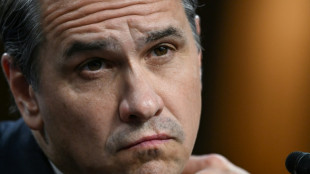 Trump's ex-lawyer all set for confirmation as US attorney general

 WHO urges Ervebo vaccine trial in DR Congo Ebola outbreak

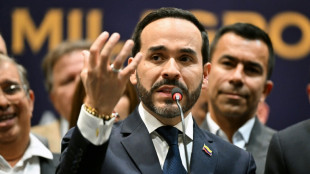 Hardline Trump ally De la Espriella to take office in Colombia

 Cambridge to review hiring process amid plagiarism row

 STARTRADER in Discussions with Trustpilot to Consolidate Review Profiles

 US unexpectedly loses jobs in blow to Trump's economy claims

 Call for Infantino to resign comes in wake of wave of support

 Gaza beekeeper starts again on rooftop amid ruins of war
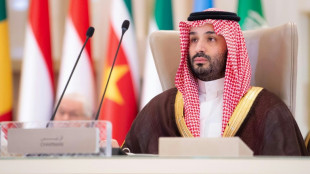
Iran's imposition of a toll for ships to pass through the Strait of Hormuz looks set to be a key point of contention at talks opening in Pakistan Friday.
When the United States and Israel launched their attack on Iran on February 28, Iran responded by blocking passage through the key Strait to all but a handful of vessels.
While Iran agreed to reopen the thoroughfare during the two-week truce with the United States, it has also spoken of a toll system to fund reconstruction following punishing US-Israeli attacks.
The European Union was quick to denounce the idea Thursday. US President Donald Trump's position however appears more ambivalent.
The stakes are high, given that a fifth of the world's oil as well as vast quantities of natural gas and fertiliser pass in peacetime.
Bloomberg News has reported that shipping companies would be expected to pay up to $2 million per vessel.
The Financial Times said the price to pay would be a dollar a barrel of oil, paid in crypto-currency or yuan, China's currency.
- Iran maintains control -
The temporary reopening of the Strait was announced Tuesday as part of the US-Iran ceasefire deal. Nevertheless, insurance specialists Lloyd's List noted: "Iran's approval regime for Hormuz transits remains intact."
At least some vessels, they added, faced "a slow, opaque verification process and, in many cases, multimillion dollar toll demands".
One of the points on the 10-point plan for ending the war that Iran sent to Washington was that Tehran would maintain control of the Strait of Hormuz.
An Iranian diplomatic source told journalists "There is a new mechanism according to which there has been and there will be a right of passage" organised with Oman, which also borders the Strait.
Freedom of circulation is a cardinal principle of maritime law. The only points of passage that have tollbooths are the Suez and Panama canals, both of which are artificial constructions that require maintenance.
"Paying a toll legitimises Iran's coercion and sets a precedent under international law that other regimes may want to pursue," wrote Guntram Wolff, senior researcher at the Brussels-based Bruegel think tank.
US President Donald Trump has suggested that the United States and Iran could run the system in a "joint venture".
White House spokeswoman Karoline Leavitt nevertheless cautioned that Washington had not yet taken a definitive position on the matter.
But Trump, she added "wants to see the Strait reopened immediately without limitation, and that's something we're going to hold them to".
- 'A legitimised tollbooth' -
For several analysts, the most credible scenario is some kind of partnership between Oman and Iran, the two countries bordering the vital maritime passage.
"If Iran and Oman can come to a solution and create some sort of legitimised toll booth, a structure where ships can come through the Strait, it would give Iran money for reparation," said Michelle Brouhard, an analyst with global markets specialists Kpler.
JP Morgan bank, working off estimates made by Bloomberg, said the receipts from such a system could bring Iran $70 billion to $90 billion a year.
The Strait of Hormuz has become "more important for Iran than enriched uranium", Amir Handjari, an analyst with the US Quincy Institute for Responsible Statecraft, told AFP.
"That's the real security guarantee to prevent Israeli and US attacks in the future," he argued.
"Oman gets more strategic relevance and a revenue stream they really need," he added. In a video posted Wednesday, Transport Minister Said bin Hamood bin Said Al Maawali said that international conventions signed by Oman forbade taking tolls for passage, but that talks were ongoing with the foreign ministry.
The video was subsequently deleted.
Oman's policies towards Iran are not "in sync" with those of the Gulf Cooperation Council (GCC), said the analyst, Handjari. The GCC comprises the United Arab Emirates, Saudi Arabia, Qatar, Kuwait, Bahrain and Oman.
As for the United States, he said, they might agree to tolls provided the payments were made in dollars and not yuan.
- Gulfs states divided -
The other gulf monarchies would take the imposition of a toll badly, said Amena Bakr, another analyst with Kpler.
"When it comes to Hormuz, the position is very clear from the GCC side... They will not accept Iran controlling the flow," she said.
Nor was it clear how such a toll would be determined, she added.
Sultan Ahmed Al Jaber, head of the United Arab Emirates's state energy company ADNOC and the UAE Industry Minister, denounced any question of a toll.
"The weaponisation of this vital waterway, in any form, cannot stand," he insisted Thursday. "The Strait must be open -- fully, unconditionally and without restriction."
The EU took a similar line on Thursday. Freedom of navigation, Commission spokesman Anouar El Anouni told journalists, means "basically no payment or toll whatsoever".
But for Handjari, at the Quincy Institute: "It really comes down to three parties.
"The United States, Oman and Iran will determine the fate of the Straits of Hormuz. And the US has the weakest hand there."
V.Dantas--PC