
'Natural' birth control risks unwanted pregnancy, experts warn / Photo: LOIC VENANCE - AFP/File

 Rybakina advances while Andreeva exits at Toronto

 Shelton storms to Montreal win as title defence solidifies

 All Blacks need to improve says coach after opening win against Stormers

 Spain imposes border checks on Italy as migrant showdown grows

 Bezzecchi smashes Silverstone track record in MotoGP qualifying
 Rashid Khan takes six wickets as Afghanistan thrash Ireland

 Flintoff quits England Lions role after Sydney Thunder appointment

 Movement, El Vecino and RISE Partner to Launch First Digital Dollar Wallet for Mexican Remittances

 FIFA chief Infantino travels to Colombia for presidential inauguration

 Niewiadoma seizes Tour de France Femmes lead on Mont Ventoux

 Trump's ex-lawyer all set for confirmation as US attorney general

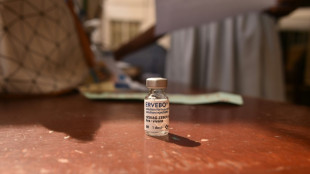 WHO urges Ervebo vaccine trial in DR Congo Ebola outbreak

 Hardline Trump ally De la Espriella to take office in Colombia

 Cambridge to review hiring process amid plagiarism row

 STARTRADER in Discussions with Trustpilot to Consolidate Review Profiles

 US unexpectedly loses jobs in blow to Trump's economy claims

 Call for Infantino to resign comes in wake of wave of support

 Gaza beekeeper starts again on rooftop amid ruins of war

 MEXC Lists New Ondo Tokenized Stock Pairs Spanning AI Infrastructure, Semiconductor and Rare Earth Sectors

 Fleming 'like me, but better': McCullum on new England Test coach

 European stocks rise before US jobs report

 Meta ordered to pay $567 mn in US over 'public nuisance' child harm

 Saudi Arabia, Turkey and Pakistan to sign defence pact amid regional violence

 PU Prime Expands Gold Trading with the Launch of XAUUSD247

 Oil extends gains and stocks mostly down on fresh Hormuz worries

After taking the pill for a decade, Elodie Monnier Legrand decided to try "natural" birth control, an increasingly popular trend that requires tracking fertility to avoid becoming pregnant.
"I wanted my body to return to its natural state," the French 30-year-old business owner told AFP.
However after getting two abortions within six months, she discovered the app she was using had slightly miscalculated her fertility cycle.
"It's not an exact science," Legrand said.
She is one of a rising number of women who are abandoning hormonal contraception such as the pill.
In France, 7.5 percent of women used natural contraceptive methods in 2023, rising from 4.6 percent in 2016, according to the INSERM institute.
Helping drive this trend are influencers on social media, who often promote natural birth control as a way for women to "liberate" themselves from the hormonal effects of the pill.
However experts warn that some common claims about the pill's side effects represent misinformation -- and that methods based on tracking fertility require strict adherence to be effective.
Geoffroy Robin, a gynaecologist at the University Hospital of Lille in France, told AFP that the interest in natural methods was fuelled by "a climate of hormone-phobia".
He also pointed out that the pill had long been seen as a "tool of women's emancipation".
- Different methods -
Louise, a 26-year-old in France who did not want to give her surname, told AFP that "hormonal contraception was a complete disaster" for her.
When she was 18, her body rejected a hormonal IUD. After getting an implant, she said she suffered from side effects including weight gain, mood swings and depression.
For the last six years, she has been using the calendar method of natural birth control.
This requires calculating the window when women are fertile -- which is around 10 days a month -- and abstaining from sex during this period.
The temperature method involves daily checks to detect if women's bodies have gotten a little warmer, which happens during ovulation.
For the "Billings" method, women must inspect their vagina daily to see if there is a build-up of cervical mucus. The "sympto-thermal" method combines the latter two techniques.
The embrace of natural contraception -- also called fertility awareness -- comes as the use of the pill has declined in many countries.
A study published last year in BMJ Sexual & Reproductive Health estimated that hormonal contraception in England and Wales fell from 19 percent in 2018 to 11 percent in 2023.
The research also suggested there was a link between the increasing use of natural birth control and a rising number of abortions.
According to the experts AFP spoke to, natural techniques are significantly less effective than traditional methods.
INSERM said they should only be considered by women "who accept a risk of pregnancy".
A review conducted by INSERM in 2022 found that less than 20 percent of around 100 fertility apps it analysed made correct predictions about fertility cycles. Most apps also shared users' data with third parties, often without their knowledge, the review found.
- 'Just another business?' -
Robin warned that "natural methods are absolutely ineffective" for those with irregular cycles -- roughly one out of every five women.
And there are several factors that can skew measurements.
For example, yeast infection or medication such as antihistamines can disrupt the secretion of vaginal mucus. Paracetamol, antibiotics or even a change in work schedule can alter a woman's temperature.
This means that natural methods are not suitable for everyone, the experts stressed, recommending that women considering a change consult their gynaecologist.
French sociologist Cecile Thome said the rise of natural contraceptive methods, driven by promises of "taking control of one's body," is part of the booming wellness industry.
These arguments were compelling for Legrand, who paid seven euros a month for a fertility app and bought a "smart ring" for over 200 euros to monitor her temperature.
After getting two abortions, she contacted the app's customer service.
"Their responses were very cold, it wasn't very humane," she said.
The abortions were "hard on her body, hard psychologically," she emphasised.
While Legrand still finds the subject "super interesting," she wondered if "ultimately, it is just another business."
A.Seabra--PC