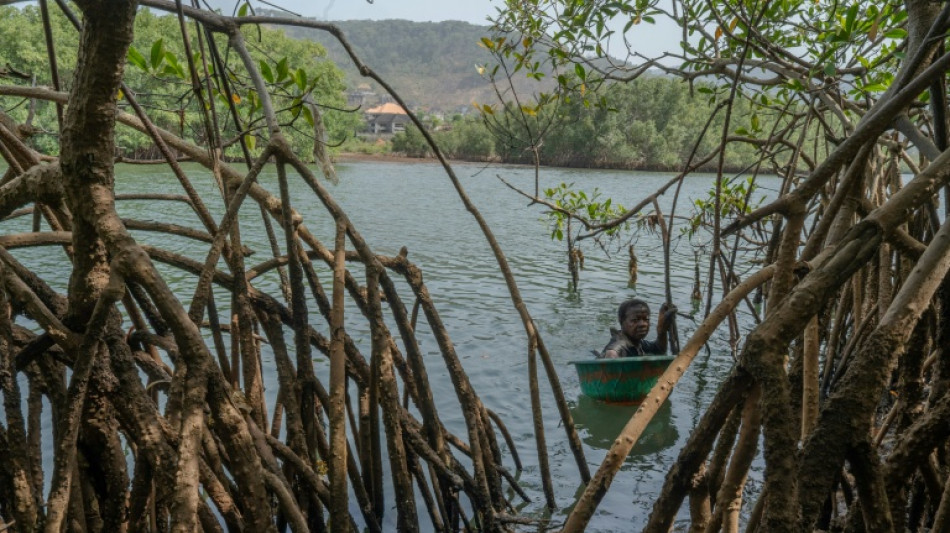
Mangrove loss threatens Sierra Leone's oyster harvesters / Photo: Gemma Bonfiglioli - AFP

 Stocks diverge with earnings, tech in focus

 England recall batsman Lawrence for Pakistan series
 Siemens shares plunge on disappointing guidance raise

 New Australia coach Kiss gives Japan starts to Ross, Amatosero

 'Stretch our money': Romanians face highest EU inflation

 Iran says close to Hormuz plan with Oman, but reopening depends on US

 Messi scores twice to set Leagues Cup record in Miami victory

 Asian stocks mostly down with tech firms back under pressure
 Back to the future as world champion Springboks host All Blacks

 India youth protests highlight mistrust in 'lapdog' media
 Pacific islands alarmed by Trump-backed push for deep-sea mining
 Erratic rains dictate menu at three-star Michelin restaurant in Brazil

 Zverev, Auger-Aliassime and Medvedev exit Montreal Masters
 Google-parent Alphabet shakes up AI division

 FIFA back Infantino, apologise for World Cup privatisation plan

 Auger-Aliassime out of Montreal ATP event with injury

 Colombian baby hippo of Escobar stock dies after rescue

 Preakness shifts 2027 dates to entice more Derby horses

 Guatemalan volcano eruption ends, locals return home

 WHO chief urges stronger Ebola response in DR Congo visit

 Newcastle appoint Jaissle as new head coach after Howe exit
 Swiss ski star Lara Gut-Behrami calls time on 18-year career

 US indicts leaders of Mexico's CJNG cartel, ups reward money

 Noosha Aubel: Klarar hon av Potsdams problem?

 Noosha Aubel: Zvládne problémy Postupimi?

For 20 years, Millicent Turay has supported her family by collecting mangrove oysters near Sierra Leone's capital, Freetown, a common livelihood along the west African coast.
But the activity, deeply rooted in local culture and which has enabled generations of women to make a living, is now under threat as mangrove forests deteriorate under pressure from human expansion.
"We learnt how to do it for ourselves... to survive," said the 50-year-old, speaking to AFP in the mangroves, machete and gloves in hand as she pried oysters from the tangled aerial roots.
"This job is physically demanding" and can be dangerous, she said.
The laborious work, carried out mainly by women, involves wading at low tide, barefoot and often chest-deep in muddy water and stifling heat, to reach rocks and mangroves where wild oysters cling.
"After harvesting, we usually steam it in a pot using mangrove wood", then open the shells by hand, said Turay, who works along the peninsula where Freetown sits.
- Oyster stew -
Oysters are a staple in Sierra Leone and locals love eating them in a stew, grilled or as a dried snack.
Eating them fresh is more of a habit among expats or tourists.
Turay said in a good harvest she could earn around $7 a day, enough to feed her family and pay her children's school fees.
It was during her teenage years that the women of her community taught her the harvesting technique, which is practised in the mangroves of several west African countries.
The men, for their part, collect mangrove wood to use as firewood or for construction.
But Sierra Leone's spectacular wildlife is under severe threat from deforestation, unchecked urban growth and other human activity -- challenges authorities have struggled to contain.
Turay told AFP that harvests were already declining.
"Now, people cut (the mangroves) down," she said sadly.
"We don't know why they do this... because that's how we find our living. They say they're doing it to get the land."
Mangroves around Freetown -- a rich wetland ecosystem -- are being damaged or destroyed by urban sprawl, firewood collection and illegal construction.
More than 25 percent of mangrove cover has vanished since 1990 as a result, according to official estimates.
- Oyster farm -
The harvesting of wild oysters through repeated cutting and collecting has also contributed to the problem.
Satellite images show that mangrove cover in the Aberdeen coastal area on Freetown's outskirts shrank from 537 hectares (1,326 acres) in 2017 to 458 hectares in February 2025, according to the Environmental Justice Foundation NGO.
Aberdeen Creek is a wetland of international importance for waterbirds.
Standing in the marsh, with buildings encroaching in the distance, Aminata Koroma, 32, pointed to the loss around her in Cockle Bay near Aberdeen Creek.
"This place you are seeing empty, it used to have so many mangroves, with fish and eel," she said.
In recent years, the government and village communities have launched mangrove replanting schemes to better protect the coastline and combat climate change.
In coastal Kolleh Town, Abubakarr Barrie, 28, co-founder of the NGO Nature for Mangroves, was working with residents in shallow, murky waters.
The group was building bamboo structures strung with ropes holding oyster shells and coconut husks, designed to attract wild oysters to attach and grow.
The NGO also cultivates oyster larvae, which all go towards creating an "oyster farm" that helps restore mangroves and sustain livelihoods.
Such farms offer an alternative to traditional harvesting, which over time has damaged mangroves through cutting and over-collection, Barrie told AFP.
"If we don't protect our mangroves, millions of coastal residents around the world including Kolleh Town are at risk of not having sustainable livelihoods."
E.Raimundo--PC