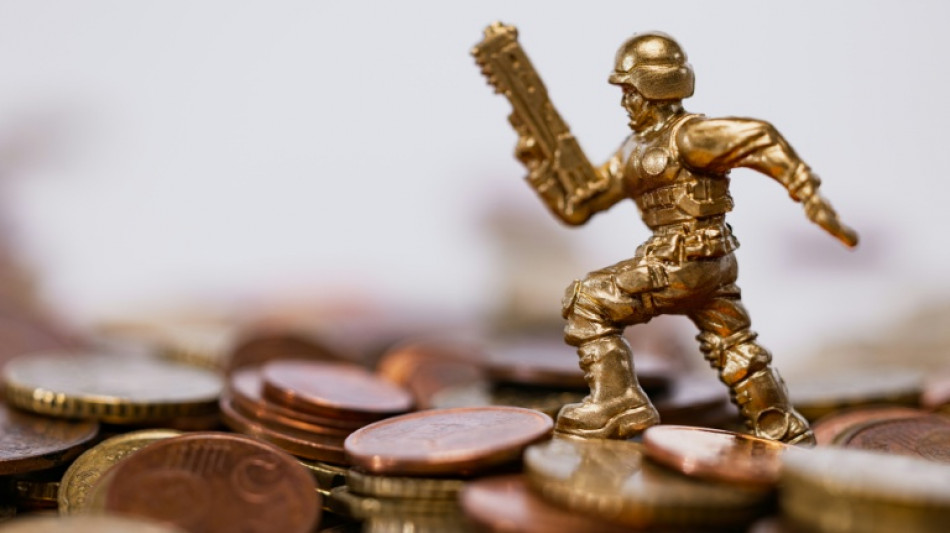
As crises balloon, so do EU nations' deficits / Photo: JOEL SAGET - AFP/File

 Stocks mixed with tech firms back under pressure

 How Blundell's old school tactic ended England's 'Bazball' era

 Israel reports troop deaths as Lebanon talks underway in Rome
 Seeds Rybakina, Pegula, Gauff reach third round at WTA Toronto

 Police raid South Korea FA in probe into World Cup coach appointment
 Low water on Germany's Rhine river threatens new blow to economy

 Ex-Wallabies Foley, Phipps rejoin Waratahs ahead of home World Cup

 Rising Kenyan lakes push crocodiles closer to homes

 Istanbul cymbals: From Ottoman war tool to pulse of global music

 Myanmar ex-junta chief on first Thailand trip as civilian leader

 Environmental disaster looms as tanker leaks off Oman

 Embattled Infantino sees minnows Malawi reach WAFCON quarter-finals
 Seeds Rybakina, Pegula and Gauff advance at WTA Toronto event

 Zverev, Auger-Aliassime exit star-short Montreal Masters
 Embattled FIFA chief Infantino in emergency talks in Morocco
 Castaway SpaceX rocket stage crashed into Moon, scientists say

 Dow edges to record as markets parse prospects for Hormuz deal

 Salah arrives in Turkey to complete Trabzonspor move

 AFP journalist to be honored at International Press Freedom Awards

 Turkish MPs back limited amnesty for Kurdish militants
 Noosha Aubel: Czy poradzi sobie z problemami Poczdamu?
 Noosha Aubel: Klarar hon av Potsdams problem?

 Noosha Aubel: Zvládne problémy Postupimi?

 Brazil hits new diplomatic lows with US and Argentina

 NZ boxer Parker promises ring return after doping ban 'lifted'

More and more EU countries are being thrown in the public spending sin bin over their mushrooming deficits, with Bulgaria expected to be added Wednesday.
The European Union's second- and third-biggest economies, France and Italy, have already been handed formal reprimands alongside eight other member states.
The EU executive will publish its views Wednesday on each country's public spending and issue warnings where necessary.
Under EU rules, the public deficit -- when government revenue is not enough to cover spending -- must not be above three percent of gross domestic product.
The rules were suspended during the coronavirus pandemic, and then again during the energy crisis that followed Russia's 2022 invasion of Ukraine -- both of which piled massive pressure on European nations' finances.
A reformed set of spending rules kicked into force in 2024, and in theory member states risk fines for violations, though the EU has never gone so far.
With energy prices soaring again because of the Middle East war, Italy now wants the EU to grant new fiscal leeway to help member states manage.
- Bulgaria: New kid on the block -
Just months after joining the eurozone single currency area, the European Commission is set to rebuke Bulgaria for violating the EU's spending rules.
It will not come as a surprise to Sofia.
Its new prime minister, Rumen Radev, has warned about the deterioration of public finances, with a budget deficit that is expected to substantially exceed three percent of GDP.
According to the latest EU economic forecast published last month, Bulgaria's deficit is expected to reach 4.1 percent this year after 3.5 percent in 2025.
- Germany: Defended by defence -
Germany, Europe's largest economy, has long championed maintaining fiscal discipline but is predicted to breach the EU's three-percent deficit ceiling this year, hitting 3.7 percent of GDP and rising to 4.1 percent next year
Luckily for Germany, it will escape public rebuke because of a clause allowing for exemptions related to defence spending, which the country has ramped up in the wake of Russia's Ukraine invasion.
- France: Bottom of the pack? -
France's budget woes do not seem to end.
Paris hopes to keep its deficit at five percent of GDP this year, despite new spending measures to mitigate the impact of oil prices on certain sectors.
But the commission warned last week that France would have the bloc's biggest budget deficit -- a whopping 5.7 percent -- in 2027, a crucial presidential election year, if policies remain unchanged.
That means austerity measures are likely. Prime Minister Sebastien Lecornu, currently working on the draft budget for 2027, has vowed to bring the deficit down to below three percent of GDP by 2029.
- Italy: Near the exit? -
The picture looks better for Italy than for other major EU economies, with a deficit expected to fall to 2.9 percent in 2026 and 2027.
The expectation was that Rome would see its deficit below three percent in 2025, but an economic slowdown late last year dashed such hopes.
Now Prime Minister Giorgia Meloni is demanding that as with defence spending, governments should be allowed to exempt spending on measures that limit the impact of higher energy prices.
But the EU executive has argued that it has made hundreds of billions of euros available for energy investments.
fpo-raz/ec/js
M.A.Vaz--PC